
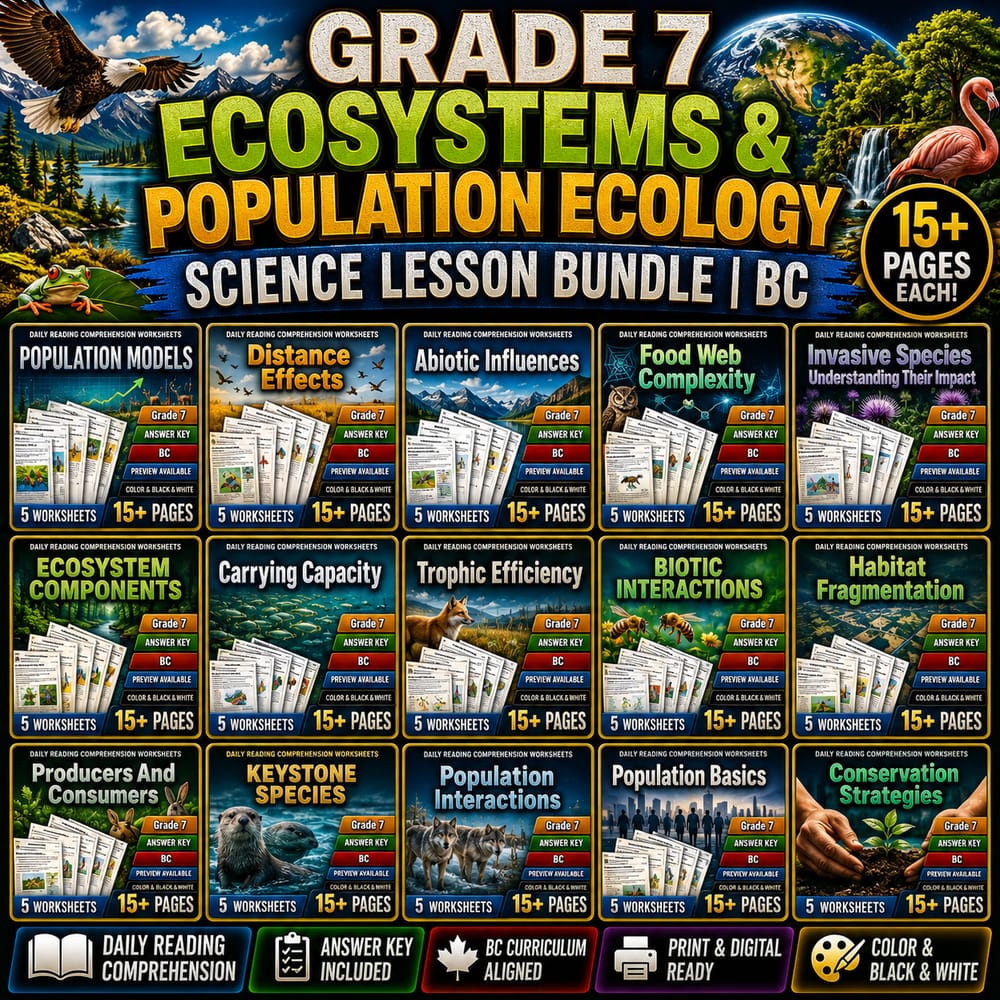


Grade 7 Ecosystems & Population Ecology Science Lesson Bundle | BC
$48.00$60.00Save $12.00
Bright Mind Resources
New·1 followers·12 sales
SubjectScienceGradeGrade 7
What’s included
15 worksheets · Save $12.00 (20%) · prices shown inside the bundle
 Grade 7 Science – Population Models & Growth | Daily Reading Worksheet
- Understand the concepts of exponential and logistic growth in populations.
- Identify factors affecting population dynamics, including density-dependent and independent factors.
- Interpret how different models predict population changes over time.
$3.20$4.00 Grade 7 Science – Forest Fires & Ecosystem Changes | Daily Reading Worksheet
- Understand key concepts related to Science
- Apply knowledge through practice questions
- Demonstrate comprehension of the material
$3.20$4.00 Grade 7 Science – Abiotic Influences on Ecosystems Daily Reading Worksheet
- Identify how temperature impacts species distributions and survival
- Analyze the effects of temperature fluctuations on ecosystems
- Evaluate the role of abiotic factors in shaping biological processes
$3.20$4.00 Grade 7 Science – Food Web & Ecosystem Relationships | Daily Reading Worksheet
- Define a food web and distinguish it from a simple food chain.
- Identify various relationships among producers, consumers, and decomposers.
- Understand how energy flows through an ecosystem via food webs.
$3.20$4.00 Grade 7 Science – Invasive Species & Ecosystem Impact | Daily Reading Worksheet
- Define invasive species and describe their characteristics.
- Explain how invasive species affect native ecosystems.
- Identify ecological consequences caused by invasive species.
$3.20$4.00 Grade 7 Science – Ecosystem Components & Interactions | Daily Reading Worksheet
- Identify biotic and abiotic components in an ecosystem
- Understand the interaction between living organisms and their environment
- Explain how energy flows through an ecosystem
$3.20$4.00 Grade 7 Science – Carrying Capacity & Ecosystem Factors | Reading Worksheet
- Define carrying capacity and explain its significance in ecology.
- Identify limiting factors that influence population sizes.
- Analyze how resource availability affects populations over time.
$3.20$4.00 Grade 7 Science – Trophic Efficiency & Food Chains | Daily Reading Worksheet
- Define trophic levels and understand their roles in ecosystems
- Explain the concept of energy transfer between trophic levels
- Describe why energy diminishes at higher trophic levels
$3.20$4.00 Grade 7 Science – Biotic Interactions & Ecosystems | Daily Reading Worksheet
- Understand predator and prey relationships
- Identify examples of predator-prey interactions in ecosystems
- Explain the importance of predator-prey dynamics in maintaining ecological balance
$3.20$4.00 Grade 7 Science – Habitat Fragmentation & Effects Daily Reading Worksheet
- Understand what habitat fragmentation is.
- Identify the effects of habitat fragmentation on ecosystems.
- Recognize ways to connect fragmented habitats.
$3.20$4.00
Reviews & Feedback
Loading reviews...
Questions & Answers
Loading questions…
About this bundle
Related categories
Frequently asked questions
Who is Grade 7 Ecosystems & Population Ecology Science Lesson Bundle | BC designed for?
Grade 7 Ecosystems & Population Ecology Science Lesson Bundle | BC is designed for Grade 7 students and Science learners and can be used in classrooms, homeschool, or independent practice.
How do I download Grade 7 Ecosystems & Population Ecology Science Lesson Bundle | BC?
Add it to your cart and complete checkout. After payment, you can download immediately from your account, and you'll also receive a download link by email.
Similar Products

Grade 9 Science Lesson Bundle: Ecosystems and Ecology Worksheets
$24.00$30.00

Grade 7 Science Lesson Bundle: Ecosystems and Population Dynamics Worksheets
$36.00$45.00

Grade 8 Science | Ecosystem & Population Change Unit Worksheet(PDF + Answer Key)
$16.00$20.00

Grade 9 Science Ecosystems Lesson Bundle | NGSS Interactions & Energy
$12.00$15.00

Grade 6 Science Ecology & Ecosystems Lesson Bundle | NGSS
$20.00$25.00