
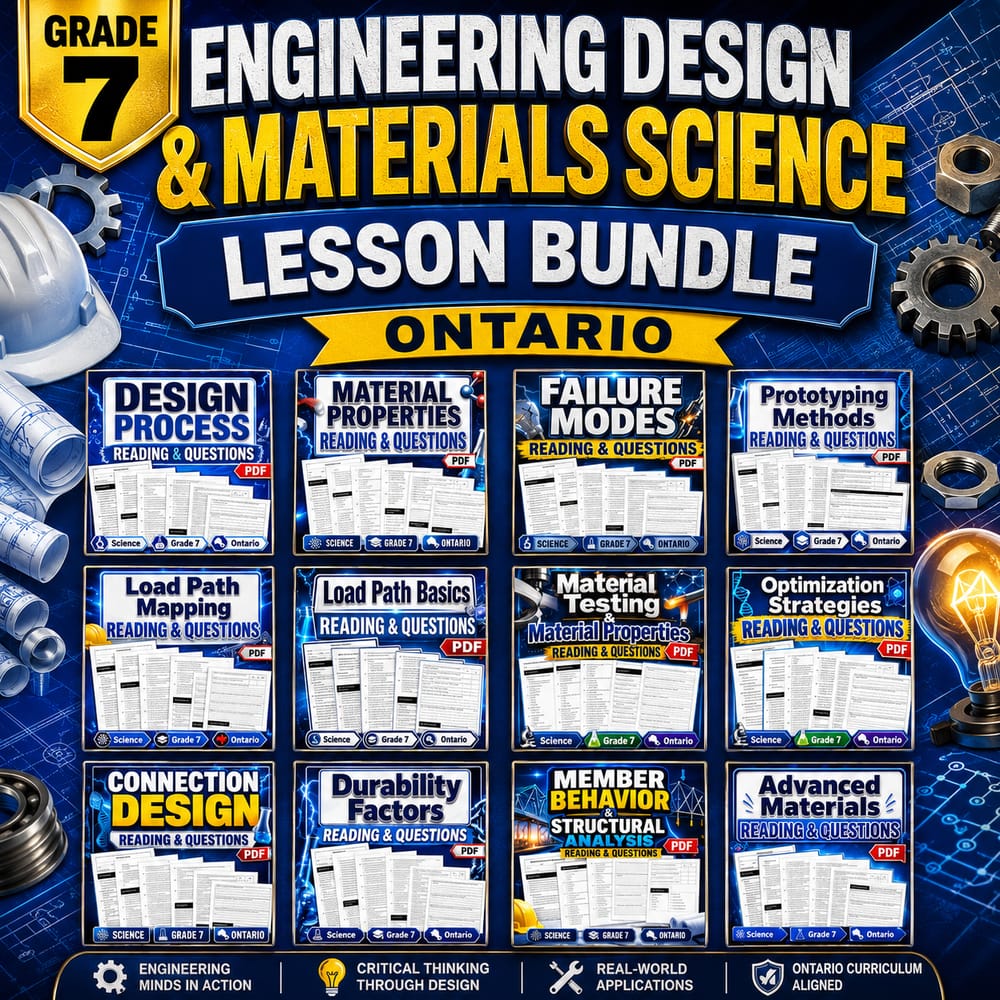


Grade 7 Engineering Design & Materials Science Lesson Bundle Ontario
$38.40$48.00Save $9.60
Evergreen Desk Education
·2 followers·17 sales
SubjectScienceGradeGrade 7
What’s included
12 worksheets · Save $9.60 (20%) · prices shown inside the bundle
 Grade 7 Science | Design Process Worksheet (Ontario Standards) (PDF)
- Explain how functional requirements and constraints guide engineering design choices from problem definition to solution selection.
- Describe how performance objectives (such as load capacity, stiffness, and serviceability) influence design decisions.
- Use a simple decision matrix and sketches to compare concept options and justify a preferred solution using criteria and trade-offs.
$3.20$4.00 Grade 7 Science Worksheet – Material Properties with Ontario Standards (PDF)
- Define and compare key material properties: density, tensile strength, compressive strength, stiffness (modulus), ductility, toughness, and thermal expansion.
- Explain how material properties influence structural performance and design choices for beams and columns.
- Contrast wood, steel, and reinforced concrete by strength-to-weight ratio, deformation under load, and typical failure modes.
$3.20$4.00 Grade 7 Science – Failure Modes Worksheet (Ontario) (PDF)
- Identify key structural failure modes such as buckling, fatigue cracking, fracture, and connection/foundation failures.
- Explain how geometry, material properties, and loading conditions affect which failure mode occurs.
- Describe limit states design thinking using safety factors, redundancy, and risk reduction strategies.
$3.20$4.00 Grade 7 Science Worksheet – Prototyping Methods (Ontario) Practice (PDF)
- Compare scaled physical models, digital finite-element models (FEM), and laboratory load rigs for evaluating strength, stiffness, and failure modes.
- Explain how instrumentation such as strain gauges and displacement transducers are used to quantify structural response.
- Identify limitations of scaling and describe how prototype test results can guide design revisions and risk assessment.
$3.20$4.00 Grade 7 Science Load Path Mapping Worksheet (Ontario) – PDF
- Describe how engineers map primary and secondary load paths in multi-span bridge and building systems
- Explain how diaphragms, shear walls, and moment frames change stiffness and redirect loads
- Predict how openings, re-entrant corners, and irregular geometry can redistribute gravity, lateral, and dynamic loads
$3.20$4.00 Grade 7 Science – Load Path Basics Worksheet (Ontario) PDF
- Describe how loads transfer through structural members using the idea of a load path.
- Differentiate dead loads and live loads and identify common examples of each.
- Recognize where tension, compression, and shear occur in beams, columns, trusses, and connections.
$3.20$4.00 Grade 7 Science Worksheet – Material Testing & Material Properties (PDF)
- Describe how tensile, compression, and bending tests reveal key material properties used in design.
- Explain how non-destructive testing (ultrasonic testing and hardness measurements) helps evaluate materials without damaging them.
- Relate material variability, anisotropy (especially in timber and composites), and strain localization to safety factors and design codes.
$3.20$4.00 Grade 7 Science | Optimization Strategies Worksheet (Ontario PDF)
- Explain how iterative refinement and quantitative comparison are used to improve engineering designs.
- Describe how topology and form optimization can reduce weight and cost while maintaining required strength, stiffness, and durability.
- Use performance-based criteria and safety margins to evaluate whether an optimized design meets code requirements.
$3.20$4.00 Grade 7 Science – Connection Design Worksheet (Ontario) (PDF)
- Explain how bolted, welded, and bearing connections help create continuous load paths in structures
- Describe shear, bearing, and slip at connections and how these behaviors affect structural performance
- Compare how connection stiffness and detailing (gusset plates and base plates) influence capacity and failure modes
$3.20$4.00 Grade 7 Science Worksheet | Durability Factors and Material Performance (PDF)
- Explain how environmental conditions (water, salts, freeze–thaw, and UV) lead to material degradation over time.
- Identify protective measures (coatings, cathodic protection, concrete cover, sealers, and detailing) that improve durability.
- Relate maintenance schedules and inspection intervals to expected lifespan and long-term structural reliability.
$3.20$4.00
Reviews & Feedback
Loading reviews...
Questions & Answers
Loading questions…
About this bundle
Related categories
Frequently asked questions
Who is Grade 7 Engineering Design & Materials Science Lesson Bundle Ontario designed for?
Grade 7 Engineering Design & Materials Science Lesson Bundle Ontario is designed for Grade 7 students and Science learners and can be used in classrooms, homeschool, or independent practice.
How do I download Grade 7 Engineering Design & Materials Science Lesson Bundle Ontario?
Add it to your cart and complete checkout. After payment, you can download immediately from your account, and you'll also receive a download link by email.
Similar Products

Grade 7 Science Structural Engineering Design & Materials Lesson Bundle |Ontario
$48.00$60.00

Grade 7 Engineering Design Materials & Load Paths Science Lesson Bundle: Ontario
$48.00$60.00

Grade 9 Science NGSS Engineering Design Lesson Bundle | Prototyping & Modeling
$9.60$12.00

Grade 7 Science NGSS Engineering Design Lesson Bundle | Worksheets
$12.00$15.00

Grade 6 Engineering Design Lesson Bundle | NGSS Science
$12.00$15.00