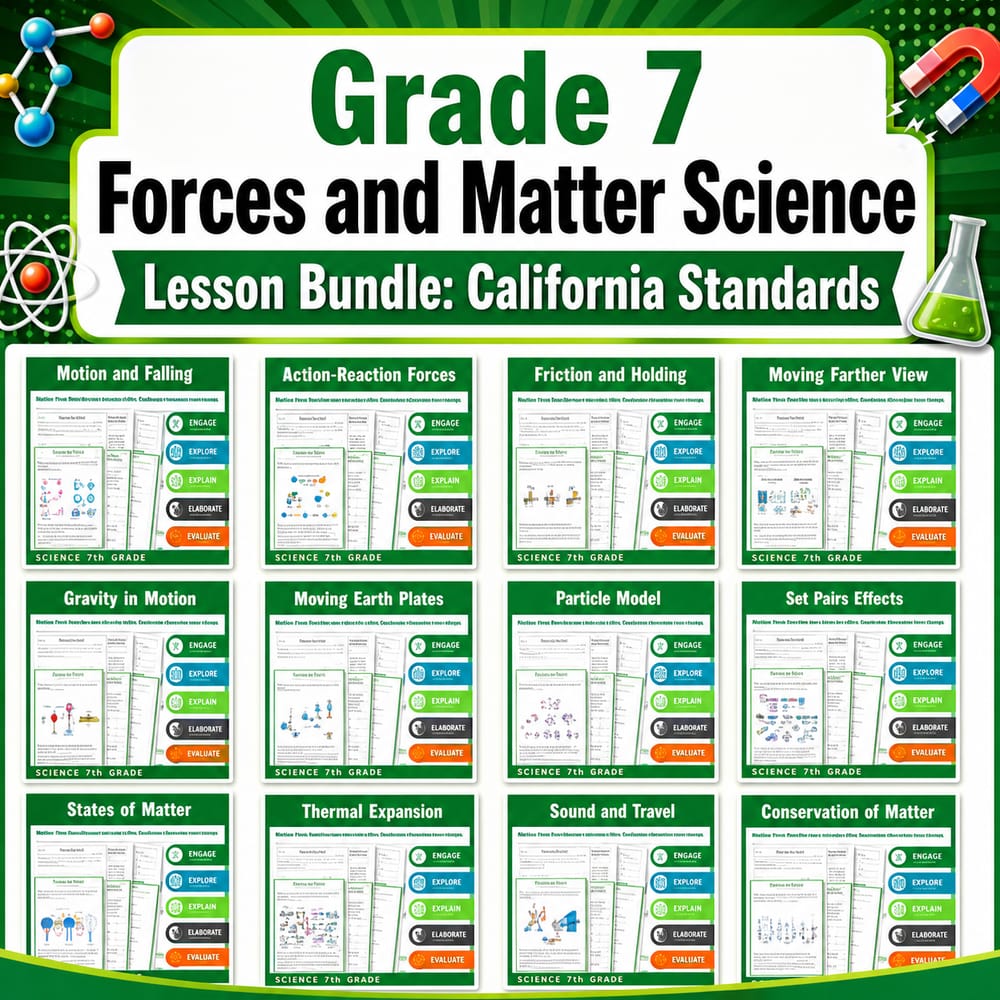
Grade 7 Forces and Matter Science Lesson Bundle: California Standards β€” bundle cover
Grade 7 Forces and Matter Science Lesson Bundle: California Standards β€” included worksheet 1
Grade 7 Forces and Matter Science Lesson Bundle: California Standards β€” included worksheet 2
Grade 7 Forces and Matter Science Lesson Bundle: California Standards β€” included worksheet 3
Grade 7 Forces and Matter Science Lesson Bundle: California Standards β€” included worksheet 4
Grade 7 Forces and Matter Science Lesson Bundle: California Standards β€” included worksheet 5
Grade 7 Forces and Matter Science Lesson Bundle: California Standards β€” included worksheet 6
Grade 7 Forces and Matter Science Lesson Bundle: California Standards β€” included worksheet 7
Grade 7 Forces and Matter Science Lesson Bundle: California Standards β€” included worksheet 8
Grade 7 Forces and Matter Science Lesson Bundle: California Standards β€” included worksheet 9
Grade 7 Forces and Matter Science Lesson Bundle: California Standards β€” included worksheet 10
Grade 7 Forces and Matter Science Lesson Bundle: California Standards β€” included worksheet 11
Grade 7 Forces and Matter Science Lesson Bundle: California Standards β€” included worksheet 12
Grade 7 Science worksheet β€” Grade 7 Forces and Matter Science Lesson Bundle: California Standards

Description

Overview


Grade Grade 7 Science Mini Bundle provides 12 assessment PDFs on forces and matter topics aligned to California Standards for Grade 7 Science πŸ“˜. This topic-focused curriculum bundle supports a printable classroom unit either on its own or alongside a full-year curriculum, helping you check mastery across multiple concepts and representations.

What’s Included


This collection includes 12 lessons and 12 Assessment resources.

  • βœ… Action-Reaction Forces Assessment for Grade 7 Science – California Standards – Checks understanding of interaction pairs and motion changes.
  • βœ… Conservation of Matter Assessment | California Standards Grade 7 Science – Assesses reasoning about matter transfer and conservation.
  • βœ… Thermal Expansion Assessment Grade 7 Science California Standards – Evaluates explanations using temperature and particle behavior.
  • βœ… States of Matter Assessment | California Standards Grade 7 Science – Measures how students classify and justify state changes.
  • βœ… Recoil And Thrust Assessment | California Standards Grade 7 Science – Reviews evidence-based claims about force direction and effects.
  • βœ… Particle Model Assessment for Grade 7 | California Standards - Science – Targets use of a particle model to explain observable properties.
  • βœ… Net Force Effects Assessment | California Standards Grade 7 Science – Assesses claims supported by force diagrams and outcomes.
  • βœ… Heating Curve Phases Assessment | standards-aligned assessment Grade 7 Science – Checks interpretation of phase changes from a heating curve.
  • βœ… Gravity On Objects Assessment Grade 7 Science | California Standards – Measures understanding of how mass and distance relate to gravity effects.
  • βœ… Friction And Stability Assessment | California Standards Grade 7 Science – Evaluates reasoning about stability and forces that oppose motion.
  • βœ… Diffusion And Mixing Assessment Graade 7 Science | California Standards – Assesses explanations of diffusion rate and mixing patterns.
  • βœ… Density Particle View Assessment Grade 7 Science | California Standards – Checks conceptual links between particle view and density.

All materials are provided in PDF format only.

Skills & Standards


These standards-aligned unit resources build mastery by moving from concrete interactions (forces and gravity) to particulate explanations (conservation of matter, diffusion, and density) using consistent assessment routines. Across the set, students practice crosscutting concepts such as energy and matter, structure and function, and systems and system models while connecting disciplinary core ideas in physical science to claims they can justify. Assessments emphasize modeling through particle models, force diagrams, and heating-curve representations, then support analytical reasoning with prompts that ask students to interpret data trends and compare outcomes. Each page is designed for evidence-based explanations so students link observations to scientific reasoning rather than relying on memorized definitions.

Perfect For


  • Teachers seeking structured instruction
  • Sub plans
  • Homework or review
  • Intervention or centers
  • Assessment preparation

How to Use


As a lesson bundle, plan multi-day pacing by assigning 1 assessment per day or grouping related topics (for example, force interactions across two days, then matter and particle ideas across the next two to three days). Use the PDFs for curriculum-aligned lesson collection checkpoints after instruction, during centers, or as exit tickets that double as graded evidence. Pair each assessment with a quick class debrief (identify the most missed claim type, model one correct explanation, and restate the key evidence standard), and keep consistent grading by using the included answers to record patterns for whole-class reteach or small-group intervention.

Closing


A standards-aligned, topic-focused assessment lesson bundle like this helps you verify learning of forces and matter while keeping feedback clear and actionable.

Grade 7 Forces and Matter Science Lesson Bundle: California Standards

$48.00$60.00Save $12.00
Prism Point Learning
Β·2 followersΒ·13 sales
SubjectScienceGradeGrade 7

What’s included

12 worksheets Β· Save $12.00 (20%) Β· prices shown inside the bundle

  1. Diffusion And Mixing Assessment Graade 7 Science | California Standards
    Diffusion And Mixing Assessment Graade 7 Science | California Standards

    Grade 7 Β· Science Β· 8 Pages

    • Explain diffusion using the particle model and concentration gradients.
    • Describe how mixing occurs without requiring particles to stop moving or change into new substances.
    • Predict how temperature affects the rate of diffusion and mixing.
    $4.00$5.00
  2. Action-Reaction Forces Assessment for Grade 7 Science – California Standards
    Action-Reaction Forces Assessment for Grade 7 Science – California Standards

    Grade 7 Β· Science Β· 8 Pages

    • Explain Newton’s third law using the action-reaction force pair for interacting objects
    • Identify how equal and opposite forces relate to contact and noncontact interactions
    • Use mass and Newton’s second law to reason about why accelerations may differ
    $4.00$5.00
  3. Friction And Stability Assessment | California Standards Grade 7 Science
    Friction And Stability Assessment | California Standards Grade 7 Science

    Grade 7 Β· Science Β· 8 Pages

    • Explain how friction opposes relative motion and how it affects whether forces balance or not.
    • Predict how changes in surface texture (roughness/smoothness) change the size of friction and the resulting motion.
    • Use the idea of net force to describe when an object speeds up, slows down, or moves at constant velocity.
    $4.00$5.00
  4. Density Particle View Assessment Grade 7 Science | California Standards
    Density Particle View Assessment Grade 7 Science | California Standards

    Grade 7 Β· Science Β· 8 Pages

    • Explain density using the particle view of matter (mass and how particles are spaced).
    • Predict how sinking, floating, and heating relate to changes in volume and average particle spacing.
    • Use evidence from particle spacing to compare the densities of different substances.
    $4.00$5.00
  5. Gravity On Objects Assessment Grade 7 Science | California Standards
    Gravity On Objects Assessment Grade 7 Science | California Standards

    Grade 7 Β· Science

    • Explain how gravity creates weight and affects the motion of objects near Earth.
    • Compare the effects of mass on gravitational force and the acceleration of gravity near Earth.
    • Describe how support forces (like the normal force) can balance weight and prevent motion.
    $4.00$5.00
  6. Heating Curve Phases Assessment | standards-aligned assessment Grade 7 Science
    Heating Curve Phases Assessment | standards-aligned assessment Grade 7 Science

    Grade 7 Β· Science Β· 8 Pages

    • Describe the temperature-time behavior of matter during heating curve phases (warming, melting plateau, liquid warming, boiling plateau).
    • Explain why temperature can remain constant during phase changes even while heat energy is added.
    • Use heating curve data to connect particle-level changes to observable temperature patterns.
    $4.00$5.00
  7. Particle Model Assessment for Grade 7 | California Standards - Science
    Particle Model Assessment for Grade 7 | California Standards - Science

    Grade 7 Β· Science

    • Explain how the particle model describes matter as tiny particles in constant motion.
    • Relate temperature to the average kinetic energy (motion) of particles.
    • Use particle ideas to predict how changes in temperature affect properties such as diffusion and pressure.
    $4.00$5.00
  8. Net Force Effects Assessment | California Standards Grade 7 Science
    Net Force Effects Assessment | California Standards Grade 7 Science

    Grade 7 Β· Science

    • Explain how forces add to create a net force using both magnitude and direction
    • Predict how an unbalanced net force changes an object’s speed and/or direction
    • Determine when forces are balanced and describe the resulting motion
    $4.00$5.00
  9. States of Matter Assessment | California Standards Grade 7 Science
    States of Matter Assessment | California Standards Grade 7 Science

    Grade 7 Β· Science Β· 8 Pages

    • Explain how energy transfer affects particle motion and arrangement during changes of state.
    • Describe and compare melting, freezing, evaporation, and condensation using the particle model.
    • Predict how temperature changes (or stays steady) during a phase change and explain why.
    $4.00$5.00
  10. Thermal Expansion Assessment Grade 7 Science California Standards
    Thermal Expansion Assessment Grade 7 Science California Standards

    Grade 7 Β· Science

    • Explain how increasing temperature affects particle motion and spacing in solids, liquids, and gases
    • Describe and predict contraction and expansion when materials are heated or cooled
    • Connect thermal expansion to real-world situations such as tight metal fits and gas pressure in sealed containers
    $4.00$5.00

Reviews & Feedback

Loading reviews...

Questions & Answers

Loading questions…

About this bundle

Related categories

Frequently asked questions

Who is Grade 7 Forces and Matter Science Lesson Bundle: California Standards designed for?
Grade 7 Forces and Matter Science Lesson Bundle: California Standards is designed for Grade 7 students and Science learners and can be used in classrooms, homeschool, or independent practice.
How do I download Grade 7 Forces and Matter Science Lesson Bundle: California Standards?
Add it to your cart and complete checkout. After payment, you can download immediately from your account, and you'll also receive a download link by email.