
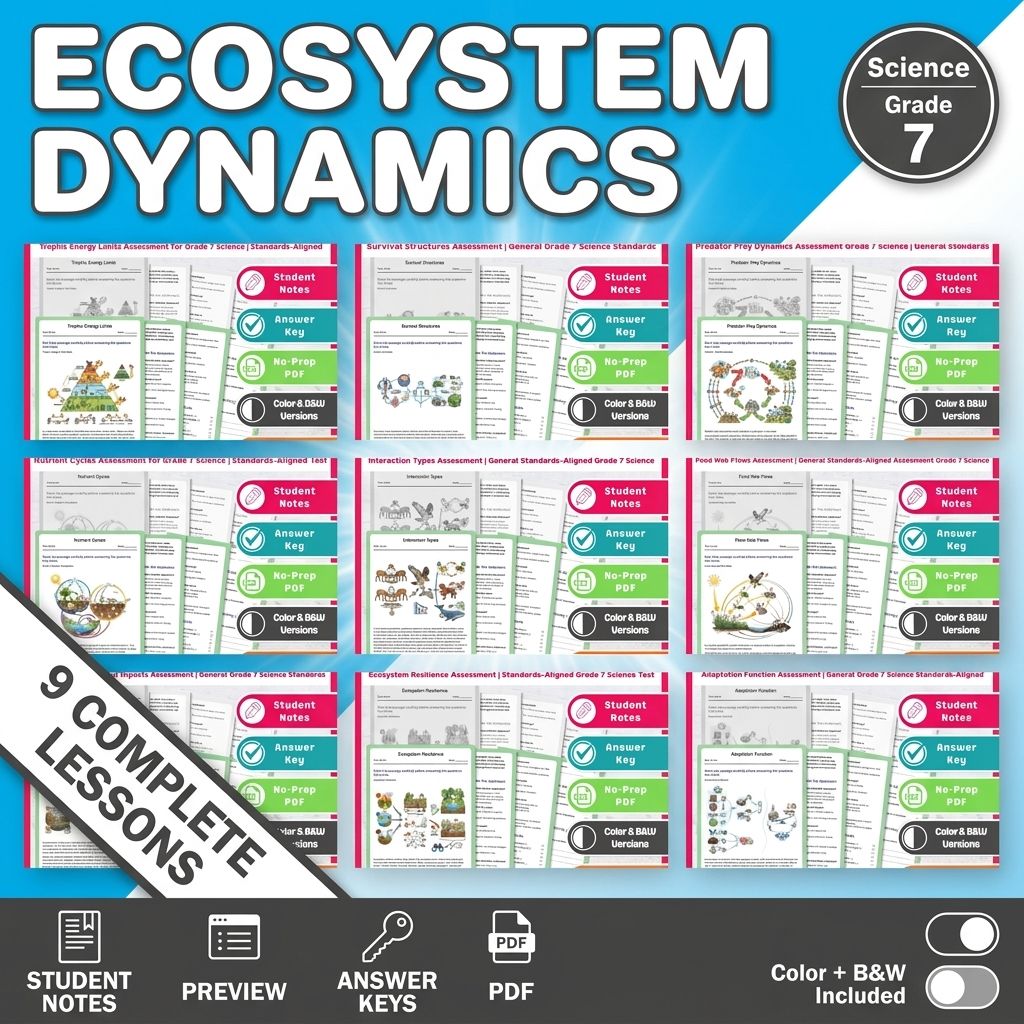
Grade 7 Life Science Lesson Bundle Science: General Framework Assessments
$36.00$45.00Save $9.00
Prism Point Learning
·2 followers·14 sales
SubjectScienceGradeGrade 7
What’s included
9 worksheets · Save $9.00 (20%) · prices shown inside the bundle
 Food Web Flows Assessment | General Standards-Aligned Assessment Grade 7 Science
- Understand how energy flows through food webs from producers to consumers.
- Explain the process of matter cycling in ecosystems and its importance.
- Identify the roles of producers, consumers, and decomposers in an ecosystem.
$4.00$5.00 Adaptation Function Assessment | General Grade 7 Science Standards-Aligned
- Understand how structural, behavioral, and functional adaptations support survival.
- Identify examples of adaptations that facilitate specific life processes.
- Explain the trade-offs involved in functional adaptations and their impact on survival.
$4.00$5.00 Survival Structures Assessment | General Grade 7 Science Standards
- Understand how internal structures support organism survival, growth, and reproduction.
- Identify external features that aid protection, feeding, and movement in organisms.
- Explain the functional relationships between traits and resource acquisition, balance, and reproduction.
$4.00$5.00 Trophic Energy Limits Assessment for Grade 7 Science | Standards-Aligned
- Explain how energy decreases as it moves through trophic levels in a food web.
- Describe the role of producers and consumers in energy transfer.
- Understand why food chains are typically short and biomass varies with trophic position.
$4.00$5.00 Interaction Types Assessment | General Standards-Aligned Grade 7 Science
- Understand the different types of organism interactions in a community.
- Identify examples of competition, predation, and symbiosis.
- Explain how these interactions affect resource availability and population dynamics.
$4.00$5.00 Ecosystem Resilience Assessment | Standards-Aligned Grade 7 Science Test
- Understand the concept of ecosystem resilience and its importance.
- Identify factors that influence how ecosystems recover from disturbances.
- Analyze patterns in population changes following environmental disruptions.
$4.00$5.00 Predator Prey Dynamics Assessment Grade 7 Science | General Standards
- Understand the cause-and-effect relationships in predator-prey interactions.
- Identify how changes in predator or prey populations affect community composition.
- Explain feedback mechanisms in ecological systems.
$4.00$5.00 Environmental Change Impacts Assessment | General Grade 7 Science Standards
- Understand how environmental changes influence ecosystems and organism survival.
- Identify different types of environmental alterations and their effects on resources and species.
- Analyze how shifts in species populations affect ecosystem interactions and patterns.
$4.00$5.00 Nutrient Cycles Assessment for Grade 7 Science | Standards-Aligned Test
- Understand how matter cycles through ecosystems via different nutrient pathways.
- Identify the roles of carbon, nitrogen, and phosphorus in nutrient cycling.
- Explain processes such as photosynthesis, respiration, decomposition, and bacterial transformations.
$4.00$5.00
Reviews & Feedback
Loading reviews...
Questions & Answers
Loading questions…
About this bundle
Related categories
Frequently asked questions
Who is Grade 7 Life Science Lesson Bundle Science: General Framework Assessments designed for?
Grade 7 Life Science Lesson Bundle Science: General Framework Assessments is designed for Grade 7 students and Science learners and can be used in classrooms, homeschool, or independent practice.
How do I download Grade 7 Life Science Lesson Bundle Science: General Framework Assessments?
Add it to your cart and complete checkout. After payment, you can download immediately from your account, and you'll also receive a download link by email.
Similar Products

Grade 6 Life Processes Science Lesson Bundle Assessment: General Framework
$36.00$45.00

Grade 6 Life Processes & Ecosystems Science lesson bundle: General Framework
$36.00$45.00

Grade 8 Life Science Science Lesson Bundle – General Framework Resources
$32.00$40.00

Grade 11 Biology Foundations Science Lesson Bundle: General Worksheets
$21.60$27.00

Life Processes Grade 6 Science Daily Reading Worksheets Lesson Bundle | General
$28.80$36.00