
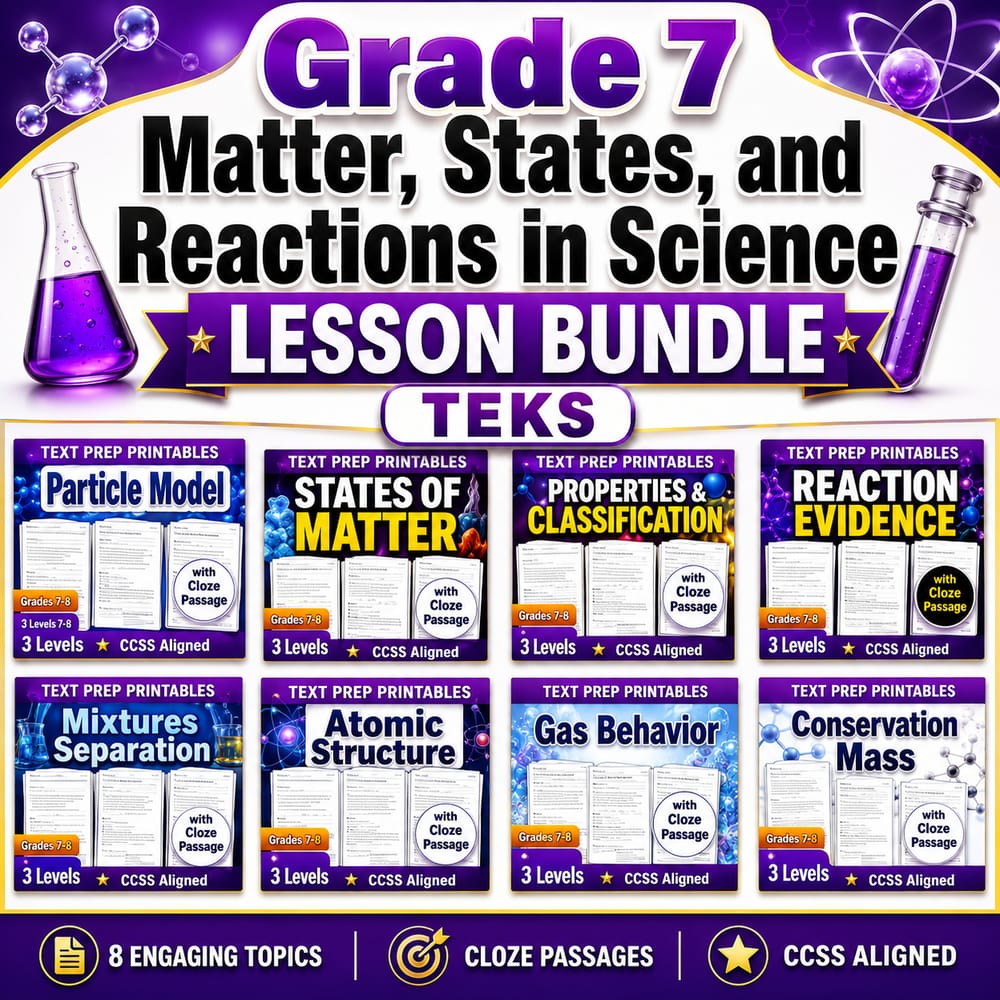
Grade 7 Matter, States, and Reactions in Science Lesson Bundle TEKS
$40.00$50.00Save $10.00
Prism Point Learning
·2 followers·14 sales
SubjectScienceGradeGrade 7
What’s included
10 worksheets · Save $10.00 (20%) · prices shown inside the bundle
 Particle Model Worksheet | Grade 7 Science Activities
- Explain how the kinetic particle model uses particle spacing, motion, and forces to describe macroscopic properties of matter.
- Use the particle model to predict how changes such as heating or applied pressure affect observable measurements.
- Connect diffusion, thermal expansion, and compressibility to micro-scale particle behavior.
$4.00$5.00 States Of Matter Worksheet | Grade 7 Science Activities
- Explain states of matter using a particle model and describe phase changes between states.
- Relate temperature and pressure to when phase changes occur and to measurable properties such as density and viscosity.
- Use water as an example to connect molecular energy to observable behavior, including how boiling point changes with atmospheric pressure.
$4.00$5.00 Properties & Classification Worksheet Pack | Grade 7 Science Activities
- Define physical and chemical properties and explain how they help classify substances.
- Identify elements, compounds, and mixtures using measurable properties such as density, solubility, hardness, conductivity, magnetism, and flammability.
- Use observable evidence from property tests to justify classifications.
$4.00$5.00 Reaction Evidence Worksheet | Grade 7 Science Activities
- Identify observable evidence that a chemical reaction has occurred, including gas evolution, precipitate formation, color change, and temperature change
- Explain how qualitative observations connect to reactant-to-product changes described by symbolic formulas
- Use particle- and energy-based reasoning to interpret reaction evidence during common classroom reactions
$4.00$5.00 Mixtures Separation Worksheet | Grade 7 Science Activities
- Distinguish homogeneous and heterogeneous mixtures based on observable properties.
- Select an appropriate separation technique (filtration, distillation, chromatography, magnetic separation) by using differences in solubility, particle size, or boiling point.
- Explain how physical separation methods produce distinct fractions without changing chemical identities.
$4.00$5.00 Atomic Structure Worksheet | Grade 7 Science Practice
- Explain how protons, neutrons, and electrons determine atomic identity and isotopic variation
- Relate atomic number and mass number to element identity and an isotope’s nucleus
- Describe basic electron arrangements and connect simple atomic models to observable patterns
$4.00$5.00 Gas Behavior Worksheet | Grade 7 Science Activities and Assessment
- Explain qualitatively how gas pressure, volume, and temperature affect one another
- Describe how diffusion and compressibility help explain everyday gas observations
- Use real-world examples (compressed air, heated air) to predict what changes and why
$4.00$5.00 Energy Transfer Worksheet | Grade 7 Science Activities
- Explain how conduction, convection, and radiation transfer thermal energy and give real-world examples.
- Relate temperature differences to the direction of heat flow and to measurable effects like warming rates.
- Describe how specific heat and phase changes affect thermal energy transfer without always changing temperature.
$4.00$5.00 Bonding Patterns Worksheet | Grade 7 Science TEKS Practice
- Differentiate ionic and covalent bonding using evidence from bonding structure and particle interactions.
- Relate bonding type to observable properties such as melting point, solubility, and electrical conductivity.
- Use empirical formulas to describe simple binary ionic salts and molecular compounds.
$4.00$5.00 Conservation of Mass Worksheet | Grade 7 Science Activities
- State the law of conservation of mass for a closed system.
- Use mass accounting to relate the masses of reactants and products in sealed transformations.
- Apply conservation of mass to physical processes like dissolution and to chemical reactions using observations and simple balancing ideas.
$4.00$5.00
Reviews & Feedback
Loading reviews...
Questions & Answers
Loading questions…
About this bundle
Related categories
Frequently asked questions
Who is Grade 7 Matter, States, and Reactions in Science Lesson Bundle TEKS designed for?
Grade 7 Matter, States, and Reactions in Science Lesson Bundle TEKS is designed for Grade 7 students and Science learners and can be used in classrooms, homeschool, or independent practice.
How do I download Grade 7 Matter, States, and Reactions in Science Lesson Bundle TEKS?
Add it to your cart and complete checkout. After payment, you can download immediately from your account, and you'll also receive a download link by email.
Similar Products

Grade 7 Science Lesson – States of Matter & Reaction Types Assessment Bundle
$60.00$75.00

Grade 7 States of Matter & Reactions Science Daily Reading Lesson Bundle | BC
$48.00$60.00

Grade 8 Science Unit Bundle | States of Matter & Reaction Rates Worksheets- TEKS
$24.00$30.00

States of Matter & Chemical Reactions Lesson Bundle | Grade 9 Science | Alberta
$60.00$75.00

Grade 7 Science Unit Bundle – States, Reactions & Atomic Structure Worksheets
$16.00$20.00