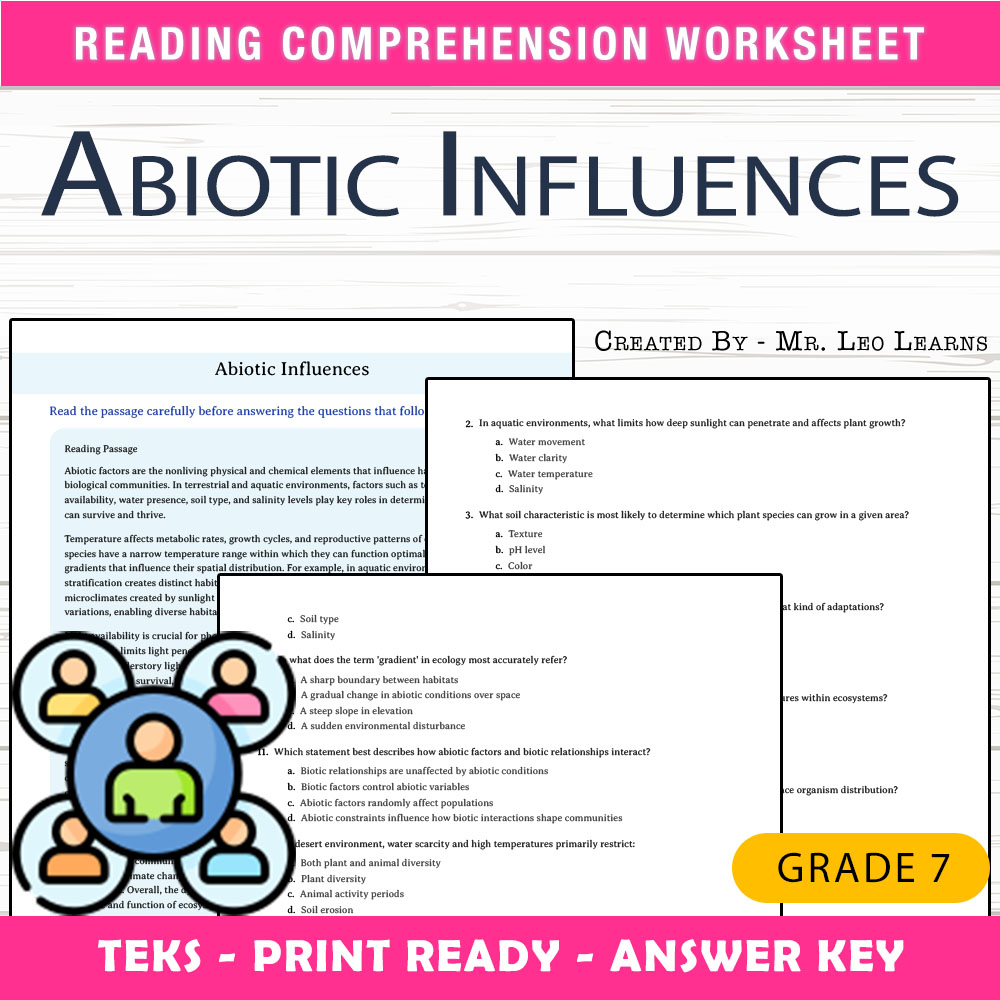
Imagine a classroom where students are trying to understand how nonliving elements shape ecosystems and influence living organisms. There’s often confusion around concepts like temperature, sunlight, soil, and water—critical abiotic factors that affect habitats. This worksheet provides a straightforward, print-ready resource designed to guide students in exploring these physical and chemical influences. It simplifies complex ideas through clear questions, encouraging independent thinking and active engagement with the material. Teachers are supported with a ready-to-use format, making it easier to facilitate discussions or assess understanding quickly.
What This Resource Helps Students Do
This worksheet helps students grasp the fundamental role of abiotic factors in ecosystems. It guides them through reading comprehension about how nonliving elements impact biological communities. The multiple-choice questions reinforce understanding of key concepts such as temperature regulation, sunlight penetration, soil composition, and water availability. It also promotes critical thinking as students analyze relationships between environmental factors and their effects on organisms. With this resource, students build confidence in identifying and explaining how changes in abiotic influences can alter habitats and species interactions. The exercises encourage independent reasoning, supporting classroom discussions and reinforcing learning through practical application.
Inside the PDF
• 1 reading passage discussing abiotic factors and their effects on ecosystems
• 25 multiple-choice questions focusing on key concepts
• A clean, print-ready layout that requires no preparation
• Clear formatting ideal for photocopying and classroom use
• An answer key complete with a rubric for quick assessment
How It Improves Learning
This worksheet promotes clarity by breaking down complex environmental science concepts into manageable, bite-sized questions. The reading passage primes students on core ideas before they tackle the multiple-choice questions, building their understanding progressively. The multiple-choice format encourages careful reading and analysis, helping students improve their critical thinking skills. As they work through the questions, they reinforce their knowledge of how abiotic factors influence ecosystems, encouraging deeper learning. The answer key allows for immediate feedback, supporting student reflection and mastery. It is especially effective in transforming confusion into clarity by aligning questions directly with key science standards and concepts. Overall, students move from uncertainty to confidence, with a concrete understanding of how nonliving factors shape the natural world.
Core Skills Students Will Develop
- ➡️ Understanding environmental influences on ecosystems
- ➡️ -reading comprehension of scientific passages
- ➡️ analyzing the relationship between abiotic factors and living organisms
- ➡️ identifying key environmental influences in different habitats
Ways Teachers Use This Worksheet
This worksheet is versatile for various classroom needs. It can be used as an individual or small-group activity during science lessons, providing a structured way for students to review or reinforce their understanding of abiotic influences. It works well as a formative assessment or as a follow-up homework assignment to deepen comprehension. Teachers may also use it for early finisher activities or as part of station rotations. Its clear layout supports quick and easy photocopying, ensuring that teachers can deploy it in busy schedules without additional prep. Whether for review, practice, or assessment, this worksheet offers a practical, classroom-friendly tool to support student learning and confidence in environmental science topics.
Why This PDF Saves Time
This resource reduces preparation time by offering a ready-made, print-and-go worksheet that's easy to implement aligned with TEKS standards. The layout is designed for direct photocopying, eliminating the need for extensive customization or formatting. Teachers can confidently print the worksheet and provide it to students as an immediate classroom activity or assessment. The included answer key streamlines grading and feedback, saving time and enabling quicker progress monitoring. With this reliable, straightforward resource, teachers can maintain consistency in instruction and assessment while freeing up time for other instructional priorities.
Each teacher deserves resources that support their goal of fostering understanding and confidence in their students. This worksheet is designed to do exactly that—helping students explore the vital role of abiotic influences in ecosystems with clarity and confidence. It’s ready to print, classroom-ready, and tailored to support meaningful learning experiences. 😊