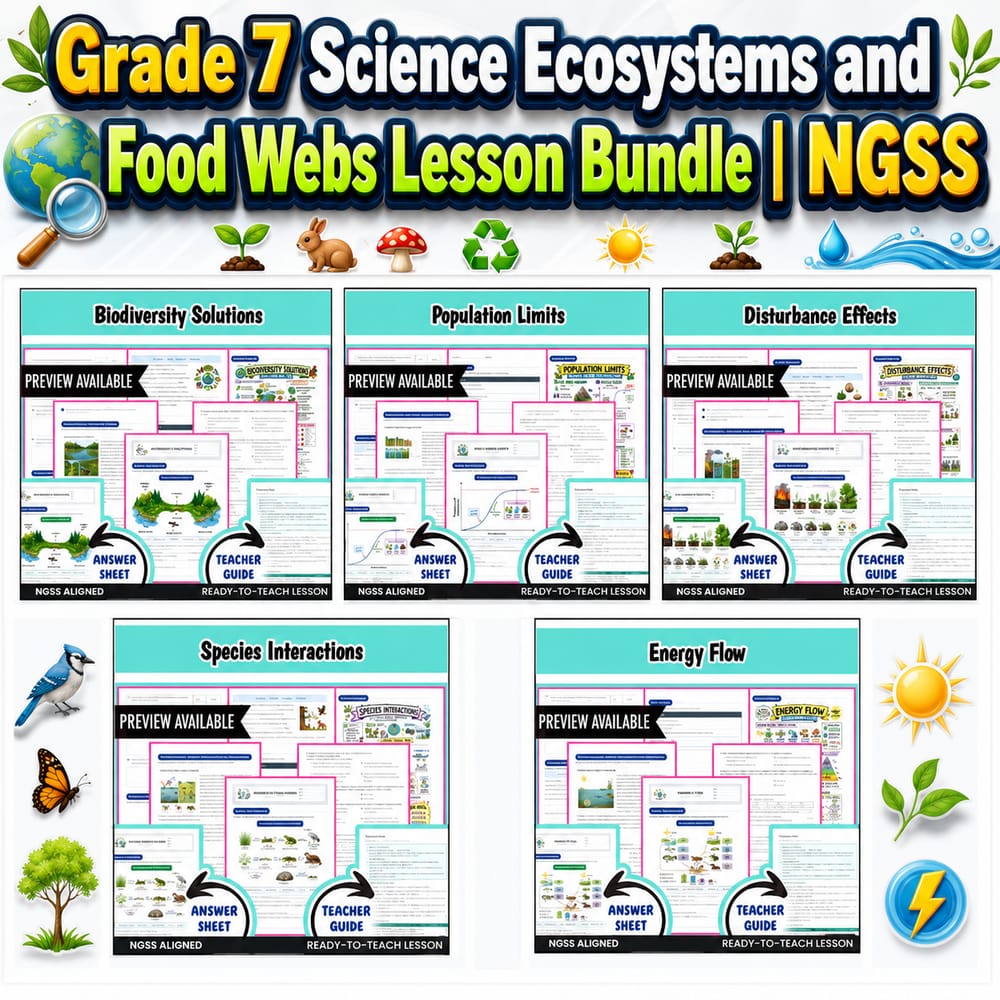
Grade 7 Science Ecosystems and Food Webs Lesson Bundle | NGSS — bundle cover
Grade 7 Science Ecosystems and Food Webs Lesson Bundle | NGSS — included worksheet 1
Grade 7 Science Ecosystems and Food Webs Lesson Bundle | NGSS — included worksheet 2
Grade 7 Science Ecosystems and Food Webs Lesson Bundle | NGSS — included worksheet 3
Grade 7 Science Ecosystems and Food Webs Lesson Bundle | NGSS — included worksheet 4
Grade 7 Science Ecosystems and Food Webs Lesson Bundle | NGSS — included worksheet 5
Grade 7 Science worksheet — Grade 7 Science Ecosystems and Food Webs Lesson Bundle | NGSS

Description

Overview


Grade 7 Science Ecosystems and Food Webs (NGSS) is a classroom-ready bundle of 5 print-only worksheet pages plus PDF answer keys and rubric. It supports Grade 7, Science, Ecosystems and Food Webs learning as a standards-aligned unit, printable resource pack, and ready-to-assess set of activities. Grade 7, Science, 5, {standards} are reflected through tasks that build systems thinking from species interactions to ecosystem management.

What's Included


This print-only unit includes Printable PDF worksheets and corresponding PDF answer keys with rubric for teacher scoring and faster feedback.

  • ✅ Species Interactions Worksheet | Grade 7 NGSS Food Webs Ecology Activity – Students examine how organisms interact within food webs and ecosystems.
  • ✅ Population Limits Worksheet | Grade 7 NGSS Ecosystems Activity Pack – Students analyze how limited resources affect population growth and stability.
  • ✅ Energy Flow Food Chains & Food Webs Worksheet | Grade 7 NGSS – Students trace energy movement through food chains and connect it to food webs.
  • ✅ Disturbance Effects Ecosystems Worksheet | NGSS Grade 7 Science – Students predict how disturbances can change ecosystem structure over time.
  • ✅ Biodiversity Solutions Worksheet | Grade 7 NGSS Ecosystem Management – Students propose evidence-based solutions for protecting biodiversity and ecosystem function.

Skills & Standards


Aligned to {standards} through an NGSS lens, this unit emphasizes core ideas and practices such as: (1) systems and stability by examining relationships among organisms and their environment; (2) energy flow by using models to show how energy transfers through trophic levels; and (3) interactions in ecosystems by explaining how competition, predation, and other relationships influence survival and population size.

Students build disciplinary skills by interpreting food web connections, identifying limiting factors, and using cause-and-effect reasoning to connect ecosystem changes to evidence from the worksheets. Each worksheet is structured for modeling and analytical thinking: students translate information into food-chain or food-web reasoning, justify claims with data or patterns from the prompts, and practice evidence-based explanations during discussion and written responses. As the unit progresses, learners move from describing interactions to applying patterns to new scenarios—then to evaluating disturbance impacts and developing biodiversity solutions with criteria drawn from the rubric.

Perfect For


  • Teachers seeking structured instruction
  • Sub plans
  • Homework or review
  • Intervention or centers
  • Assessment preparation

How to Use


Plan this single unit over 1–3 weeks to match your schedule and pacing. Use a short warm-up each day to review one key vocabulary relationship (interactions, limits, energy flow, disturbance, biodiversity). For guided practice, work through one worksheet step at a time, pausing for students to explain patterns they notice in their models and written responses; then use the PDF answer keys with rubric for efficient end-of-day scoring. Finish with an end-of-unit review that blends predictions: students revisit a simplified food web, apply what they learned about limiting factors and disturbances, and choose a biodiversity solution supported by their worksheet evidence.

Closing


Print these worksheets to strengthen student confidence with ecosystem reasoning, evidence-based explanations, and NGSS-aligned models.

Grade 7 Science Ecosystems and Food Webs Lesson Bundle | NGSS

$20.00$25.00Save $5.00
Amber Owl Education
New·0 followers·1 sales
SubjectScienceGradeGrade 7Pages76 Pages

What’s included

5 worksheets · 76 pages · Save $5.00 (20%) · prices shown inside the bundle

  1. Biodiversity Solutions Worksheet | Grade 7 NGSS Ecosystem Management
    Biodiversity Solutions Worksheet | Grade 7 NGSS Ecosystem Management

    Grade 7 · Science · 15 Pages

    • Explain how different biodiversity management strategies (protected areas, restoration, corridors, and invasive species control) can affect ecosystem services.
    • Evaluate trade-offs among ecological, economic, and social constraints when planning biodiversity solutions.
    • Use evidence from case examples to predict likely outcomes for species persistence and ecosystem functions.
    $4.00$5.00
  2. Population Limits Worksheet | Grade 7 NGSS Ecosystems Activity Pack
    Population Limits Worksheet | Grade 7 NGSS Ecosystems Activity Pack

    Grade 7 · Science · 15 Pages

    • Explain how resource availability and competition influence population growth rates
    • Interpret logistic growth curves and the concept of carrying capacity
    • Relate birth, death, immigration, and emigration to changes in population size
    $4.00$5.00
  3. Disturbance Effects Ecosystems Worksheet | NGSS Grade 7 Science
    Disturbance Effects Ecosystems Worksheet | NGSS Grade 7 Science

    Grade 7 · Science · 16 Pages

    • Explain how abiotic and biotic disturbances can change population sizes and community composition
    • Compare resistance, resilience, and succession as mechanisms that shape ecosystem recovery
    • Interpret longitudinal observations to connect population trends to specific disturbance causes
    $4.00$5.00
  4. Species Interactions Worksheet | Grade 7 NGSS Food Webs Ecology Activity
    Species Interactions Worksheet | Grade 7 NGSS Food Webs Ecology Activity

    Grade 7 · Science · 15 Pages

    • Explain how predation, competition, parasitism, mutualism, and commensalism affect populations in both terrestrial and aquatic ecosystems.
    • Use food webs and interaction networks to trace direct and indirect (cascading) effects between species.
    • Make evidence-based claims about interaction strength using examples such as predator-prey cycles and invasive species.
    $4.00$5.00
  5. Energy Flow Food Chains & Food Webs Worksheet | Grade 7 NGSS
    Energy Flow Food Chains & Food Webs Worksheet | Grade 7 NGSS

    Grade 7 · Science · 15 Pages

    • Explain how energy moves through trophic levels in a food chain, including the roles of producers, consumers, and decomposers
    • Describe photosynthesis and cellular respiration as mechanisms for capturing and releasing energy
    • Model an energy budget using energy-pyramid ideas and typical transfer efficiencies
    $4.00$5.00

Reviews & Feedback

Loading reviews...

Questions & Answers

Loading questions…

About this bundle

Related categories

Frequently asked questions

Who is Grade 7 Science Ecosystems and Food Webs Lesson Bundle | NGSS designed for?
Grade 7 Science Ecosystems and Food Webs Lesson Bundle | NGSS is designed for Grade 7 students and Science learners and can be used in classrooms, homeschool, or independent practice.
How do I download Grade 7 Science Ecosystems and Food Webs Lesson Bundle | NGSS?
Add it to your cart and complete checkout. After payment, you can download immediately from your account, and you'll also receive a download link by email.