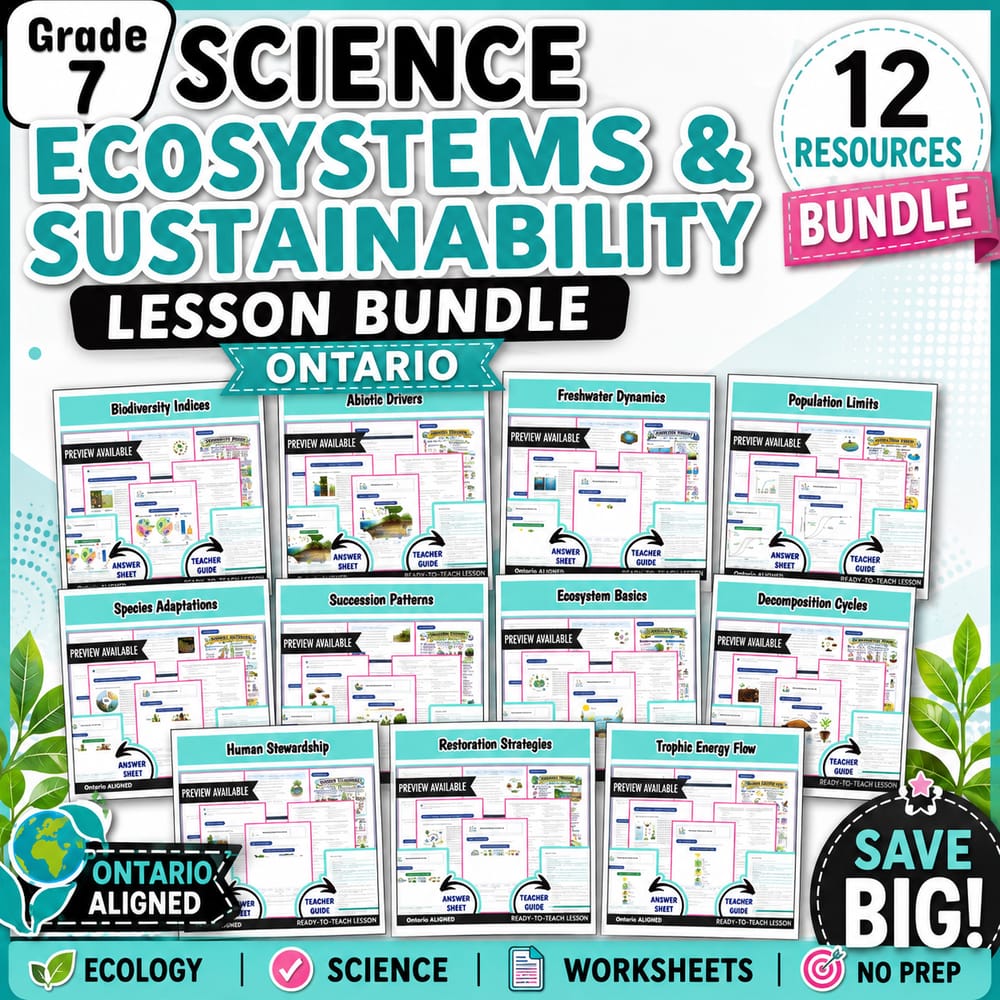
Grade 7 Science Ecosystems & Sustainability Lesson Bundle | Ontario — bundle cover
Grade 7 Science Ecosystems & Sustainability Lesson Bundle | Ontario — included worksheet 1
Grade 7 Science Ecosystems & Sustainability Lesson Bundle | Ontario — included worksheet 2
Grade 7 Science Ecosystems & Sustainability Lesson Bundle | Ontario — included worksheet 3
Grade 7 Science Ecosystems & Sustainability Lesson Bundle | Ontario — included worksheet 4
Grade 7 Science Ecosystems & Sustainability Lesson Bundle | Ontario — included worksheet 5
Grade 7 Science Ecosystems & Sustainability Lesson Bundle | Ontario — included worksheet 6
Grade 7 Science Ecosystems & Sustainability Lesson Bundle | Ontario — included worksheet 7
Grade 7 Science Ecosystems & Sustainability Lesson Bundle | Ontario — included worksheet 8
Grade 7 Science Ecosystems & Sustainability Lesson Bundle | Ontario — included worksheet 9
Grade 7 Science Ecosystems & Sustainability Lesson Bundle | Ontario — included worksheet 10
Grade 7 Science Ecosystems & Sustainability Lesson Bundle | Ontario — included worksheet 11
Grade 7 Science Ecosystems & Sustainability Lesson Bundle | Ontario — included worksheet 12
Grade 7 Science worksheet — Grade 7 Science Ecosystems & Sustainability Lesson Bundle | Ontario

Description

Overview


Grade 7 Science Ecosystems & Sustainability is a classroom-ready, print-only unit worksheet bundle for Ontario science with 12 focused worksheets and PDF answer keys with rubric. Students work through food-chain and habitat foundations, then extend their reasoning to succession, species adaptations, populations, invasive impacts, stewardship, freshwater dynamics, nutrient cycling, and biodiversity.

This Lesson Bundle supports multi-day teaching with a coherent progression: learners start by interpreting ecological relationships, move into modeling and data reasoning, and finish by explaining how biotic and abiotic factors shape ecosystem health over time.

What's Included


  • ✅ Trophic Energy Flow Worksheet Grade 7 Science Food Chains Ontario – Students trace energy transfer through trophic levels to support accurate food chain explanations.
  • ✅ Succession Patterns Worksheet Grade 7 Science | Ontario Curriculum – Students interpret succession stages and connect ecosystem change to observable patterns.
  • ✅ Grade 7 Species Adaptations Worksheet | Ontario Science Activity – Students analyze adaptations and match traits to environmental conditions.
  • ✅ Restoration Strategies Worksheet Grade 7 Science Ecology Activity – Students evaluate restoration options and justify which approach best supports ecosystem recovery.
  • ✅ Population Limits Worksheet | Carrying Capacity & Growth Grade 7 – Students apply limiting factors to predict population growth and identify carrying capacity effects.
  • ✅ Invasive Species Impacts Worksheet Grade 7 Science Ontario Activity – Students examine how invasive species alter native relationships and ecosystem stability.
  • ✅ Human Stewardship Worksheet Grade 7 Science | Ecosystems & Sustainability – Students connect human actions to sustainability goals and propose evidence-based stewardship steps.
  • ✅ Grade 7 Freshwater Dynamics Worksheet | Lakes, Ponds & Turnover – Students use freshwater concepts to explain seasonal turnover and habitat implications.
  • ✅ Ecosystem Basics Worksheet Grade 7 Science | Food Chains & Habitats – Students build foundational ecosystem models that distinguish habitats and food chain roles.
  • ✅ Decomposition Cycles Worksheet | Nutrient Cycling Science Grade 7 – Students sequence decomposition processes and describe how nutrients cycle within ecosystems.
  • ✅ Biodiversity Indices Worksheet | Species Richness & Evenness Grade 7 – Students interpret biodiversity indices and explain what richness and evenness reveal.
  • ✅ Abiotic Drivers Science Worksheet Grade 7 Ontario Ecosystems Activity – Students connect abiotic drivers to ecosystem conditions and predict impacts on organisms.

Skills & Standards


Aligned to Ontario science expectations, Grade 7 Science Ecosystems & Sustainability emphasizes systems thinking through crosscutting concepts such as energy flow, matter cycling, and patterns of change. Students strengthen disciplinary core ideas related to ecology, including how organisms interact within food chains and habitats, how populations respond to limiting factors, and how ecosystems shift through succession and disturbance.

Throughout the bundle, learners practice modeling and analytical reasoning by creating or interpreting simplified ecosystem representations (food-chain energy pathways, succession stages, nutrient cycling sequences) and by using ecological data to support claims. Many activities require evidence-based explanations—students must connect observations (e.g., adaptation traits, biodiversity measures, freshwater turnover effects) to ecological cause-and-effect reasoning. By the end, students demonstrate confidence in explaining how biotic factors (species traits, populations, biodiversity) and abiotic drivers (environmental conditions) work together to influence ecosystem health.

Perfect For


  • Teachers seeking structured instruction
  • Sub plans
  • Homework or review
  • Intervention or centers
  • Assessment preparation

How to Use


Plan for 1–3 weeks of instruction, pacing the bundle so students move from foundational ecosystem relationships into deeper analysis (populations, invasive impacts, stewardship) before applying concepts to nutrient cycling, biodiversity indices, and abiotic drivers.

Use a short warm-up each day (for example, a quick trophic-level prompt or “choose the best explanation” claim) to activate prior learning. Assign guided practice on one worksheet type at a time—then use exit tickets that ask students to justify predictions using at least one ecological term from the unit (e.g., carrying capacity, succession, decomposition, evenness). Finish with an end-of-unit review that combines biodiversity indices and abiotic driver scenarios to support a complete, evidence-based ecosystem explanation.

Closing


Print, teach, assess, and re-teach with ready-to-use worksheets and rubric-supported answer keys that keep your Grade 7 ecology instruction cohesive. ✅

Grade 7 Science Ecosystems & Sustainability Lesson Bundle | Ontario

$48.00$60.00Save $12.00
Chalk and Compass
·5 followers·13 sales
SubjectScienceGradeGrade 7Pages183 Pages

What’s included

12 worksheets · 183 pages · Save $12.00 (20%) · prices shown inside the bundle

  1. Biodiversity Indices Worksheet | Species Richness & Evenness Grade 7
    Biodiversity Indices Worksheet | Species Richness & Evenness Grade 7

    Grade 7 · Science · 15 Pages

    • Explain what species richness and evenness mean and how they contribute to biodiversity
    • Interpret common biodiversity index values when comparing habitats
    • Describe how habitat heterogeneity and niche diversity can affect species turnover
    $4.00$5.00
  2. Abiotic Drivers Science Worksheet Grade 7 Ontario Ecosystems Activity
    Abiotic Drivers Science Worksheet Grade 7 Ontario Ecosystems Activity

    Grade 7 · Science · 15 Pages

    • Identify key abiotic drivers (temperature, light, soil composition, moisture, and pH) and describe how they influence where organisms live.
    • Explain how gradients create environmental templates that affect community structure and species distribution.
    • Use organism tolerance ranges to predict which habitats or microhabitats may support different species.
    $4.00$5.00
  3. Grade 7 Freshwater Dynamics Worksheet | Lakes, Ponds & Turnover
    Grade 7 Freshwater Dynamics Worksheet | Lakes, Ponds & Turnover

    Grade 7 · Science · 16 Pages

    • Describe how stratification, oxygen gradients, and light penetration form in lakes and ponds
    • Explain how abiotic gradients shape community composition and vertical zonation
    • Predict how seasonal turnover changes dissolved oxygen, nutrients, and habitat suitability
    $4.00$5.00
  4. Population Limits Worksheet | Carrying Capacity & Growth Grade 7
    Population Limits Worksheet | Carrying Capacity & Growth Grade 7

    Grade 7 · Science · 16 Pages

    • Distinguish exponential growth from logistic growth using the ideas of limiting factors and carrying capacity.
    • Explain how density-dependent and density-independent factors can affect population size over time.
    • Interpret population growth and carrying-capacity graphs and connect patterns to real environmental causes.
    $4.00$5.00
  5. Grade 7 Species Adaptations Worksheet | Ontario Science Activity
    Grade 7 Species Adaptations Worksheet | Ontario Science Activity

    Grade 7 · Science · 16 Pages

    • Identify and classify structural, physiological, and behavioral adaptations in organisms.
    • Explain how selective pressures (temperature, moisture, predation, and resource availability) can shape adaptations.
    • Analyze how adaptation trade-offs can influence where species can survive and function.
    $4.00$5.00
  6. Succession Patterns Worksheet Grade 7 Science | Ontario Curriculum
    Succession Patterns Worksheet Grade 7 Science | Ontario Curriculum

    Grade 7 · Science · 15 Pages

    • Explain how ecological succession changes a community after disturbance
    • Distinguish primary and secondary succession and identify common stages
    • Describe drivers of succession, including soil development, seed dispersal, competition, and facilitation
    $4.00$5.00
  7. Ecosystem Basics Worksheet Grade 7 Science | Food Chains & Habitats
    Ecosystem Basics Worksheet Grade 7 Science | Food Chains & Habitats

    Grade 7 · Science · 15 Pages

    • Identify biotic and abiotic components of an ecosystem and explain how they affect organisms.
    • Classify organisms as producers, consumers, or decomposers and describe their roles.
    • Explain energy flow from sunlight to organic matter and how matter cycles through ecosystems.
    $4.00$5.00
  8. Decomposition Cycles Worksheet | Nutrient Cycling Science Grade 7
    Decomposition Cycles Worksheet | Nutrient Cycling Science Grade 7

    Grade 7 · Science · 15 Pages

    • Explain how detritivores, fungi, and bacteria break down organic matter and how abiotic factors affect decomposition rates.
    • Describe carbon and nitrogen transformations that occur during decomposition and nutrient cycling.
    • Connect decomposition rate to soil fertility and ecosystem productivity across wetlands, forests, and grasslands.
    $4.00$5.00
  9. Human Stewardship Worksheet Grade 7 Science | Ecosystems & Sustainability
    Human Stewardship Worksheet Grade 7 Science | Ecosystems & Sustainability

    Grade 7 · Science · 15 Pages

    • Summarize how human activities can alter ecosystems, including habitat loss, pollution, resource extraction, and invasive species.
    • Explain how these impacts can change species composition, disrupt ecosystem functions, and reduce long-term resilience.
    • Describe stewardship principles such as mitigation, habitat protection, restoration priorities, and evidence-based monitoring.
    $4.00$5.00
  10. Invasive Species Impacts Worksheet Grade 7 Science Ontario Activity
    Invasive Species Impacts Worksheet Grade 7 Science Ontario Activity

    Grade 7 · Science · 15 Pages

    • Explain how non-native species can harm native ecosystems through competition, altered food webs, and habitat changes.
    • Describe common pathways for how invasive species are introduced and why some become established.
    • Evaluate how long-term ecological and economic effects increase management needs.
    $4.00$5.00

Reviews & Feedback

Loading reviews...

Questions & Answers

Loading questions…

About this bundle

Related categories

Frequently asked questions

Who is Grade 7 Science Ecosystems & Sustainability Lesson Bundle | Ontario designed for?
Grade 7 Science Ecosystems & Sustainability Lesson Bundle | Ontario is designed for Grade 7 students and Science learners and can be used in classrooms, homeschool, or independent practice.
How do I download Grade 7 Science Ecosystems & Sustainability Lesson Bundle | Ontario?
Add it to your cart and complete checkout. After payment, you can download immediately from your account, and you'll also receive a download link by email.