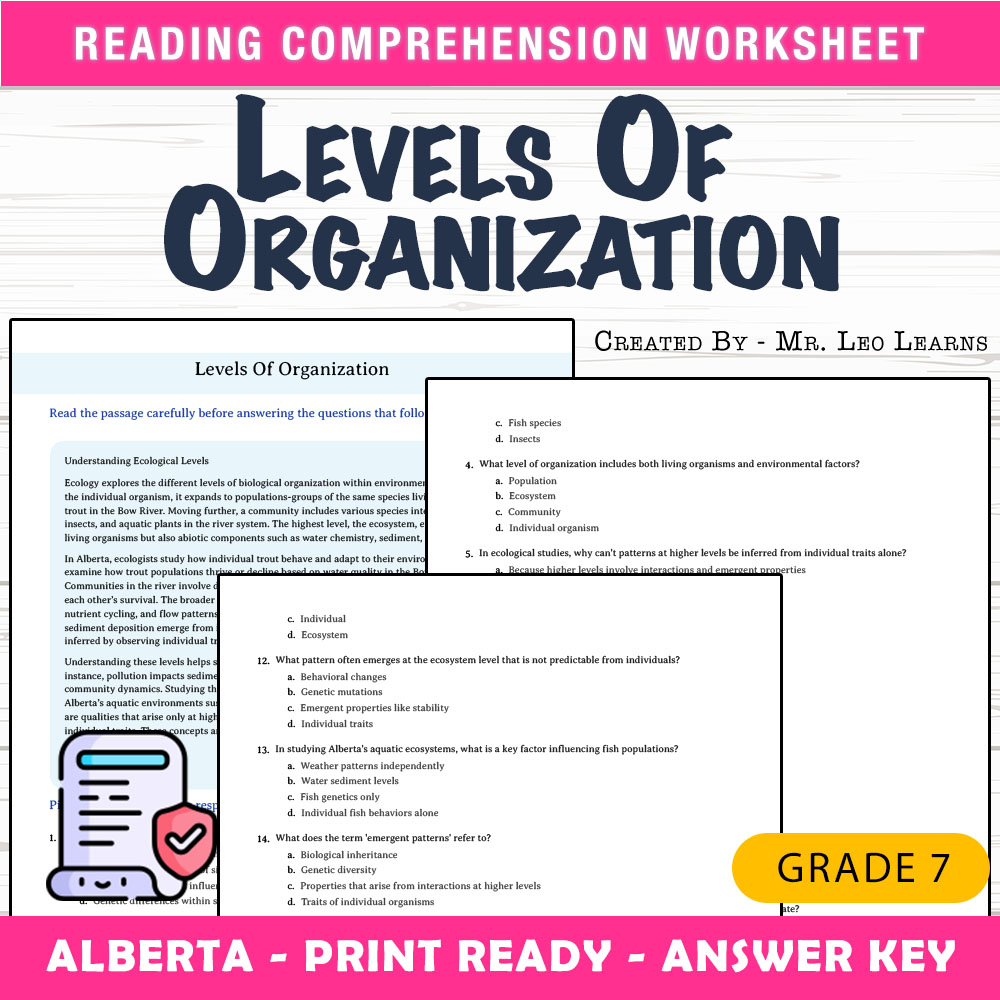
Imagine walking into your classroom and seeing students quietly focused on a worksheet that helps them understand the complex concept of biological levels of organization. Perhaps they’re referring to diagrams, answering multiple-choice questions, or reviewing their responses after completing the activity. This worksheet provides a straightforward, print-and-go resource that guides students through the various levels, from cells to ecosystems, with a focus on building clarity and understanding.
What This Resource Helps Students Do
This worksheet is designed to support students in mastering the key concepts of biological hierarchy within ecosystems. It includes a reading passage that introduces the different levels of organization—cells, tissues, organs, organ systems, organisms, populations, communities, and ecosystems—encouraging students to grasp how these levels relate to one another. The multiple-choice questions reinforce this understanding by prompting students to identify examples, differentiate levels, and comprehend the importance of each component in environmental contexts specific to Alberta. It encourages independent thinking, builds confidence in scientific terminology, and provides practice in analyzing ecological relationships.
Inside the PDF
• A comprehension-based reading passage about ecological levels
• 25 multiple-choice questions focused on key concepts
• Clear, printable format that requires no additional preparation
• PDF answer key with rubric for quick assessment
• Designed layout for easy photocopying and classroom use
How It Improves Learning
This worksheet supports learners by clearly articulating the different levels of biological organization, helping students connect abstract concepts with real-world examples. The reading passage offers context that deepens understanding, while the multiple-choice questions reinforce comprehension and critical thinking. As students work through the questions, they develop their ability to distinguish between levels, such as populations versus communities, which enhances their overall scientific literacy. The alignment of questions with Alberta standards ensures targeted learning, and the answer key provides a quick means for teachers to evaluate progress, boosting confidence in assessment. The straightforward format minimizes confusion, allowing students to focus on mastering content rather than navigating complex instructions.
Core Skills Students Will Develop
- ➡️ Understanding biological levels of organization
- ➡️ Identifying ecological examples
- ➡️ Differentiating between populations, communities, and ecosystems
- ➡️ Engaging in critical thinking about ecological relationships
Ways Teachers Use This Worksheet
This resource can be used as a classwork activity to introduce or review ecological concepts, assigned as homework to reinforce lessons, or utilized for small-group practice sessions. It also serves well as an assessment tool to gauge students’ understanding after instruction or as an early finisher activity for students who complete their work early. In addition, the worksheet can be incorporated into review sessions before tests or used in informal quizzes to monitor progress over time.
Why This PDF Saves Time
This ready-to-print worksheet streamlines lesson planning by providing a complete, well-organized resource that requires no additional prep. Its clear layout ensures that students can work independently without confusion, saving teachers valuable time during busy days. The included answer key allows for quick feedback and assessment, maintaining consistency and fairness across different classes or groups. Designed for immediate classroom use, this PDF eliminates the need for creating questions from scratch, giving teachers a reliable tool that’s easy to implement.
With this worksheet, you’re equipped with a practical, classroom-ready resource to support teaching about ecological levels. It helps students build confidence in their understanding of complex scientific concepts while fitting seamlessly into your lesson plans. Simply print, distribute, and watch your students engage with the material effectively! 😊