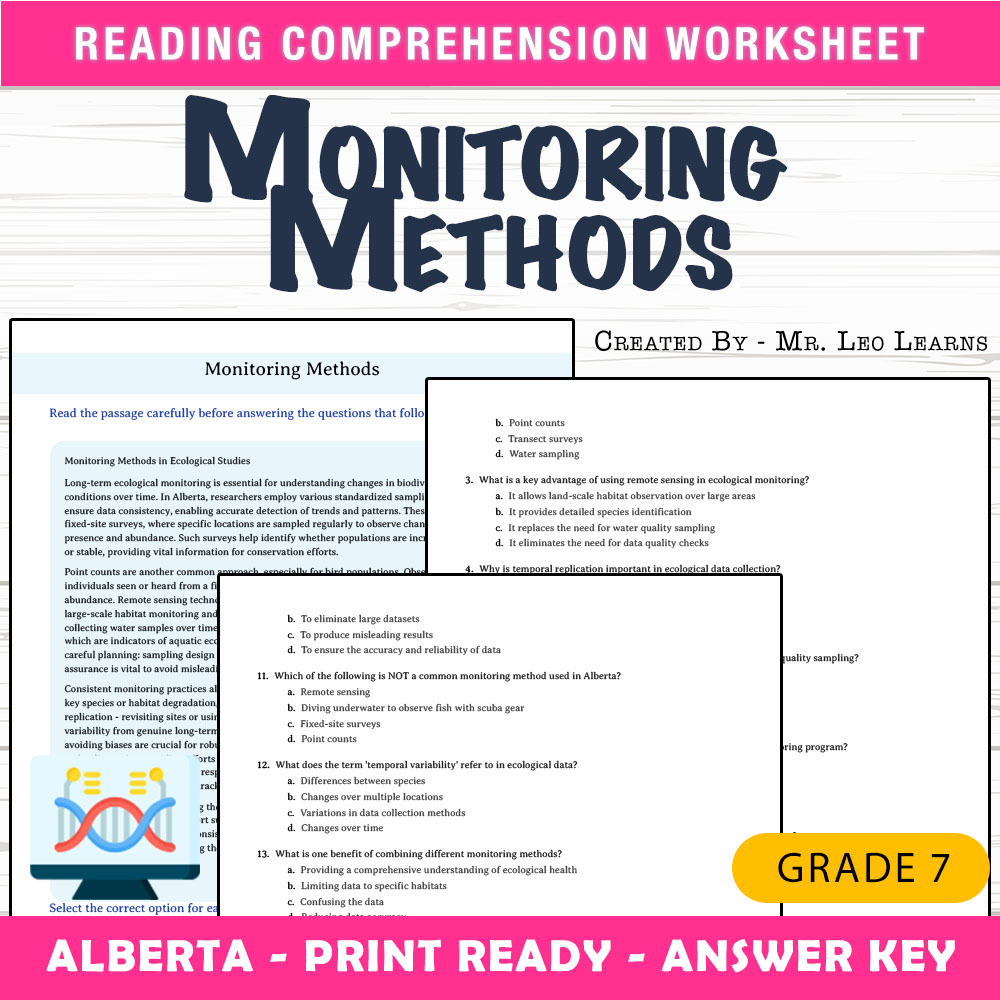
Imagine your classroom filled with curious students eager to understand how scientists monitor ecosystems over time. They read a passage about ecological monitoring methods and then answer multiple-choice questions that help them evaluate their understanding of key concepts. This worksheet provides a structured and straightforward way for students to practice and reinforce their knowledge about monitoring techniques such as fixed-site surveys and recording bird species. It supports independent review and helps clarify complex ideas through focused questions, making it easier for learners to grasp the importance of long-term ecological data collection.
What This Resource Helps Students Do
This worksheet guides students through the essential aspects of ecological monitoring methods. By reading a short passage and then engaging with multiple-choice questions, learners deepen their understanding of why monitoring is crucial for assessing biodiversity and habitat changes. The questions challenge students to think critically about different techniques used in ecological studies and connect theoretical concepts to real-world applications. This resource builds confidence in interpreting scientific information and improves their ability to analyze monitoring data. It encourages active engagement and reinforces comprehension through focused, practice-oriented questions that gradually develop their scientific reasoning skills.
Inside the PDF
• A reading passage about ecological monitoring methods
• 25 multiple-choice questions to assess understanding
• A print-ready format designed for immediate classroom use
• Clear layout for easy photocopying and distribution
How It Improves Learning
This worksheet supports learning by presenting information in a logical, easy-to-follow sequence that helps students build their understanding step-by-step. The initial reading passage introduces key concepts in a clear manner, setting a solid foundation. The subsequent multiple-choice questions serve as checkpoints, encouraging students to apply what they've learned and think critically about ecological monitoring methods. The variety of questions prompts students to analyze scenarios, recall facts, and connect ideas, all of which reinforce retention. As students rotate through reading and questioning, they gain confidence in interpreting scientific data, which improves their overall comprehension of ecology and field techniques. This structured approach helps reduce confusion and guides learners toward mastery with clarity and purpose.
Core Skills Students Will Develop
- ➡️ Understanding ecological monitoring techniques and their purposes
- ➡️ Critical thinking and data interpretation skills
- ➡️ Reading comprehension for scientific passages
- ➡️ Application of ecological concepts to real-world scenarios
Ways Teachers Use This Worksheet
This worksheet is a versatile tool that can be used in various ways to support student learning. It works well as a classwork assignment, providing an engaging activity during lessons on ecology and environmental science. It can also serve as homework to reinforce concepts introduced in class, or as a formative assessment to gauge student understanding. Teachers may use it for small-group activities, encouraging discussion and collaborative analysis of ecological methods. Additionally, the worksheet supports early finishers by offering a meaningful activity that consolidates learning without requiring additional preparation. Its adaptable format makes it suitable for review sessions, assessments, or as part of a larger unit on environmental science.
Why This PDF Saves Time
This resource arrives in a print-and-go format, eliminating prep time for teachers. The clear layout makes photocopying simple and efficient, ensuring consistency across lessons. The included answer key with rubric simplifies grading and provides quick feedback, freeing teachers to focus on instruction and student support. Its ready-to-use design means you can distribute this worksheet immediately, saving time and effort while maintaining high-quality student engagement. This practical tool helps ensure lessons are thorough, organized, and efficient—making your teaching experience smoother and more effective.
End your teaching session with confidence knowing this worksheet is classroom-ready, supports diverse learning needs, and encourages students to develop a solid understanding of ecological monitoring methods. Quick to print and easy to implement, it is designed to help students succeed with clarity and confidence. 😊