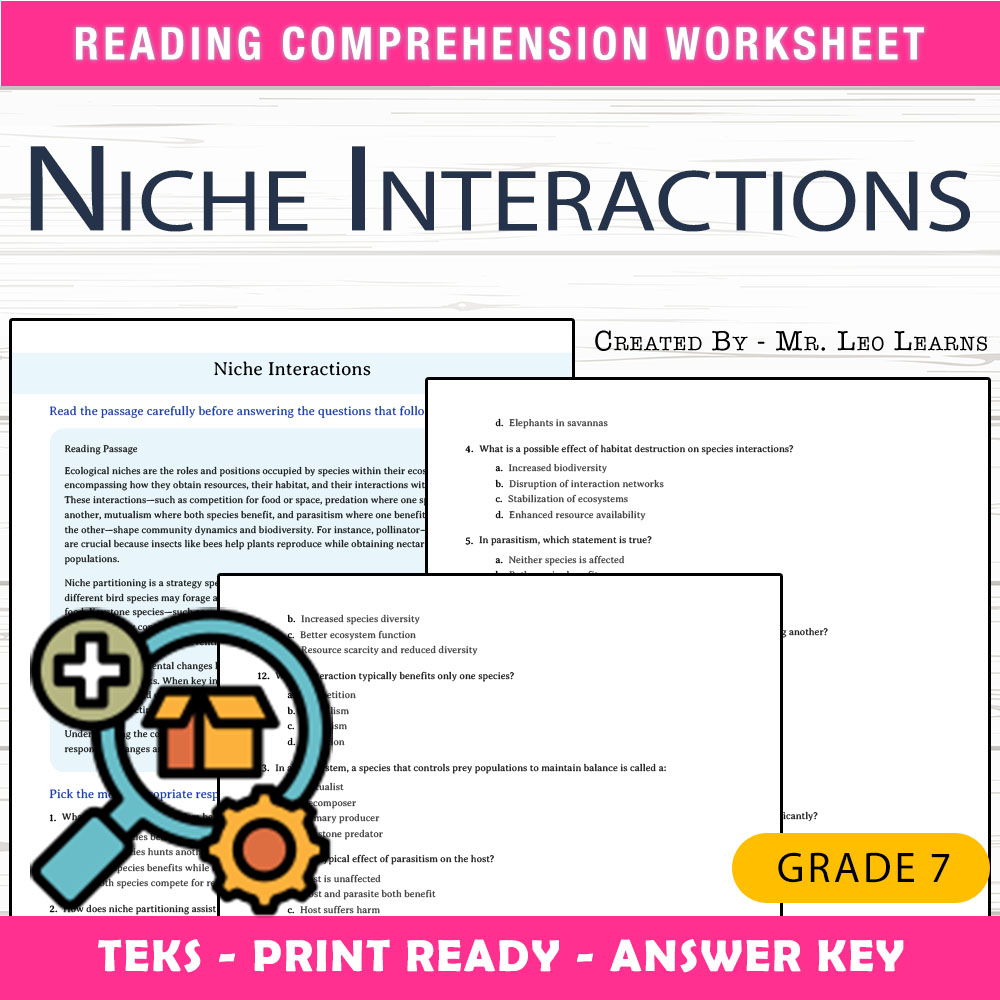
Imagine your students exploring the complex web of life in your classroom. As they delve into the topic of ecological niches, they often find it challenging to fully grasp how different species coexist and interact within their environments. This worksheet provides a straightforward, print-ready resource that guides students through understanding niche roles, mutualism, niche partitioning, and other key ecological interactions. Designed to support comprehension, this worksheet helps clarify these concepts with a combination of reading passages and focused multiple-choice questions, making complex ideas more accessible.
What This Resource Helps Students Do
This worksheet actively supports students in understanding the roles and interactions of species within ecosystems. It encourages critical thinking by prompting students to analyze scenarios, interpret passage-based questions, and apply their knowledge to specific ecological principles. Through step-by-step reading comprehension and targeted multiple-choice questions, students build confidence in identifying relationships such as mutualism and niche partitioning. The format provides structure for independent practice, reinforcing learning outside of direct instruction and helping students retain key concepts in ecology.
Inside the PDF
• A detailed reading passage explaining ecological niches and species interactions
• 25 multiple-choice questions focused on key ecological concepts
• A printable, ready-to-use format that minimizes preparation time
• Clear layout designed for easy photocopying and classroom distribution
• Includes a comprehensive answer key with rubric for quick assessment
How It Improves Learning
This worksheet enhances learning by providing clear, structured content that guides students from basic understanding to more complex application of ecological concepts. The reading passage offers foundational knowledge in a concise, student-friendly format, setting the stage for deeper engagement. Multiple-choice questions reinforce critical thinking skills, encouraging students to interpret information accurately and analyze real-world scenarios. The use of a rubric in the answer key helps teachers assess student understanding consistently. Overall, this resource builds student confidence, sharpens reasoning, and ensures mastery of ecological interactions, making the abstract concepts more tangible and memorable.
Core Skills Students Will Develop
- ➡️ Reading comprehension of scientific passages
- ➡️ Understanding species interactions in ecosystems
- ➡️ Applying ecological concepts to real-world scenarios
- ➡️ Critical thinking and analytical reasoning
Ways Teachers Use This Worksheet
This worksheet can be effectively incorporated into various classroom activities. It works well for independent classwork, homework assignments, or review sessions after instruction. Teachers often utilize it for small-group discussions to reinforce ecological concepts or as an assessment tool to gauge student understanding. It also suits early finishers or as a reinforcement exercise following lessons on ecosystems and biodiversity, providing a versatile resource for busy classrooms seeking to deepen student understanding of ecological niches and species interactions.
Why This PDF Saves Time
The printable PDF format ensures that teachers can easily distribute this resource without any preparation. Its straightforward, ready-to-print layout minimizes the need for additional materials or customization. This resource provides a reliable, consistent tool for classroom use, eliminating the time spent designing assessments and enabling teachers to focus more on instructional engagement. With a clear answer key built-in, grading becomes quicker and more efficient, helping teachers maintain a smooth and organized workflow.
Overall, this practical worksheet is designed to support your teaching of ecological interactions in a clear, accessible way. It’s ready to print and use immediately, helping your students build confidence and mastery in understanding vital scientific concepts. 😊