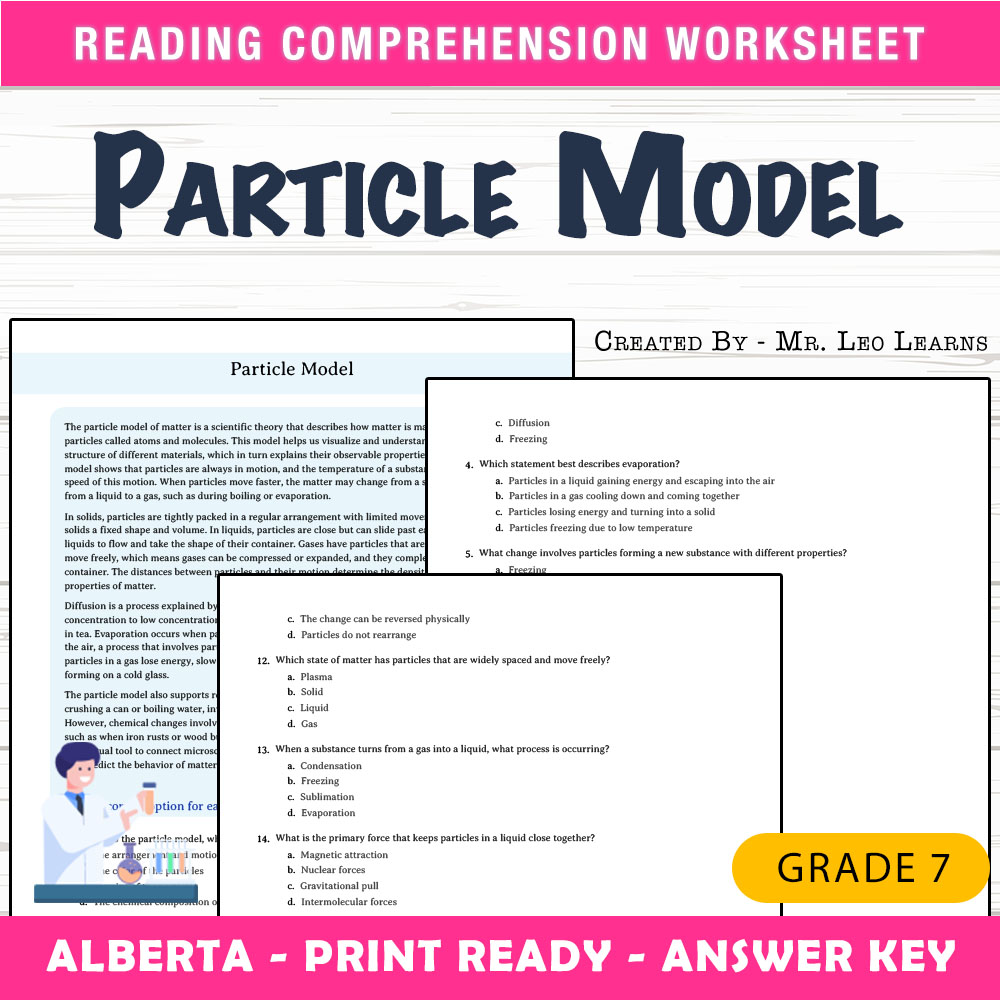
Imagine standing at the front of your classroom, watching students pore over their science textbooks, some looking puzzled as they try to grasp the concept of the particle model of matter. Many students struggle to translate abstract ideas into clear understanding, especially when describing how particles behave in different states of matter. This worksheet provides a straightforward, structured approach to help clarify these complex ideas through a series of multiple-choice questions that reinforce key concepts. It offers an easy-to-use, print-ready resource designed to consolidate student learning and promote independent practice, making it an effective tool for classroom instruction.
What This Resource Helps Students Do
This worksheet guides students step-by-step through understanding the particle model of matter, helping them connect theoretical descriptions with real-world examples. The questions encourage students to analyze how particles behave in solids, liquids, and gases, fostering critical thinking and scientific reasoning. By working through the multiple-choice questions, students build confidence in identifying particle arrangements and properties that define each state. The worksheet also promotes mastery of vocabulary and concepts essential for deeper science understanding, making it suitable for review, reinforcement, or assessment preparation.
Inside the PDF
• 25 structured questions designed for gradual learning
• A print-ready format that requires no additional preparation
• PDF answer key with rubric that facilitates quick grading
• Layout optimized for easy photocopying and classroom use
How It Improves Learning
This worksheet enhances student understanding by providing clear, targeted questions that reinforce fundamental concepts about the particle model. The multiple-choice format helps students recognize correct ideas and common misconceptions, encouraging independent reasoning. The concise questions challenge students to apply what they've learned to different scenarios, promoting deeper cognitive engagement. The answer key allows teachers to offer immediate, consistent feedback, supporting ongoing learning and mastery. Overall, this resource helps turn abstract theories into concrete understanding, empowering students with the vocabulary and reasoning skills they need in science.
Core Skills Students Will Develop
- ➡️ Scientific reasoning and analysis
- ➡️ Understanding states of matter and particle behavior
- ➡️ Vocabulary development related to the particle model
- ➡️ Critical thinking and applying scientific concepts
Ways Teachers Use This Worksheet
This worksheet is a versatile classroom resource that can be used in a variety of ways. It makes an excellent activity for classwork to assess understanding after a teaching session or as homework to reinforce learning at home. Teachers also incorporate it into review sessions prior to assessments, or as part of small-group work to target students needing extra support. Additionally, it serves as an effective tool for early finishers to deepen their grasp of the particle model or for formative assessments to gauge student progress. Its straightforward, print-and-go format makes it easy to incorporate into any lesson plan without additional prep.
Why This PDF Saves Time
Designed for immediate use, this PDF provides a ready-to-print worksheet that minimizes preparation time. The clear layout makes photocopying quick and seamless, ensuring that teachers spend less time on formatting or customization. The included answer key with rubric makes grading consistent and efficient, saving valuable time during assessments. Because the worksheet covers essential concepts in a structured way, teachers can rely on it as a dependable resource for review, formative assessment, or independent practice, reducing the need to create comparable materials from scratch.
Overall, this worksheet is a practical, classroom-ready tool that simplifies teaching science concepts related to matter, enhances student confidence, and supports consistent assessment. It’s an easy way to reinforce learning, develop core skills, and foster a deeper understanding of the particle model—an essential component of middle school science education. 😊