
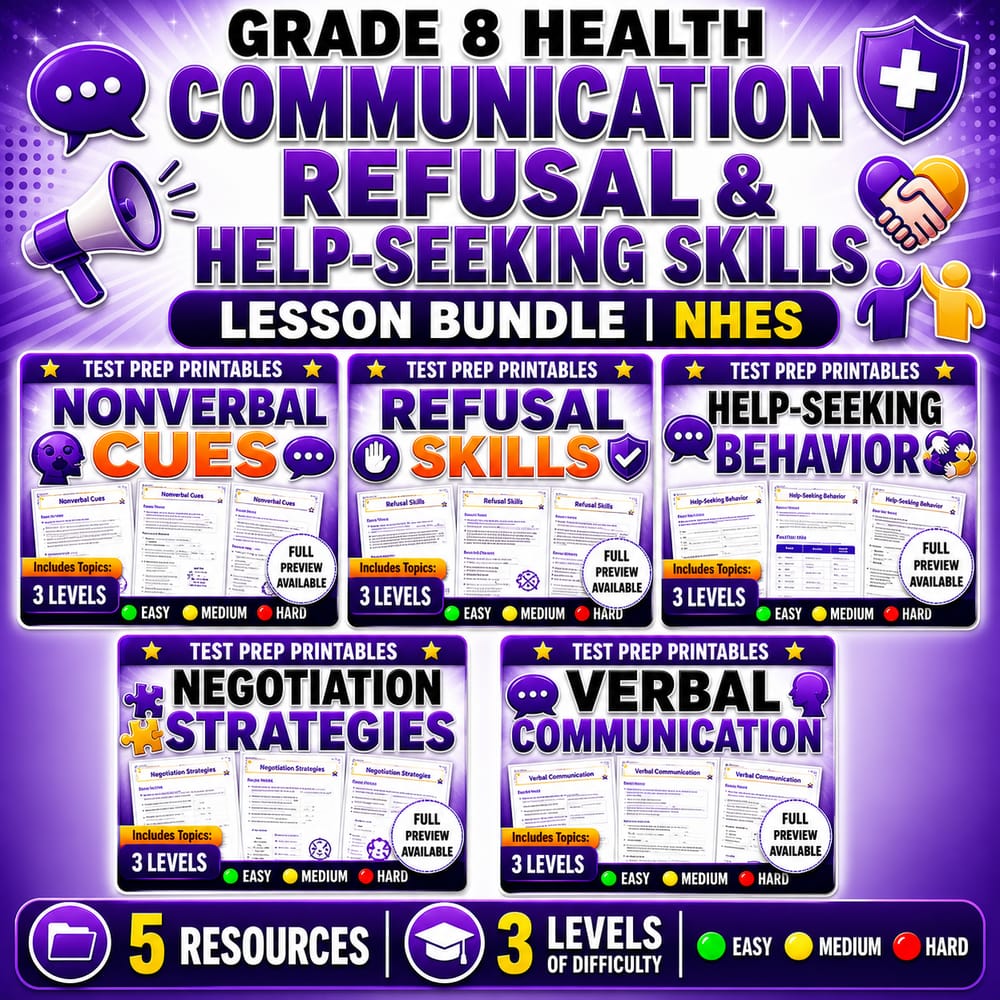
Grade 8 Health Communication, Refusal & Help-Seeking Skills Lesson Bundle | NHES
$20.00$25.00Save $5.00
Prism Point Learning
·2 followers·14 sales
SubjectHealthGradeGrade 8Pages150 Pages
What’s included
5 worksheets · 150 pages · Save $5.00 (20%) · prices shown inside the bundle
 Grade 8 Health Nonverbal Cues Worksheet | Communication Skills NHES
- Explain how facial expressions, gestures, posture, and eye contact can communicate emotions and attitudes.
- Identify when nonverbal cues match or contradict spoken words in common conversation scenarios.
- Use nonverbal awareness to improve understanding and reduce miscommunication.
$4.00$5.00 Refusal Skills Worksheet Grade 8 Health | NHES Decision Making
- Explain what refusal skills are and when using them is necessary for safety and well-being.
- Practice respectful refusal with clear verbal messages and helpful body language.
- Identify effective responses to peer pressure and risky requests in social situations.
$4.00$5.00 Help Seeking Behavior Health Worksheet Grade 8 | NHES Activity
- Identify situations where help is needed for health and safety.
- Use clear, respectful communication to ask trusted people for support.
- Recognize reliable sources of help and explain why support matters.
$4.00$5.00 Grade 8 Health Negotiation Strategies Worksheet | NHES Skills Activity
- Explain how calm tone, active listening, and compromise support successful negotiation.
- Identify common strategies that help people resolve disagreements respectfully.
- Apply negotiation steps to a personal or community conflict scenario.
$4.00$5.00 Verbal Communication Skills Worksheet Grade 8 Health | NHES Activity
- Explain how tone, clarity, and word choice affect verbal communication in different situations.
- Interpret verbal cues to understand the message a speaker is trying to send.
- Apply respectful speaking strategies when sharing opinions, asking for help, or discussing disagreements.
$4.00$5.00
Reviews & Feedback
Loading reviews...
Questions & Answers
Loading questions…
About this bundle
Related categories
Frequently asked questions
Who is Grade 8 Health Communication, Refusal & Help-Seeking Skills Lesson Bundle | NHES designed for?
Grade 8 Health Communication, Refusal & Help-Seeking Skills Lesson Bundle | NHES is designed for Grade 8 students and Health learners and can be used in classrooms, homeschool, or independent practice.
How do I download Grade 8 Health Communication, Refusal & Help-Seeking Skills Lesson Bundle | NHES?
Add it to your cart and complete checkout. After payment, you can download immediately from your account, and you'll also receive a download link by email.
Similar Products

Grade 11 Refusal & Communication Health Lesson Bundle Worksheets - NHES
$16.00$20.00

Grade 12 Health Lesson Bundle | Interpersonal Communication Skills NHES
$12.00$15.00

Grade 3 Interpersonal Communication Skills Health Lesson Bundle | NHES
$9.60$12.00

Grade 6 Health Communication & Refusal Skills Lesson Bundle | NHES
$16.00$20.00

Grade 11 Health | Interpersonal Communication Skills Unit Bundle (NHES Aligned)
$12.00$15.00