
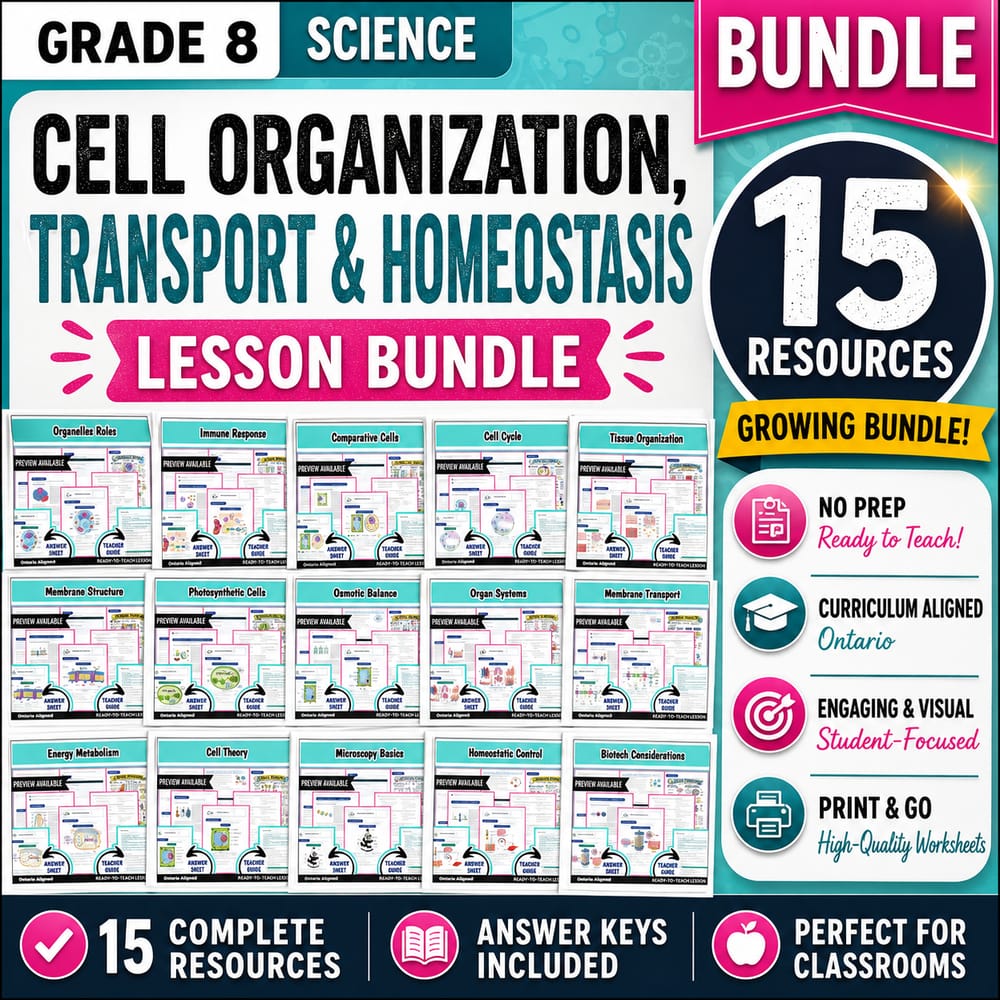


Grade 8 Science Cell Organization, Transport & Homeostasis Lesson Bundle – Ontario
$60.00$75.00Save $15.00
Chalk and Compass
·5 followers·13 sales
SubjectScienceGradeGrade 8Pages226 Pages
What’s included
15 worksheets · 226 pages · Save $15.00 (20%) · prices shown inside the bundle
 Grade 8 Science Organelles Roles Worksheet | Cell Organelles Ontario
- Explain how major cell organelles contribute to energy conversion, protein synthesis, and material transport.
- Describe the interdependence of organelles by linking structure to function.
- Predict how organelle dysfunction can affect overall cell performance.
$4.00$5.00 Grade 8 Immune Response Worksheet | Ontario Science + Doodle Notes Pack
- Explain how innate and adaptive immune responses work together to defend the body
- Describe key immune cells and their roles, including macrophages, neutrophils, and lymphocytes
- Distinguish between phagocytosis, antibody production, and cell-mediated cytotoxicity
$4.00$5.00 Grade 8 Comparative Cells Worksheet | Ontario Science Cell Structure Activity
- Compare plant and animal cell structures and explain how those structures affect cell functions.
- Contrast prokaryotic and eukaryotic cellular organization and relate differences to metabolic capabilities.
- Use cellular features (e.g., chloroplasts, vacuoles, centrioles, lysosomes, cell walls) to describe adaptation to roles such as photosynthesis and motility.
$4.00$5.00 Grade 8 Cell Cycle Worksheet | Ontario Science Doodle Notes & Guide
- Explain the main phases of the cell cycle, including interphase, mitosis, and cytokinesis.
- Describe how DNA replication and chromosome segregation help maintain genetic information.
- Identify how cyclins, kinases, and checkpoint mechanisms regulate the cell cycle.
$4.00$5.00 Grade 8 Tissue Organization Worksheet | Ontario Science Doodle Notes
- Identify the four major tissue types (epithelial, connective, muscle, nervous) and describe their key structural features.
- Explain how the structure of tissues and cell junctions relates to their functions in the body.
- Connect tissue organization to organ-level outcomes such as transport, movement, signal transmission, and structural support.
$4.00$5.00 Grade 8 Membrane Structure Worksheet | Ontario Science Cells Activity Pack
- Describe the components of cell membranes, including the phospholipid bilayer, proteins, cholesterol, and carbohydrates.
- Explain how membrane proteins help with transport, signaling, and structural support.
- Compare how membrane composition affects permeability and cell interactions with the extracellular environment.
$4.00$5.00 Grade 8 Photosynthetic Cells Worksheet | Chloroplasts, Doodle Note & Guide
- Describe chloroplast structure and identify where light-dependent reactions and the Calvin cycle occur
- Explain how the production of ATP and NADPH supports carbon fixation and biomass synthesis
- Compare photosynthetic capacity between different plant cell types and algal cells and predict how environment affects photosynthesis
$4.00$5.00 Grade 8 Osmotic Balance Worksheet | Ontario Science + Doodle Notes
- Explain how water potential and tonicity determine the direction of water movement across cell membranes.
- Compare how plant and animal cells respond to hypotonic, isotonic, and hypertonic environments.
- Describe how osmoregulatory mechanisms help maintain cellular survival in changing environments.
$4.00$5.00 Grade 8 Organ Systems Worksheet | Ontario Science Doodle Notes & Teacher Guide
- Explain how specialized tissues work together to form organs that perform specific functions in organ systems.
- Describe how transport mechanisms and surface area support efficient gas exchange and nutrient distribution.
- Connect epithelial interfaces and blood to how wastes are removed from the body.
$4.00$5.00 Grade 8 Membrane Transport Worksheet | Diffusion, Osmosis & Active Transport
- Explain how diffusion, osmosis, facilitated diffusion, and active transport move substances across cell membranes.
- Distinguish passive from active transport using concentration gradients, carrier proteins, and energy use.
- Describe how surface area, concentration gradient, and membrane properties affect the rate of net transport.
$4.00$5.00
Reviews & Feedback
Loading reviews...
Questions & Answers
Loading questions…
About this bundle
Related categories
Frequently asked questions
Who is Grade 8 Science Cell Organization, Transport & Homeostasis Lesson Bundle – Ontario designed for?
Grade 8 Science Cell Organization, Transport & Homeostasis Lesson Bundle – Ontario is designed for Grade 8 students and Science learners and can be used in classrooms, homeschool, or independent practice.
How do I download Grade 8 Science Cell Organization, Transport & Homeostasis Lesson Bundle – Ontario?
Add it to your cart and complete checkout. After payment, you can download immediately from your account, and you'll also receive a download link by email.
Similar Products

Grade 8 Cell Organization & Homeostasis Science lesson bundle: Ontario
$60.00$75.00

Grade 8 Science Organ Systems & Cells Lesson Bundle | NGSS
$12.00$15.00

Grade 8 Cell Structure & Homeostasis Science Lesson Bundle (Ontario)
$48.00$60.00

Grade 8 Science Lesson Bundle on Molecules, Cells, and Organ Systems
$12.00$15.00

Grade 7 Cellular and Organ Systems Science Lesson Bundle: NGSS Practice
$20.00$25.00