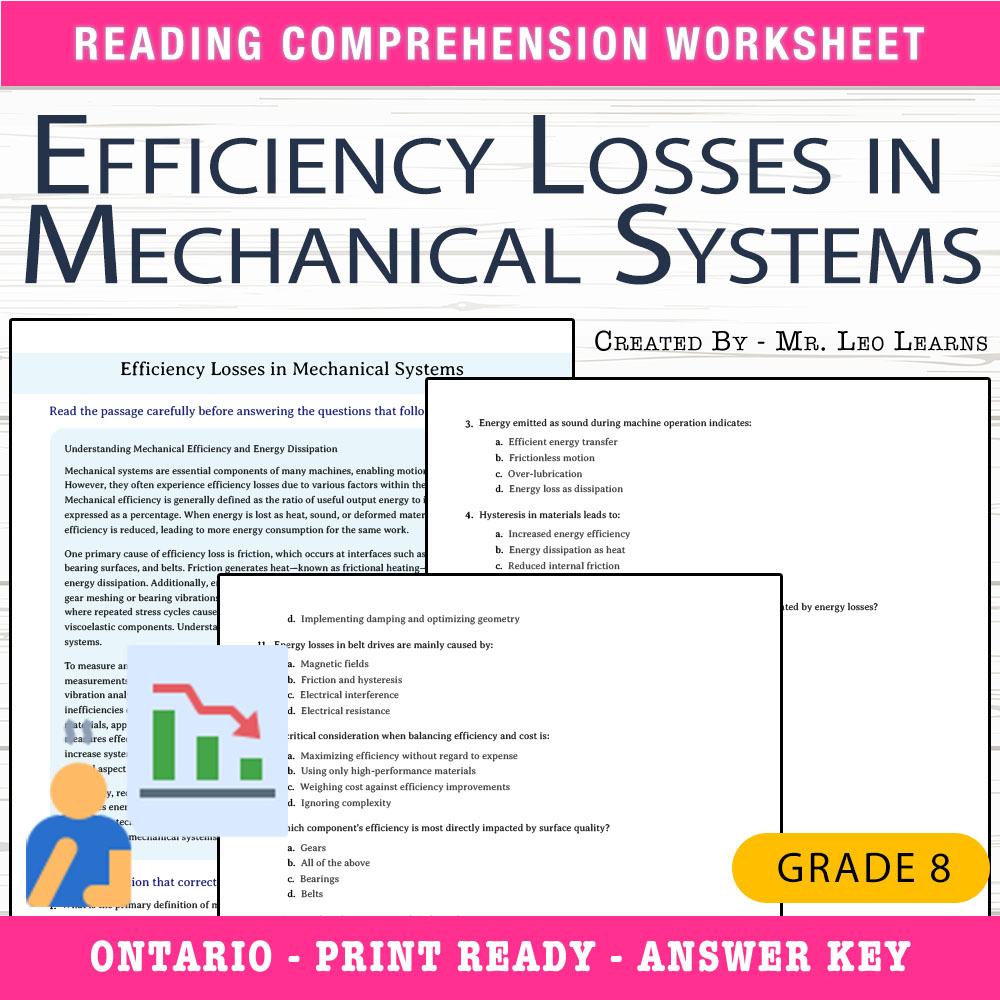
Imagine walking into your classroom and seeing students engaged with a thought-provoking question about how mechanical systems transfer energy and why some methods lead to efficiency losses. Many students struggle to grasp the concept of energy dissipation in machines, which can cause confusion and hinder their understanding of real-world applications. This worksheet offers a straightforward, print-and-go resource designed to clarify these ideas, helping students develop a deeper understanding of how efficiency impacts mechanical systems and their performance.
What This Resource Helps Students Do
This worksheet guides students through the core concepts of mechanical efficiency and energy losses in systems such as gears, pulleys, and engines. It encourages critical thinking through a reading passage that introduces key ideas, followed by multiple-choice questions that reinforce understanding. Students are supported to analyze how energy is transferred and where most losses occur, gradually building their confidence to explain these processes independently. The activities promote skill-building in scientific reasoning, comprehension of technical terminology, and application of concepts to real-world examples. With this worksheet, students gain clarity on why mechanical systems sometimes operate less efficiently, and they learn to identify sources of energy dissipation in various machines.
Inside the PDF
• 25 structured questions designed for step-by-step understanding
• A print-ready format that requires no preparation
• PDF answer key with rubric for quick assessment
• Layout optimized for easy photocopying and classroom use
How It Improves Learning
This worksheet enhances learning by breaking down complex concepts into manageable sections, making it easier for students to grasp technical ideas. The reading passage provides context and clarity, helping learners understand the significance of efficiency in mechanical systems. The multiple-choice questions reinforce key points, allowing students to check their understanding and make connections between theory and application. As students work through the questions, they practice critical thinking and reasoning, which strengthens their ability to analyze mechanical processes more confidently. The clear layout and well-structured questions support independent learning, enabling students to revisit concepts at their own pace. Teachers will appreciate how this resource offers a reliable, consistent tool to assess understanding, review lessons, or reinforce key ideas without extensive prep time.
Core Skills Students Will Develop
- ➡️ Understanding theoretical concepts of energy transfer
- ➡️ Identifying sources of energy dissipation
- ➡️ Analyzing the impact of efficiency on machinery
- ➡️ Applying scientific terminology accurately
Ways Teachers Use This Worksheet
This worksheet is a versatile resource that can be used as part of classroom lessons, for homework assignments, or during review sessions. It is an excellent tool for small-group practice or independent work, especially for students who need extra support understanding energy losses in mechanical systems. Teachers can also utilize it for quick formative assessments or as a reinforcement activity after a lesson on mechanical efficiency. Its print-and-go format makes it easy to incorporate into daily instruction, and it helps ensure all students engage with the material in a clear, structured way.
Why This PDF Saves Time
This resource eliminates the need for lengthy prep, offering a ready-made worksheet that can be printed and distributed immediately. The clear layout and straightforward question sets promote consistency in assessment and review, saving valuable instructional time. With the included answer key, teachers can quickly gauge student understanding and provide feedback without having to create additional materials or spend extra time grading complex responses. It’s a dependable, efficient tool that supports effective classroom instruction right out of the box.
Designed to be student-friendly and teacher-ready, this worksheet is a practical solution for enhancing understanding of mechanical systems and efficiency losses. It helps students develop essential skills, confidence, and critical thinking, all while fitting seamlessly into your existing curriculum. Simply print and use—ready to support successful learning in your classroom today! 😊