
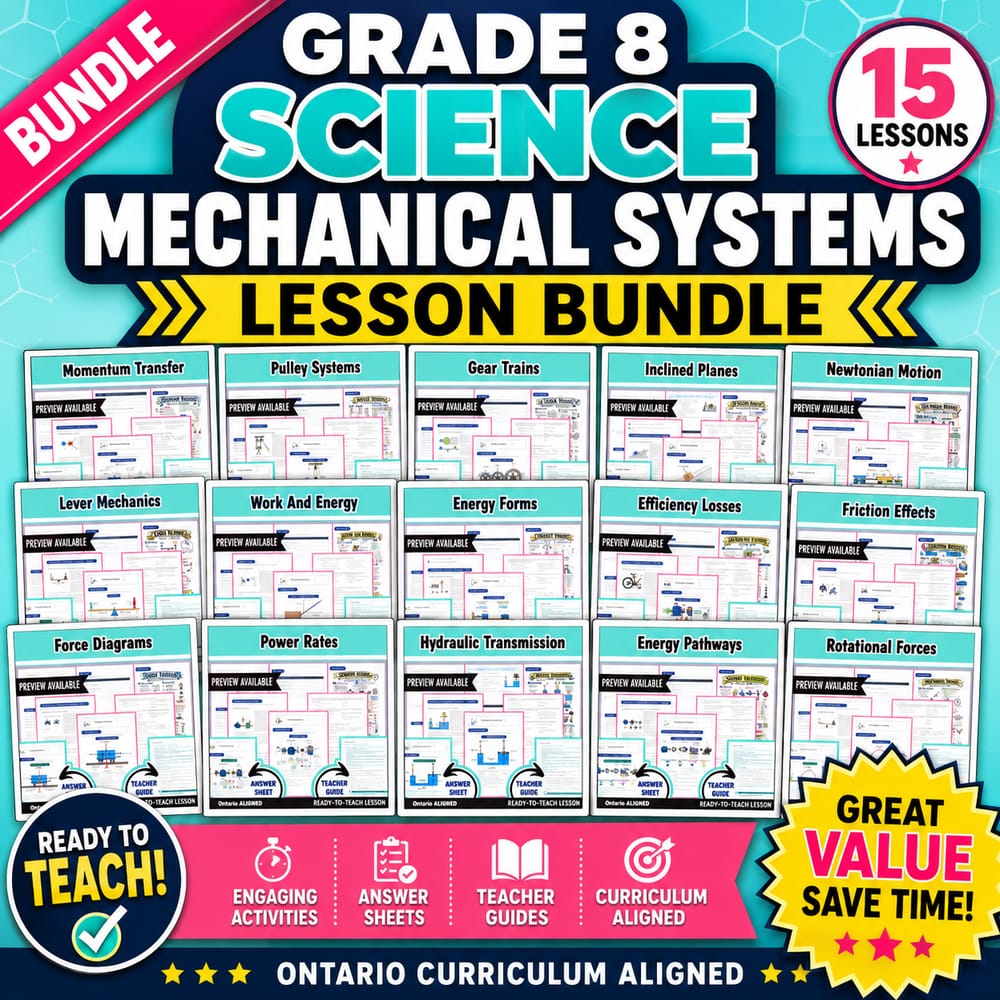


Grade 8 Science Mechanical Systems Lesson Bundle | Ontario
$60.00$75.00Save $15.00
Chalk and Compass
·5 followers·13 sales
SubjectScienceGradeGrade 8
What’s included
15 worksheets · Save $15.00 (20%) · prices shown inside the bundle
 Grade 8 Momentum Transfer Worksheet | Collisions, Impulse & Ontario Science
- Explain linear momentum and impulse in terms of collisions and interactions.
- Use conservation of momentum to predict post-interaction velocities in classroom-scale systems.
- Distinguish elastic vs. inelastic collisions using momentum and kinetic energy ideas.
$4.00$5.00 Grade 8 Pulley Systems Worksheet | Ontario Science Simple Machines Activity
- Identify and compare fixed, movable, and compound pulley arrangements in terms of effort direction and mechanical advantage
- Calculate ideal mechanical advantage from the number of supporting rope segments and explain how real-world losses reduce performance
- Describe how rope tension is distributed across multiple pulley segments and how input force relates to load and displacement
$4.00$5.00 Grade 8 Gear Trains Worksheet | Gear Ratio, Torque & Ontario Science
- Explain how gear ratio connects the angular velocity of driving and driven gears
- Describe torque multiplication and the speed trade-off in simple and compound gear trains
- Identify how idler gears change direction without changing the overall gear ratio
$4.00$5.00 Grade 8 Inclined Planes Worksheet | Mechanical Advantage Science Ontario
- Explain how an inclined plane changes the direction and magnitude of the force needed to move a load using force components.
- Calculate ideal mechanical advantage (IMA) using the ratio of slope length to height.
- Describe how friction affects the required input force compared with ideal conditions.
$4.00$5.00 Grade 8 Newtonian Motion Worksheet | Ontario Science Forces & Motion
- Explain Newton’s three laws using cause-and-effect language between forces and motion.
- Use F = ma to relate force, mass, and acceleration in simple one- and two-object systems.
- Apply inertia and action–reaction pairs to everyday mechanical examples and identify common assumptions.
$4.00$5.00 Grade 8 Lever Mechanics Worksheet | Simple Machines Science Activity Ontario
- Explain the three classes of levers and identify where the fulcrum, effort, and load are located
- Use the distance from the fulcrum to calculate mechanical advantage for first-, second-, and third-class levers
- Apply moment balance ideas to predict how changing distances affects force and range of motion
$4.00$5.00 Grade 8 Work and Energy Worksheet | Ontario Science with Doodle Note
- Explain how work depends on the component of force parallel to displacement
- Calculate work for constant forces and reason about variable forces using force–displacement ideas
- Connect net work to change in kinetic energy using the work–energy theorem
$4.00$5.00 Grade 8 Energy Forms Worksheet | Ontario Science with Doodle Notes
- Identify kinetic and potential energy in everyday mechanical systems
- Explain how energy transfers between potential and kinetic energy during motion
- Recognize thermal and acoustic energy as common energy sinks in mechanical systems
$4.00$5.00 Grade 8 Efficiency Losses Worksheet | Mechanical Efficiency Ontario Science
- Define mechanical efficiency as useful output energy divided by input energy
- Identify common mechanisms of efficiency loss in mechanical systems (frictional heating, sound emission, and material hysteresis)
- Explain how engineers can measure and reduce energy dissipation while considering cost and complexity trade-offs
$4.00$5.00 Grade 8 Friction Effects Worksheet | Ontario Science Activities & Teacher Guide
- Explain how static and kinetic friction oppose motion and how they depend on normal force and surface texture
- Describe how aerodynamic drag can reduce system performance for moving objects
- Estimate frictional force magnitude using simple relationships and interpret how design choices reduce unwanted energy loss
$4.00$5.00
Reviews & Feedback
Loading reviews...
Questions & Answers
Loading questions…
About this bundle
Related categories
Frequently asked questions
Who is Grade 8 Science Mechanical Systems Lesson Bundle | Ontario designed for?
Grade 8 Science Mechanical Systems Lesson Bundle | Ontario is designed for Grade 8 students and Science learners and can be used in classrooms, homeschool, or independent practice.
How do I download Grade 8 Science Mechanical Systems Lesson Bundle | Ontario?
Add it to your cart and complete checkout. After payment, you can download immediately from your account, and you'll also receive a download link by email.
Similar Products

Grade 8 Fluid Mechanics Science Lesson Bundle | Ontario Pressure & Flow Practice
$60.00$75.00

Grade 5 Science Lesson Group Bundle | Ontario Mechanical Structures & Forces
$21.60$27.00

Grade 6 Science Unit | Space Systems & Orbital Mechanics Worksheet Pack
$16.00$20.00

Grade 10 Science Unit Bundle | Motion, Forces & Mechanics Worksheets (Ontario Standards)
$19.20$24.00

Grade 8 Mechanical Systems Science Reading Worksheets – Lesson Bundle | Ontario
$48.00$60.00