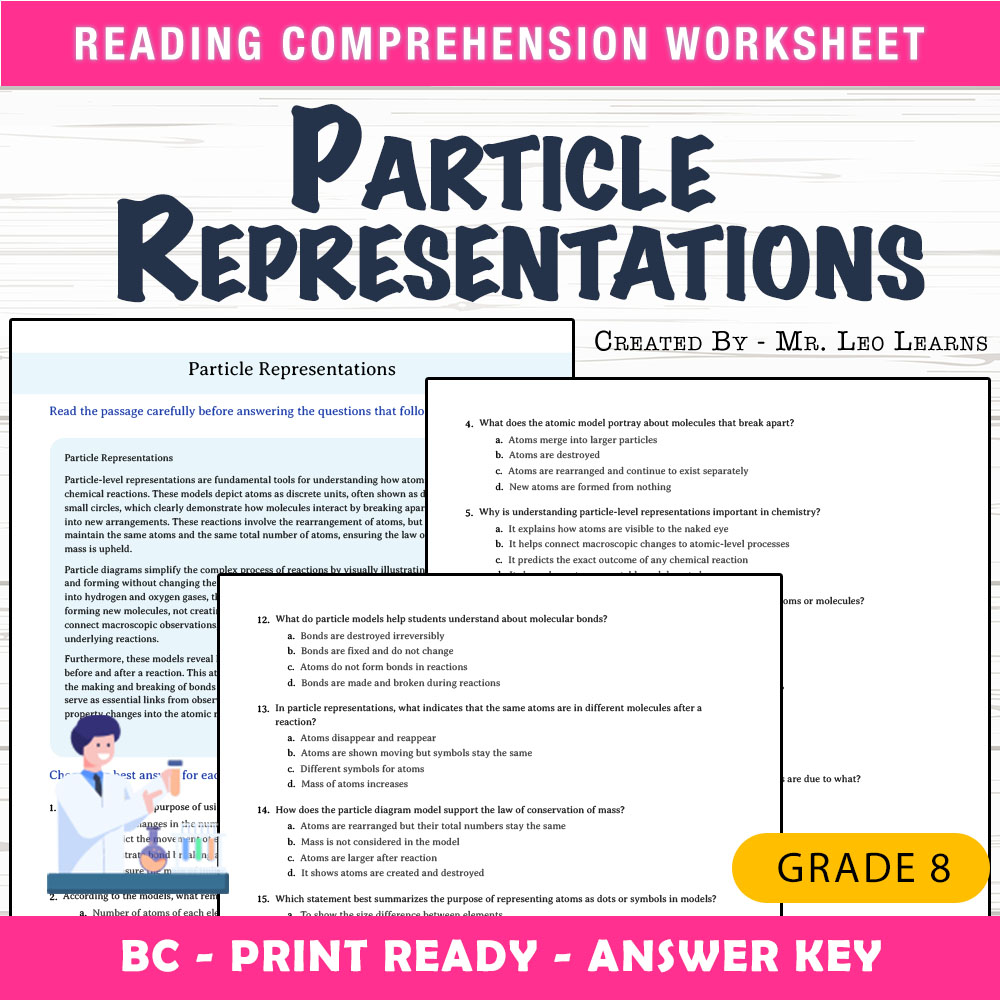
Imagine standing at the front of the classroom as your students eagerly prepare for a quiz on what happens at the particle level during chemical reactions. Some students find it challenging to grasp how atoms and molecules behave and interact, especially when visual models are involved. This worksheet provides a straightforward way to reinforce those complex concepts through a series of thoughtfully crafted questions. It helps clarify the role of particle diagrams and how they represent atomic interactions, making the topic more accessible and manageable for your students.
What This Resource Helps Students Do
This worksheet is designed to guide students through understanding key concepts about particles in chemistry. The initial passage sets the scene, helping students connect theory to real-world models. The 25 multiple-choice questions reinforce understanding, encouraging students to think critically about the purpose of particle diagrams and what stays constant during chemical processes. The questions support independent practice, enabling students to develop confidence in interpreting models and applying their knowledge to different scenarios. By progressing through these exercises, students build a stronger conceptual framework for the particle model, an essential foundation for further chemistry studies.
Inside the PDF
• 25 structured questions that facilitate a step-by-step comprehension journey
• A print-ready format requiring no additional preparation
• An answer key with rubric to streamline assessment
• Layout optimized for easy copying and classroom use
How It Improves Learning
This worksheet improves student learning by providing a clear pathway from basic understanding to deeper comprehension of particles in chemistry. The initial reading passage introduces the topic in familiar language, engaging students at their level. The multiple-choice questions challenge students to analyze diagrams and models, promoting reasoning skills. As students select answers, they reinforce their understanding of how atoms behave during reactions and what remains unchanged, reducing misconceptions. The immediate feedback from the answer key helps teachers gauge student progress and identify areas for further explanation. Overall, this resource encourages confidence-building and supports students in mastering the particle model concept through structured, meaningful practice.
Core Skills Students Will Develop
- ➡️ interpreting particle diagrams
- ➡️ understanding atomic interactions
- ➡️ explaining chemical reactions at the particle level
- ➡️ differentiating between different models of atoms
Ways Teachers Use This Worksheet
This printable worksheet serves multiple purposes in the classroom. It can be used as a warm-up activity to introduce the particle model, a formative assessment to check understanding after instruction, or a homework assignment to reinforce concepts learned during lessons. It also works well for small-group work, allowing students to discuss and analyze particle diagrams together. Teachers can utilize it as a quick review before tests or as practice for early finishers needing additional challenge. Its versatile format provides teachers with an easy resource to support a variety of instructional strategies both during class time and for independent study.
Why This PDF Saves Time
Because this worksheet is print-ready, it requires no additional setup or formatting, saving valuable preparation time. The straightforward layout makes photocopying simple, ensuring consistency across lessons. The included answer key with rubric allows teachers to quickly assess student responses without extensive grading or interpretation. Its ready-to-use design means teachers can focus more on instruction and student engagement instead of creating supplemental materials, making it a practical tool for busy classrooms.
With this resource, you’ll have a dependable, classroom-friendly worksheet that helps your students confidently understand the particle representations in chemistry. It’s designed to be printed and used immediately, supporting meaningful practice that promotes mastery of essential science concepts. Your students will appreciate the clarity and focus of this formative assessment, and you’ll appreciate the ease of implementation. 😊