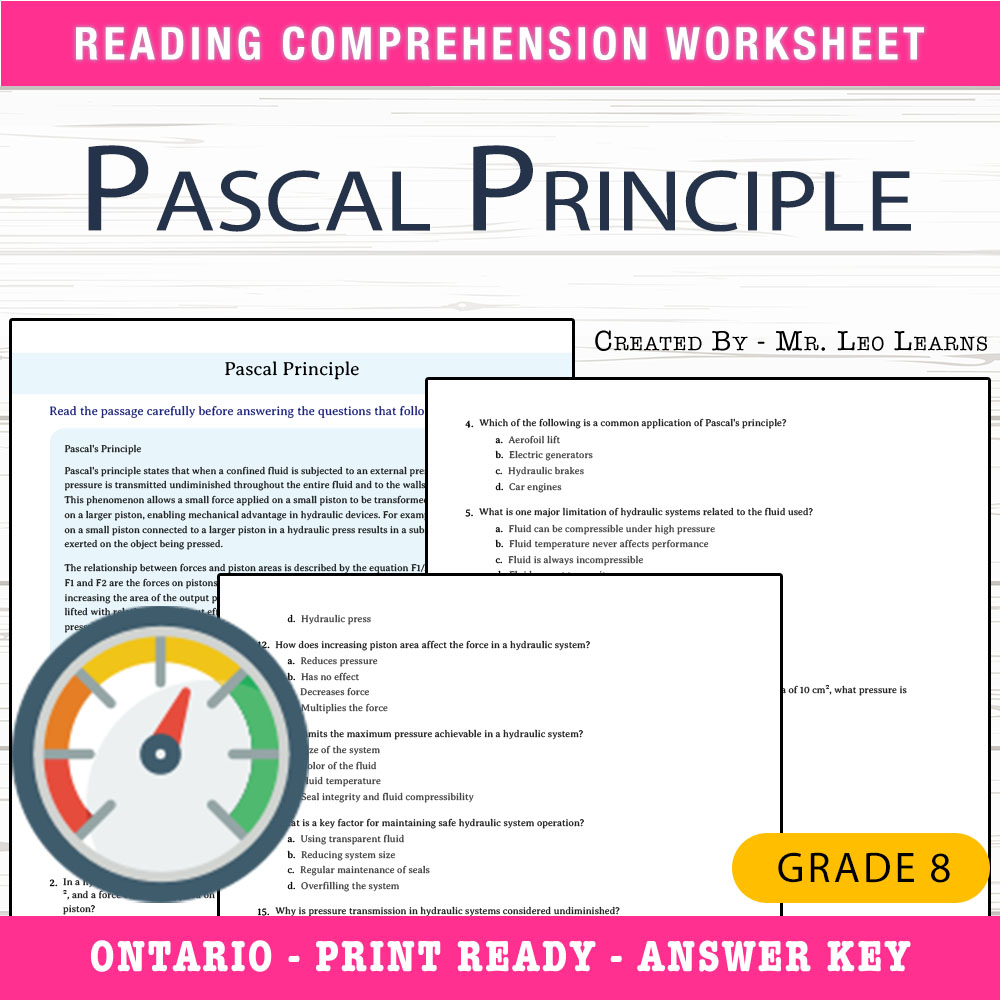
Teaching complex scientific concepts like Pascal’s principle can be a challenge in a busy classroom setting. Many students struggle with understanding how pressure is transmitted through confined fluids and how this principle applies to hydraulic systems. This worksheet provides a straightforward, print-and-go resource to help clarify these ideas, making it easier for teachers to guide students toward a solid understanding of Pascal’s principle. With focused questions and visual examples, it addresses common misconceptions while offering an accessible way for students to practice their skills effectively.
What This Resource Helps Students Do
This worksheet is designed to deepen students’ comprehension of Pascal’s principle by guiding them through a structured learning process. It includes questions that reinforce the core ideas, such as how pressure is transmitted in confined fluids and how hydraulic devices operate based on this principle. Students will also analyze real-world applications, such as hydraulic lifts or brakes, fostering critical thinking. The worksheet encourages independent practice, helping students build confidence in their understanding and ability to apply the concept in different contexts.
Inside the PDF
• 1 reading passage that introduces Pascal’s principle in clear, accessible language
• 25 multiple-choice questions designed to reinforce key concepts and common misconceptions
• A print-ready format that is easy to distribute and use in any classroom setting
• Included answer key with rubric for quick assessment and review
• Designed layout allows for effortless photocopying to save planning time
How It Improves Learning
This worksheet supports student learning by presenting the core idea of Pascal’s principle in a simple, comprehensible way. The reading passage lays a foundation, while the multiple-choice questions challenge students to recall and analyze their understanding. As students work through the questions, they develop reasoning skills related to pressure and force transmission in fluids. Immediate completion of the worksheet helps students feel more confident and prepared to explore more complex applications. The structure encourages active engagement, reinforcing the connection between theory and real-world examples, ultimately transforming confusion into clarity.
Core Skills Students Will Develop
- ➡️ Understanding the principles of fluid pressure transmission
- ➡️ Applying scientific concepts to hydraulic systems
- ➡️ Analyzing real-world applications of physics principles
- ➡️ Critical thinking and problem-solving skills in science
Ways Teachers Use This Worksheet
This worksheet can be seamlessly integrated into various classroom activities. It works well as a part of daily lessons, providing a structured practice opportunity after introducing Pascal’s principle. It can be used as homework to reinforce class learning or as an assessment review tool. Additionally, it’s effective for small-group work when students need targeted support or for early finishers to deepen their understanding independently. Its print-and-go format makes it a practical resource for busy teachers aiming to deliver consistent, high-quality instruction.
Why This PDF Saves Time
This resource is ready to print and distribute immediately, reducing prep time and allowing teachers to focus more on instruction rather than materials preparation. The clear, well-organized layout ensures an efficient classroom experience, and the included answer key supports quick assessment. Teachers can confidently apply this worksheet for immediate classroom use, knowing it’s designed for ease, consistency, and effectiveness in helping students master Pascal’s principle.
With this worksheet, you have a reliable, student-friendly tool that supports building a strong understanding of Pascal’s principle. It’s ideal for reinforcing key concepts, practicing application skills, and promoting classroom discussions that enhance learning confidence. Print, distribute, and watch your students grow in their physics knowledge! 😊