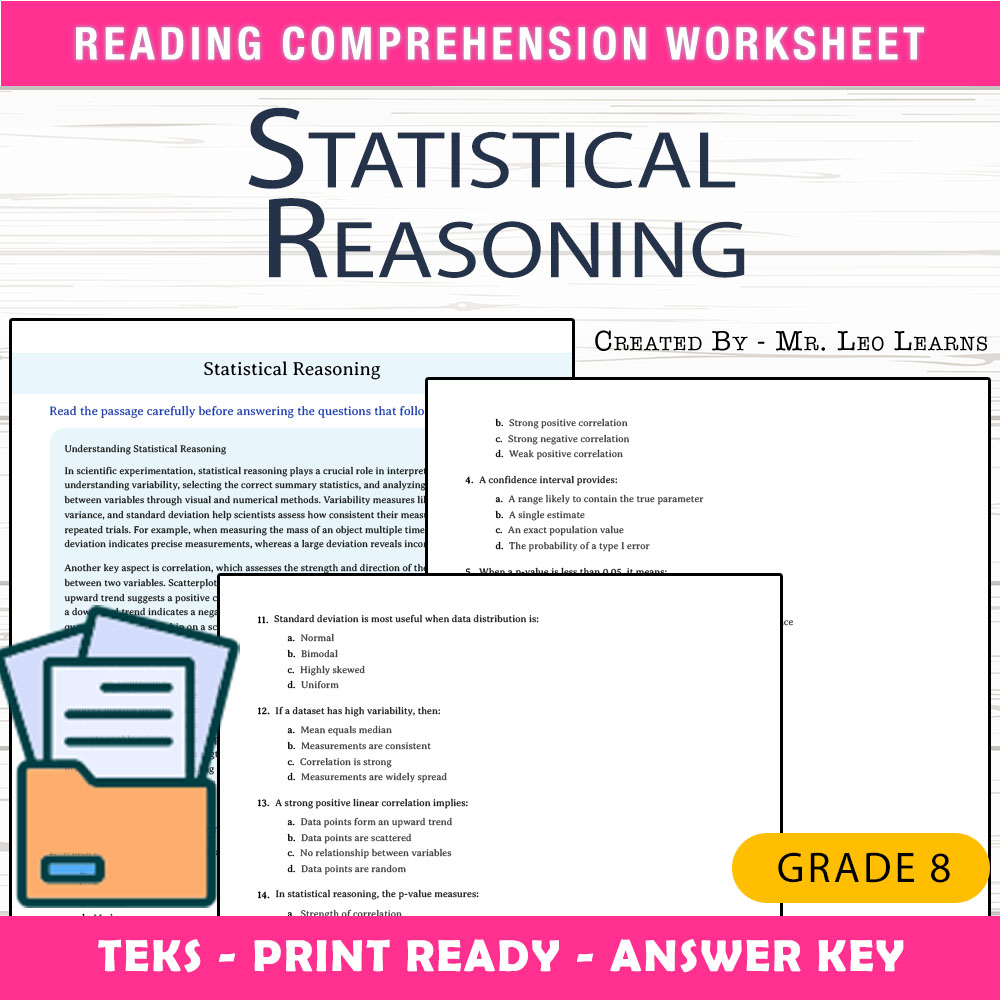
Imagine walking into your classroom and seeing students eager to understand the role of statistics in scientific experimentation. Many students find interpreting data challenging, especially when it involves understanding variability, patterns, and the significance of different statistical measures. This worksheet provides a straightforward, print-and-go resource that guides students through these concepts with clarity and confidence, making data interpretation less intimidating and more accessible.
What This Resource Helps Students Do
This worksheet is designed to support students in developing strong statistical reasoning skills essential for science. Through a combination of reading comprehension and multiple-choice questions, students learn to analyze data, interpret patterns, and understand key statistical concepts such as measures of variability and data distribution. The questions guide learners step-by-step, helping them connect theory with real-world data interpretation while building their confidence in analyzing scientific information independently.
Inside the PDF
- 25 structured questions that gradually lead students to understand concepts better
- A print-ready format, designed for quick classroom distribution without any preparation needed
- An answer key with a rubric to assist with assessment and feedback
- Layout optimized for easy photocopying and classroom use, ensuring clear readability
How It Improves Learning
This worksheet enhances learning by providing students with opportunities to practice interpreting various types of data and statistical measures, reinforcing their understanding through structured questions. The reading passage offers context, making the concepts relevant and easier to grasp. The multiple-choice section asks students to analyze data patterns, identify measures of variability, and interpret scatterplots, which helps develop their reasoning skills. As students work through the questions, they gain independence and confidence in scientific data analysis, leading to improved comprehension and application of statistical methods in science experiments. The clear layout and immediate practice foster better retention and understanding, supporting students' overall success in science.
Core Skills Students Will Develop
- ➡️ Understanding measures of variability such as range and standard deviation
- ➡️ Analyzing data patterns in scatterplots and graphs
- ➡️ Interpreting how data spread and distribution relate to scientific experiments
- ➡️ Applying statistical reasoning to real-world scientific contexts
Ways Teachers Use This Worksheet
This worksheet is a versatile resource for many classroom activities. It serves well as a quick classwork assignment or homework to reinforce lessons on data analysis. It can be used during assessment review sessions to gauge understanding or in small-group settings for targeted practice. Teachers also find it useful for early finishers who need additional challenge or for peer review activities to encourage collaborative learning. Its straightforward format makes it easy to integrate into daily lesson plans, providing a practical tool for continuous skill development in statistical reasoning.
Why This PDF Saves Time
Designed for convenience, this printable worksheet requires no additional preparation, allowing teachers to distribute it immediately. The clear, organized layout ensures that students can readily understand what is expected, reducing the need for extensive instructions. The included answer key with a rubric enables quick and consistent assessment, saving valuable grading time and ensuring accurate feedback. Its print-and-go format streamlines classroom management, giving teachers a reliable, long-lasting tool to support student learning without the hassle of creating new materials from scratch.
There’s no need to wait—this worksheet is ready to help your students master statistical reasoning confidently and effectively. Easy to use, classroom-friendly, and aligned with TEKS standards, it is an excellent addition to your science instruction. Your students will benefit from structured practice that builds their data interpretation skills step-by-step, setting them up for success in more advanced scientific analysis. 😊