
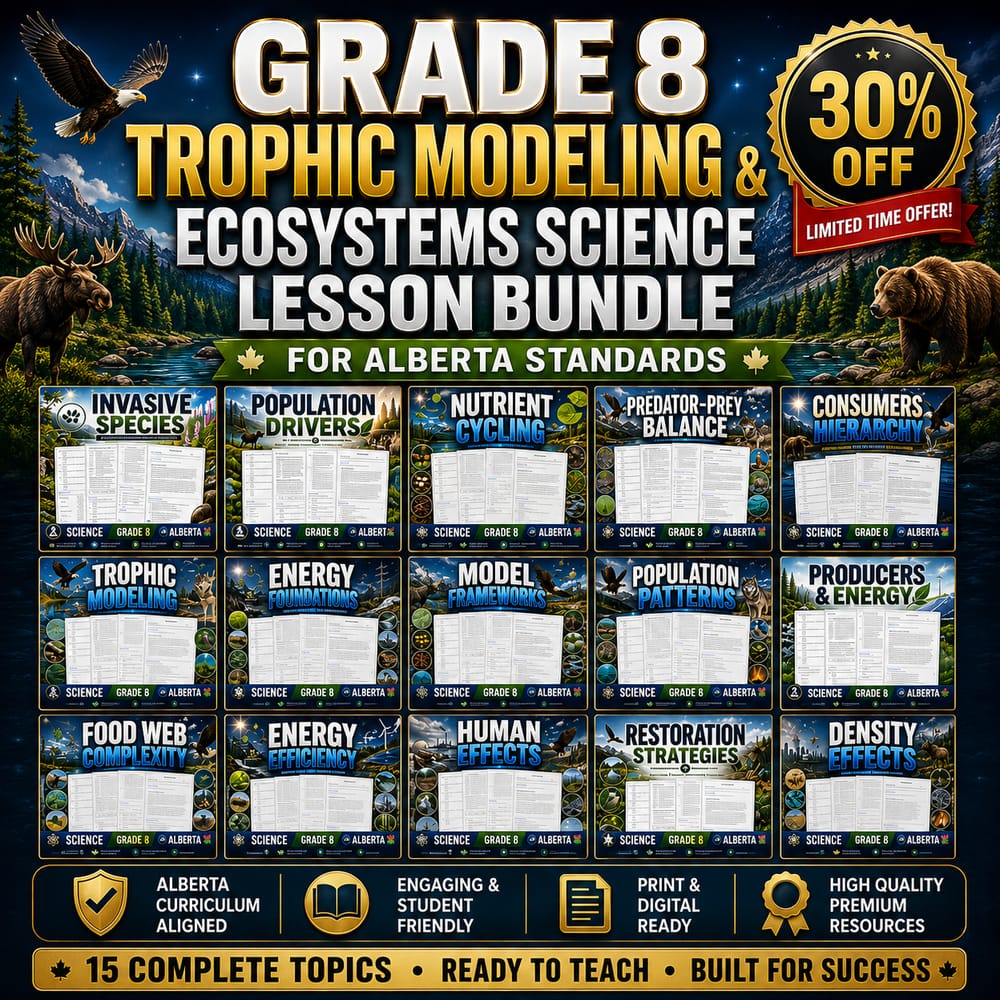


Grade 8 Trophic Modeling & Ecosystems Science Lesson Bundle for Alberta Standards
$60.00$75.00Save $15.00
Silver Birch Teaching
New·0 followers·0 sales
SubjectScienceGradeGrade 8
What’s included
15 worksheets · Save $15.00 (20%) · prices shown inside the bundle
 Grade 8 Science | Invasive Species Worksheet (Alberta Standard) (PDF)
- Explain how invasive (non-native) species can disrupt native biodiversity and ecosystem balance
- Describe how invasive species can change energy pathways and nutrient cycles within food webs
- Identify pathways that allow invasive species to spread and predict ecosystem-level consequences
$4.00$5.00 Grade 8 Science | Population Drivers Worksheet (PDF) Alberta Standards
- Explain how abiotic and biotic factors influence population size and distribution.
- Describe how birth, death, immigration, and emigration change population numbers over time.
- Use density dependence and seasonal climate to predict how populations may rise or fall.
$4.00$5.00 Grade 8 Science Worksheet – Nutrient Cycling | Alberta Standards (PDF)
- Explain how matter cycles through ecosystems using decomposition, mineralization, nitrogen fixation, and sedimentation.
- Describe carbon and nitrogen pathways and how soil organic matter connects biotic and abiotic pools.
- Analyze how temperature, moisture, and altered river flows affect nutrient availability and ecosystem productivity.
$4.00$5.00 Grade 8 Science Worksheet – Predator–Prey Relationships (Alberta Standards, PDF)
- Explain how predator–prey interactions affect population sizes using ideas like functional responses.
- Describe behavioural adaptations and refuges that help prey reduce predation risk.
- Identify how removing or returning top predators can cause trophic cascades that change habitats and vegetation.
$4.00$5.00 Grade 8 Science | Consumers Hierarchy Worksheet (Alberta) (PDF)
- Explain how herbivores, omnivores, and carnivores fit into trophic positions within a food web.
- Describe how omnivory can blur discrete trophic levels compared with strict herbivory or carnivory.
- Predict how trophic position affects energy transfer and vulnerability to environmental change.
$4.00$5.00 Grade 8 Science | Trophic Modeling Worksheet (Alberta Standards) (PDF)
- Explain how trophic models track energy and matter across compartments and environmental pools.
- Use mass-balance ideas to interpret production, respiration, and decomposition in ecosystems.
- Identify common assumptions and parameter sensitivities in simple trophic models.
$4.00$5.00 Grade 8 Science | Energy Foundations Worksheet (Alberta Standard) (PDF)
- Explain how energy from primary sources moves through producers, consumers, and decomposers in ecosystems.
- Describe how energy is lost between trophic levels and why this limits population sizes.
- Model how detritivores (decomposers) return matter and energy to the ecosystem through decomposition.
$4.00$5.00 Grade 8 Science | Model Frameworks Worksheet – Alberta Standards (PDF)
- Describe how ecosystem models represent matter and energy using stocks, pools, fluxes, and trophic-level connections
- Interpret model outputs by relating assumptions and limitations to observable ecosystem features such as biomass and decomposition rates
- Apply conservation ideas when reasoning about changes in nutrients and energy in ecosystem model frameworks
$4.00$5.00 Grade 8 Science | Population Patterns Worksheet (PDF) – Alberta Standards
- Explain how exponential growth, logistic regulation, and cyclical fluctuations differ in population dynamics
- Use carrying capacity and time lags to interpret real-world population trajectories
- Describe how predation, food supply, and spatial heterogeneity create source–sink dynamics
$4.00$5.00 Grade 8 Science | Producers & Energy Worksheet (Alberta Standards) (PDF)
- Explain how primary producers convert solar or chemical energy into organic matter.
- Compare factors that affect primary productivity, including light and soil nutrients.
- Describe how aquatic algae function as producers in food chains.
$4.00$5.00
Reviews & Feedback
Loading reviews...
Questions & Answers
Loading questions…
About this bundle
Related categories
Frequently asked questions
Who is Grade 8 Trophic Modeling & Ecosystems Science Lesson Bundle for Alberta Standards designed for?
Grade 8 Trophic Modeling & Ecosystems Science Lesson Bundle for Alberta Standards is designed for Grade 8 students and Science learners and can be used in classrooms, homeschool, or independent practice.
How do I download Grade 8 Trophic Modeling & Ecosystems Science Lesson Bundle for Alberta Standards?
Add it to your cart and complete checkout. After payment, you can download immediately from your account, and you'll also receive a download link by email.