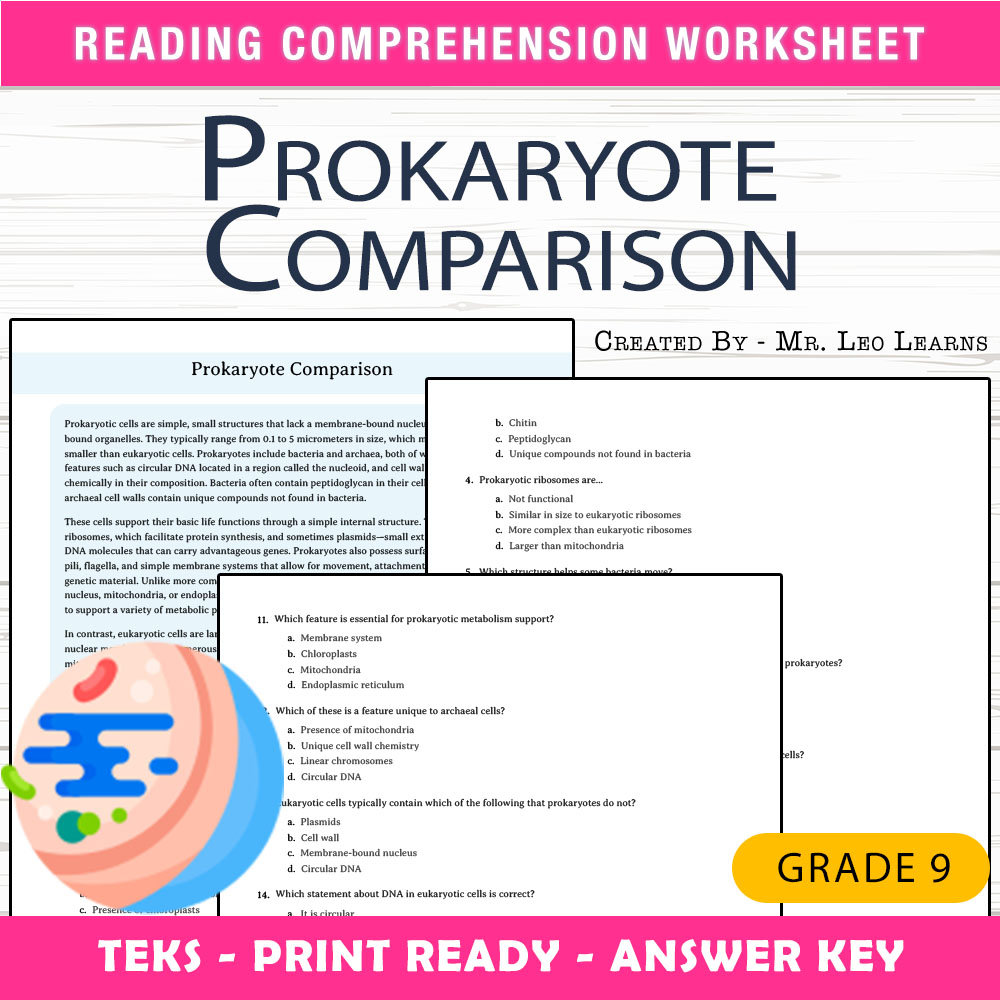
Inside a busy science classroom, teachers often seek clear, straightforward resources that help students grasp fundamental concepts without extra prep work. When exploring cells, understanding the differences between prokaryotic and eukaryotic cells can be a challenging topic for many students. This worksheet offers a focused, print-and-go solution designed to support student comprehension of prokaryotes, emphasizing core structural features and functions. With its concise questions and engaging passages, it helps students build confidence in identifying key differences and locating important cell structures, making complex topics accessible and manageable.
What This Resource Helps Students Do
This worksheet guides students through the essential characteristics that distinguish prokaryotic cells from eukaryotic cells. By working through the reading passage and multiple-choice questions, students develop skills in reading scientific passages critically and understanding cellular structures. The sequence of questions supports incremental learning — starting with basic identification and moving toward more detailed understanding, such as the location of DNA in bacterial cells. It encourages independent thinking and reinforces key vocabulary and concepts, enabling students to clearly articulate how prokaryotes differ from other cell types.
Inside the PDF
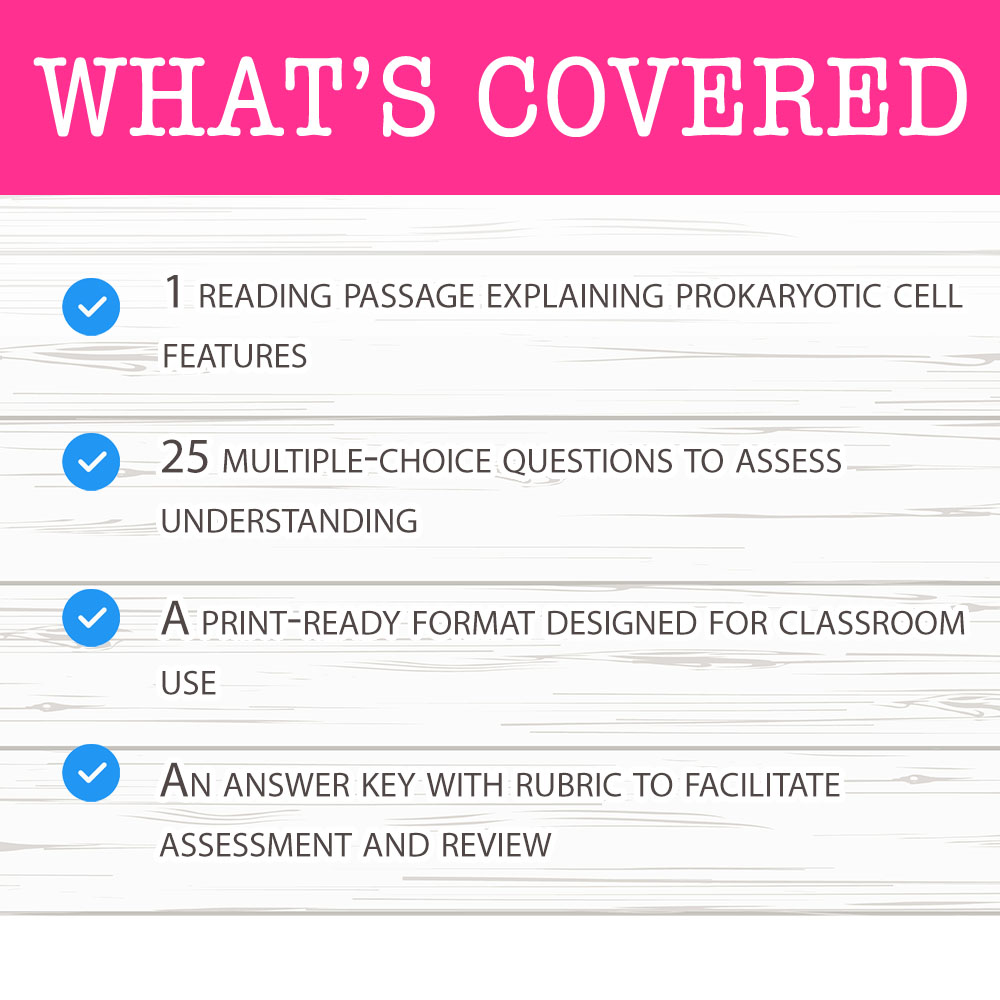
• 1 reading passage explaining prokaryotic cell features
• 25 multiple-choice questions to assess understanding
• A print-ready format designed for classroom use
• Clear layout for easy photocopying and distribution
• An answer key with rubric to facilitate assessment and review
How It Improves Learning
This worksheet is crafted to promote clarity and reinforce foundational scientific knowledge. The reading passage introduces students to the basic structure of prokaryotic cells in an accessible way, removing confusion around complex terminology. The multiple-choice questions challenge students to recall facts and develop reasoning skills, encouraging them to differentiate between examples and non-examples of cell structures. The format supports self-paced review and encourages active engagement, helping students move from initial confusion to confident understanding of cell differences. Teachers can use this resource to pinpoint areas where students may need additional clarification or reinforcement, making their instruction more effective.
Core Skills Students Will Develop
- ➡️ Reading scientific passages critically
- ➡️ Identifying key cell structures and functions
- ➡️ Applying knowledge to differentiate cell types
- ➡️ Using vocabulary accurately in context
- ➡️ Developing reasoning skills through multiple-choice analysis
Ways Teachers Use This Worksheet
This worksheet functions effectively in several classroom situations. It can be used as classwork for introducing or reinforcing the concept of prokaryotic cells or assigned as homework for independent practice. It also serves as a quick assessment or review tool during lessons, particularly after instructional lectures or discussions. Small-group activities become more focused when students work through the questions together, encouraging peer discussions. Additionally, it can be an excellent resource for students who finish early, providing meaningful practice that supports mastery of cell biology concepts without requiring additional preparation from teachers.
Why This PDF Saves Time
This resource is designed to be ready to print and distribute immediately, minimizing lesson planning time. Its clear layout and print-ready format ensure that teachers can quickly integrate it into their lesson plans without fuss. The structured questions and included answer key streamline grading and review, providing a consistent, reliable tool to reinforce essential concepts. Teachers benefit from having an immediate, classroom-ready worksheet that supports instruction and assessment equally, helping to maintain a smooth flow in busy science classes.
By choosing this worksheet, teachers can confidently provide students with focused practice that deepens understanding of prokaryotic cells. It’s a simple yet effective resource that makes teaching cellular biology straightforward and engaging. Plus, it’s ready to print and use today, helping educators save time while ensuring students learn with clarity and confidence. 😊