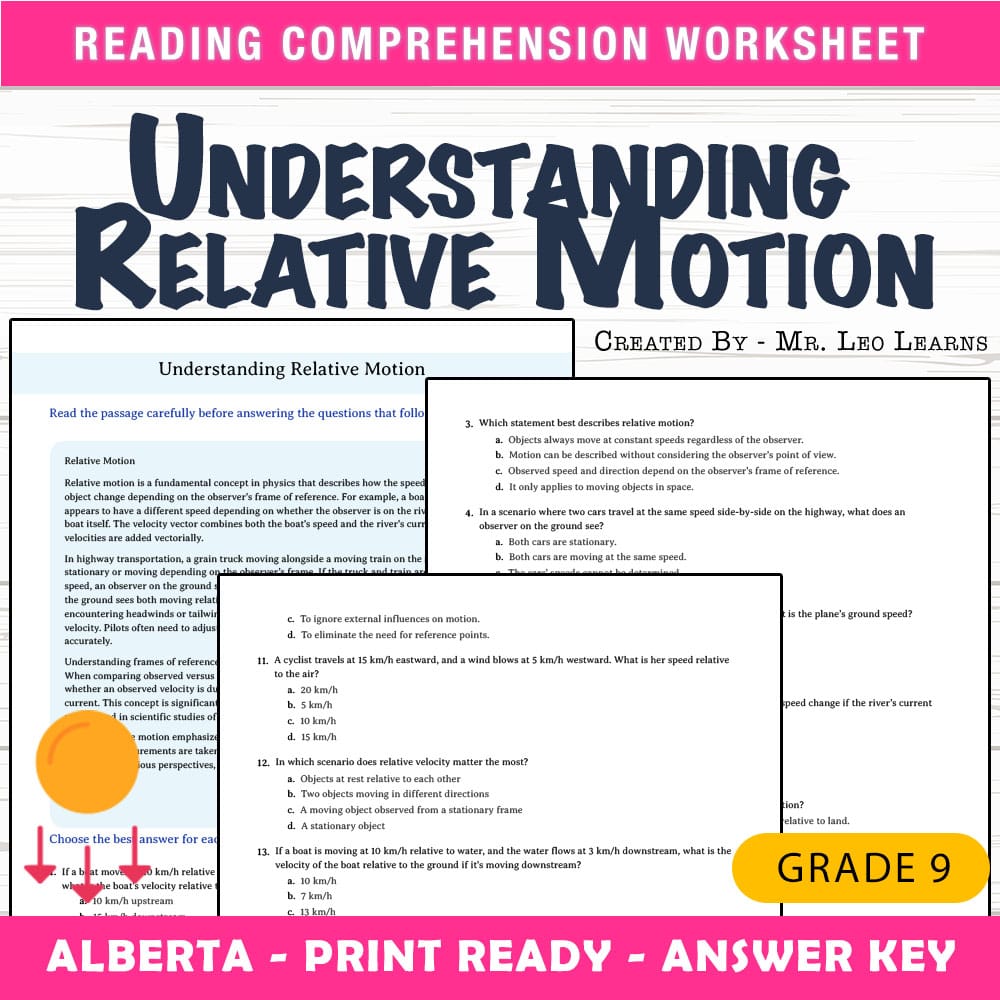
Imagine standing at the front of your classroom as students quietly work through a new lesson on relative motion. Some students struggle to grasp how objects can move differently depending on the observer's frame of reference, leading to confusion during discussions and assessments. This worksheet provides a straightforward, print-ready resource that helps clarify these concepts through targeted questions, making it easier for students to understand and apply their knowledge of relative motion in various scenarios.
What This Resource Helps Students Do
This worksheet actively guides students through the core ideas of relative motion, starting with a reading passage that introduces the concept in an accessible way. The multiple-choice questions reinforce understanding by prompting students to analyze different situations involving moving objects, such as boats, cars, and cyclists. As they work through the questions, students develop critical thinking skills and deepen their comprehension of how relative velocity operates in real-world contexts. The worksheet encourages independent practice while providing a clear structure that supports self-assessment and mastery of fundamental physics principles.
Inside the PDF
• 1 reading passage focused on the concept of relative motion
• 25 multiple-choice questions designed for comprehension and application
• A printable format that is ready to use with no prior preparation
• An answer key with a rubric for quick grading and assessment
• Layout optimized for photocopying and classroom distribution
How It Improves Learning
This resource enhances student learning by providing clear, focused questions that clarify complex ideas about motion from different reference points. The reading passage builds a foundational understanding, making abstract physics concepts more concrete. The multiple-choice format allows students to recognize correct reasoning and common misconceptions, which promotes critical thinking. Using this worksheet regularly helps students gain confidence in analyzing motion problems independently. The straightforward, print-and-go design means you can quickly integrate it into your lessons without additional prep, enabling more effective and efficient review or assessment. Overall, it supports active engagement and encourages students to connect theoretical concepts to everyday experiences involving movement.
Core Skills Students Will Develop
- ➡️ Understanding the principles of relative motion
- ➡️ Applying velocity concepts in different scenarios
- ➡️ Analyzing motion from different frames of reference
- ➡️ Critical thinking and reasoning about physics problems
Ways Teachers Use This Worksheet
This worksheet is versatile and easy to incorporate into various classroom activities. It can serve as a quick in-class practice, a formative assessment to gauge student understanding, or an individual homework assignment to reinforce new concepts. Educators also find it useful for small-group review sessions or as an extension activity for students who finish early. Its clear format supports early finisher work and provides a consistent, reliable tool for building student confidence in physics topics.
Why This PDF Saves Time
This resource is designed for immediate use, eliminating the need for additional setup or preparation. The printable PDF is formatted for easy photocopying, ensuring consistent presentation across lessons. Its straightforward layout reduces grading time, as the answer key with rubric is included to streamline assessment. With everything ready to print and distribute, teachers save valuable time and can focus more on facilitating discussion and personalized support for students.
End your lessons on relative motion with this ready-to-use worksheet that helps students develop a clear understanding of the topic. It is classroom-friendly, easy to implement, and built to support student success in physics. Display confidence in your teaching tools and help your students understand motion from every perspective — because understanding movement in physics is essential for their scientific growth. 😊