
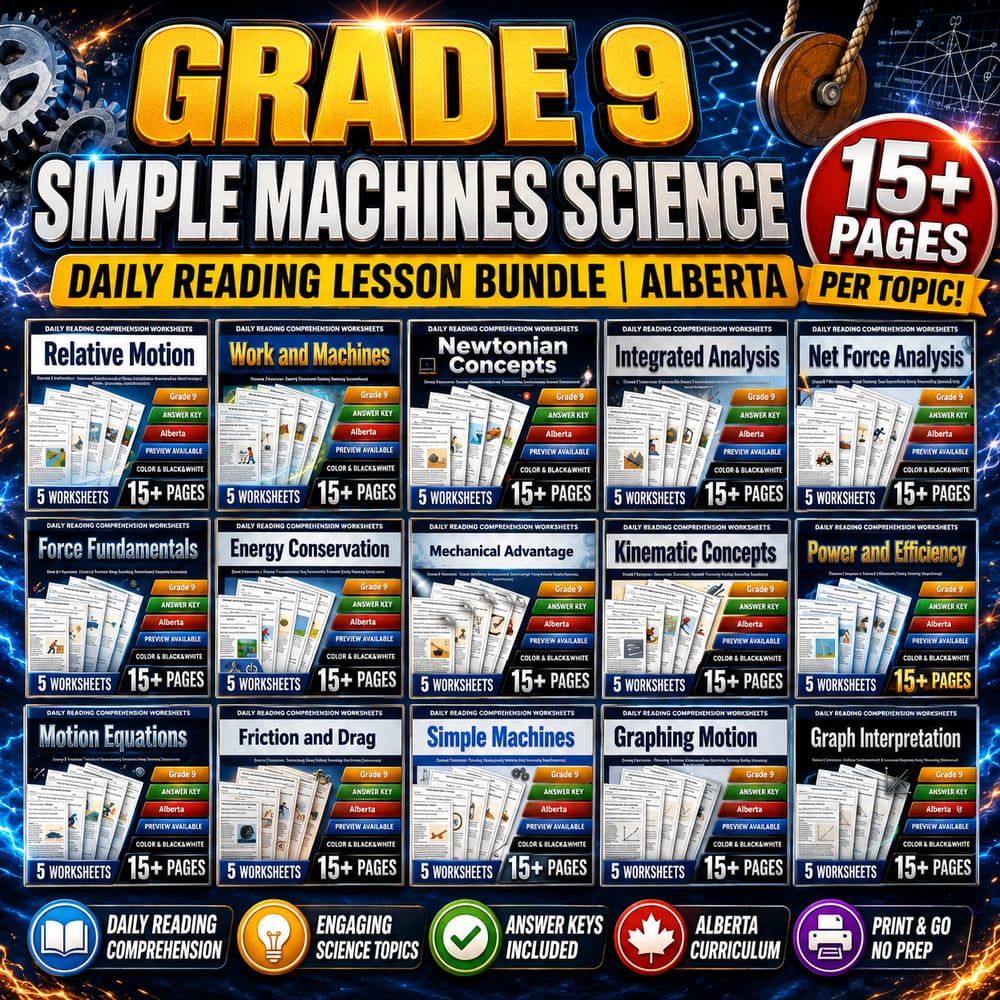


Grade 9 Simple Machines Science Daily Reading Lesson Bundle | Alberta
$48.00$60.00Save $12.00
Bright Mind Resources
New·1 followers·12 sales
SubjectScienceGradeGrade 9
What’s included
15 worksheets · Save $12.00 (20%) · prices shown inside the bundle
 Grade 9 Science – Relative Motion & Frames of Reference | Reading Worksheet
- Define relative motion and explain its significance in physics.
- Identify different frames of reference in various scenarios.
- Describe how velocity depends on the chosen frame of reference.
$3.20$4.00 Grade 9 Science – Work & Machines | Daily Reading Worksheet
- Understand key concepts related to Science
- Apply knowledge through practice questions
- Demonstrate comprehension of the material
$3.20$4.00 Grade 9 Science – Newtonian Concepts Daily Reading Worksheet | Alberta Standards
- Explain the concept of inertia and its effects on objects in motion or at rest.
- Describe how forces influence the motion of objects according to Newton's laws.
- Apply Newtonian reasoning to real-world examples such as snowplows, recoil, and anchors.
$3.20$4.00 Grade 9 Science – Integrated Analysis in Kinematics & Dynamics | Worksheet
- Understand how forces affect motion in various scenarios.
- Analyze graphs, equations, and net-force reasoning to interpret complex motion.
- Apply integrated analysis techniques to real-world transportation and recreational contexts.
$3.20$4.00 Grade 9 Science – Net Force & Equilibrium Daily Reading Worksheet
- Understand the concept of net force as the vector sum of all forces acting on an object.
- Analyze how different forces combine to produce acceleration or equilibrium.
- Apply the principles of force addition to practical scenarios such as vehicle deceleration and load balancing.
$3.20$4.00 Grade 9 Science – Force & Motion Daily Reading Worksheet | Alberta Standards
- Define force and its role in motion
- Identify different types of forces, including contact and non-contact forces
- Understand how forces act in real-world Alberta settings such as icy roads and suspended cables
$3.20$4.00 Grade 9 Science – Energy Conservation & Hydroelectric Power | Reading Worksheet
- Understand how potential energy stored in water can be transformed into kinetic and electrical energy.
- Explain the energy transfer process in hydroelectric dams.
- Describe how gravitational potential energy converts to kinetic energy in falling water and skiers.
$3.20$4.00 Grade 9 Science – Mechanical Advantage & Machines | Daily Reading Worksheet
- Define mechanical advantage and explain its significance in machinery.
- Identify different types of simple machines that provide mechanical advantage.
- Describe how mechanical advantage affects force and distance in machines.
$3.20$4.00 Grade 9 Science – Kinematic Concepts: Speed & Velocity | Daily Reading Worksheet
- Define and distinguish between speed and velocity
- Understand basic units of motion measurement
- Apply real-world examples of speed and velocity
$3.20$4.00 Grade 9 Science – Power & Efficiency | Daily Reading Worksheet
- Understand the concepts of power and efficiency in mechanical systems
- Calculate power output in various engineering contexts
- Identify factors affecting the efficiency of machines
$3.20$4.00
Reviews & Feedback
Loading reviews...
Questions & Answers
Loading questions…
About this bundle
Related categories
Frequently asked questions
Who is Grade 9 Simple Machines Science Daily Reading Lesson Bundle | Alberta designed for?
Grade 9 Simple Machines Science Daily Reading Lesson Bundle | Alberta is designed for Grade 9 students and Science learners and can be used in classrooms, homeschool, or independent practice.
How do I download Grade 9 Simple Machines Science Daily Reading Lesson Bundle | Alberta?
Add it to your cart and complete checkout. After payment, you can download immediately from your account, and you'll also receive a download link by email.
Similar Products

Grade 7 Simple Machines and Forces Science Lesson Bundle: Alberta
$60.00$75.00

Forces, Structures & Simple Machines Lesson Bundle | Grade 7 Science Alberta
$60.00$75.00

Grade 4 Science Lesson Bundle | Simple Machines & Mechanisms
$24.00$30.00

Grade 4 Science Simple Machines & Mechanical Advantage Lesson Bundle | Ontario
$40.00$50.00

Grade 3 Simple Machines Science Lesson Bundle: General
$19.20$24.00