
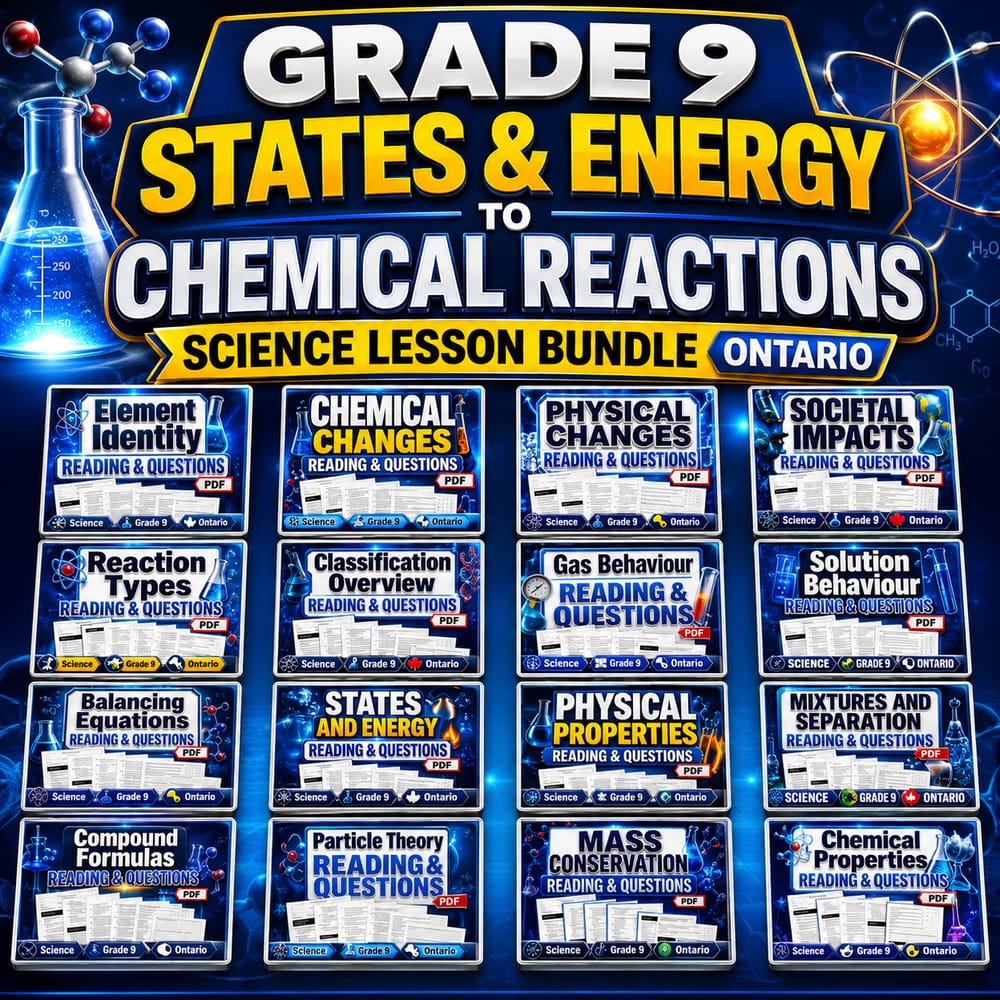


Grade 9 States & Energy to Chemical Reactions Science Lesson Bundle (Ontario)
$51.20$64.00Save $12.80
Evergreen Desk Education
·2 followers·17 sales
SubjectScienceGradeGrade 9
What’s included
16 worksheets · Save $12.80 (20%) · prices shown inside the bundle
 Grade 9 Science | Element Identity Worksheet (Ontario Standards) (PDF)
- Explain how an element’s identity is determined by its proton count and represented by a chemical symbol.
- Describe how atomic models (including drawings or diagrams) represent atoms and link those models to element identity.
- Compare representative elements (such as iron, carbon, and oxygen) by using metallic/nonmetallic characteristics and symbol notation.
$3.20$4.00 Grade 9 Science Worksheet | Chemical Changes with Ontario Standards (PDF)
- Distinguish chemical changes from physical changes by linking observable evidence to new substances.
- Identify common indicators of chemical change: temperature change, gas production, precipitate formation, and persistent colour change.
- Explain chemical change using a microscopic reactant-to-product model rather than only macroscopic rearrangement.
$3.20$4.00 Grade 9 Science Worksheet | Understanding Physical Changes (PDF) – Ontario Standards
- Define physical changes as changes in state or form that do not create new substances.
- Differentiate reversible and irreversible physical transformations using examples.
- Explain how energy transfer drives melting, freezing, evaporation, condensation, and dissolution.
$3.20$4.00 Grade 9 Science Worksheet | Societal Impacts & Chemical Risks (PDF)
- Assess how chemical properties (volatility, reactivity, solubility) influence real-world risks and benefits.
- Explain how persistence and routes of exposure affect measurable environmental and health impacts.
- Evaluate trade-offs between utility and consequences using evidence-based reasoning and regulatory concepts.
$3.20$4.00 Grade 9 Science Reaction Types Worksheet (Ontario Standard) (PDF)
- Classify common chemical reactions (synthesis, decomposition, single displacement, double displacement, and combustion) using reactant–product patterns and observable clues.
- Predict likely products from balanced reaction-type patterns and explain why conservation of mass constrains what can happen.
- Connect reaction type to real-world outcomes, including safety and environmental impacts (e.g., burning fuels, reactivity, and salt formation).
$3.20$4.00 Grade 9 Science Worksheet | Classification Overview (PDF) – Ontario Standards
- Distinguish elements, compounds, and mixtures using macroscopic appearance and compositional criteria.
- Define pure substances and explain how fixed composition differs from variable composition in mixtures.
- Use chemical symbols and formulas to represent elements and compounds and relate them to classification.
$3.20$4.00 Grade 9 Science Worksheet | Gas Behaviour (Ontario Standard) PDF
- Explain gas pressure using the particle model in terms of collisions and force.
- Describe how temperature and volume qualitatively affect gas pressure in different container situations.
- Use qualitative reasoning to predict how pressure differences cause gas flow in real-world contexts.
$3.20$4.00 Grade 9 Science – Solution Behaviour Worksheet (Ontario Standard) PDF
- Describe dissolution using solute–solvent interactions and explain how these interactions influence solubility.
- Differentiate saturated, unsaturated, and supersaturated solutions using qualitative examples such as sugar and salt in water.
- Explain how temperature and agitation affect solubility and relate these to practical methods like evaporation and crystallization.
$3.20$4.00 Grade 9 Science Worksheet | Balancing Equations (PDF) – Ontario Standards
- Explain why chemical equations must be balanced to reflect conservation of atoms and mass
- Interpret reactants, products, and coefficients in a chemical equation
- Balance simple equations using particle counts represented by coefficients
$3.20$4.00 Grade 9 Science – States and Energy Worksheet (Ontario Standards PDF)
- Explain phase changes using energy transfer, including how melting, vaporization, sublimation, and condensation relate to latent heat.
- Use qualitative heating/cooling curves to interpret temperature plateaus and characteristic transition temperatures.
- Describe how particle motion and potential energy change during phase transitions without changing chemical identity.
$3.20$4.00
Reviews & Feedback
Loading reviews...
Questions & Answers
Loading questions…
About this bundle
Related categories
Frequently asked questions
Who is Grade 9 States & Energy to Chemical Reactions Science Lesson Bundle (Ontario) designed for?
Grade 9 States & Energy to Chemical Reactions Science Lesson Bundle (Ontario) is designed for Grade 9 students and Science learners and can be used in classrooms, homeschool, or independent practice.
How do I download Grade 9 States & Energy to Chemical Reactions Science Lesson Bundle (Ontario)?
Add it to your cart and complete checkout. After payment, you can download immediately from your account, and you'll also receive a download link by email.
Similar Products

States of Matter & Chemical Reactions Lesson Bundle | Grade 9 Science | Alberta
$60.00$75.00

Grade 7 Science Unit Bundle – States, Reactions & Atomic Structure Worksheets
$16.00$20.00

Grade 7 Science Lesson – States of Matter & Reaction Types Assessment Bundle
$60.00$75.00

Grade 8 Science Unit Bundle – Matter, Reaction Rates & Energy Mastery Worksheets
$16.00$20.00

Grade 6 Science Lesson Bundle | States of Matter, Energy, and More
$21.60$27.00