
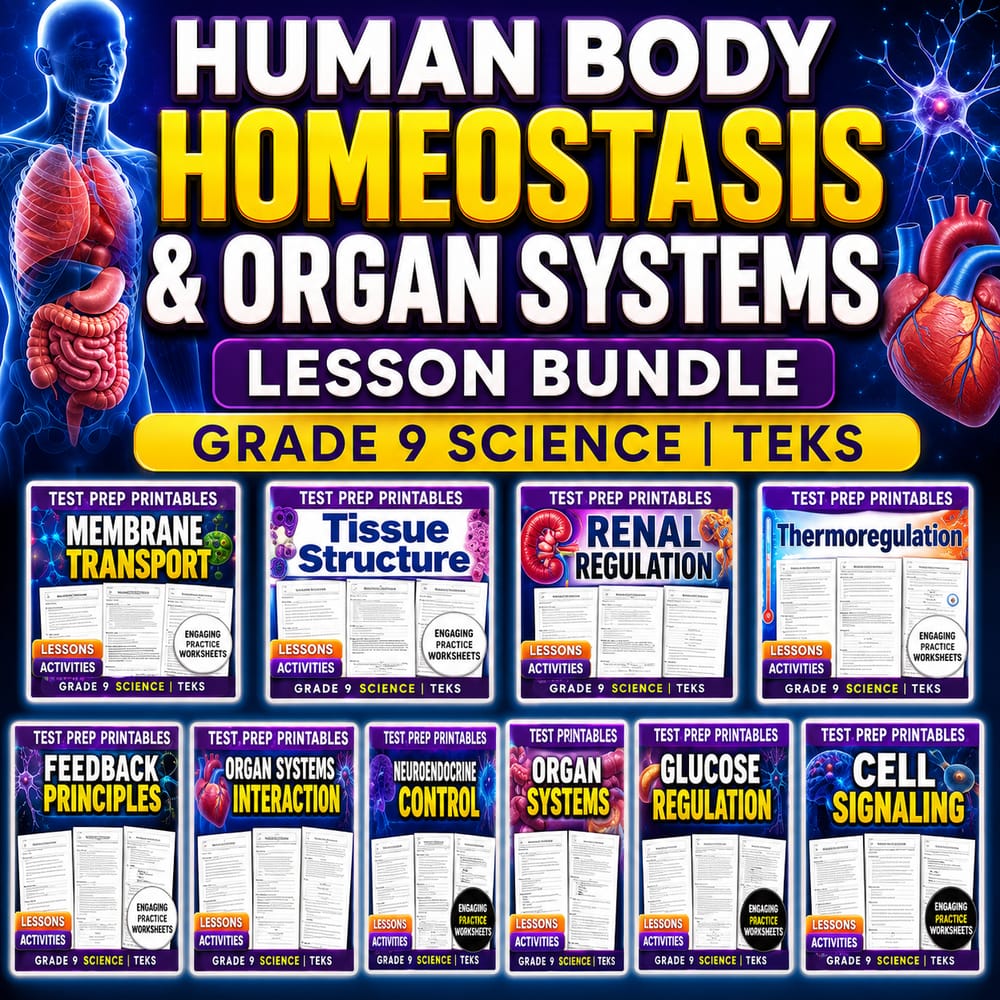
Human Body Homeostasis & Organ Systems Lesson Bundle | Grade 9 Science | TEKS
$40.00$50.00Save $10.00
Prism Point Learning
·2 followers·14 sales
SubjectScienceGradeGrade 9Pages312 Pages
What’s included
10 worksheets · 312 pages · Save $10.00 (20%) · prices shown inside the bundle
 Membrane Transport Worksheet | Grade 9 Science Activities
- Explain how passive transport (diffusion, facilitated diffusion, and osmosis) moves substances based on concentration and water potential gradients.
- Describe how active transport and vesicular transport help maintain homeostasis when substances must move against gradients.
- Connect membrane transport processes to cell function such as nutrient uptake, ion balance, and volume regulation.
$4.00$5.00 Tissue Structure Worksheet | Grade 9 Science Practice TEKS Aligned
- Explain how the structure of epithelial, connective, muscle, and nervous tissues supports their functions in organs.
- Compare how cells, junctions, and extracellular matrix influence permeability, strength, and signaling speed.
- Use tissue-structure vocabulary to answer questions about transport, force generation, and communication.
$4.00$5.00 Renal Regulation Worksheet | Grade 9 Science Activities
- Explain how the nephron supports filtration, reabsorption, and secretion to regulate water and electrolytes.
- Describe how ADH and the renin–angiotensin–aldosterone system respond to blood volume and osmolarity cues.
- Connect renal transport processes to changes in blood pressure and internal fluid balance.
$4.00$5.00 Thermoregulation Worksheet | Grade 9 Science Activities
- Explain how the hypothalamus and thermoreceptors help regulate body temperature through feedback loops.
- Describe how the body adjusts heat loss and heat gain using vascular, evaporative, behavioral, and metabolic responses.
- Compare thermoregulation in cold versus hot environments using correct scientific vocabulary.
$4.00$5.00 Feedback Principles Worksheet | Grade 9 Science Practice
- Explain how homeostatic feedback loops maintain internal stability using sensors, control centers, and effectors.
- Differentiate negative feedback from positive feedback and predict their overall effects on a body variable.
- Describe how signaling pathways and transport processes help transmit information and coordinate responses across tissues.
$4.00$5.00 Cardiopulmonary Interaction Worksheet | Grade 9 Science Practice
- Explain how the respiratory and cardiovascular systems work together to deliver gases and support cellular respiration.
- Describe how changes in ventilation and blood chemistry can influence heart rate, stroke volume, and vascular resistance.
- Use examples to connect chemoreceptor feedback to regulation of oxygen delivery and acid–base balance.
$4.00$5.00 Neuroendocrine Control Worksheet | Grade 9 Science Practice
- Explain the pathway from brain neural inputs to hormone release in the neuroendocrine system
- Describe how anatomical interfaces (portal vessels and fenestrated capillaries) help control timing and hormone magnitude
- Connect neuroendocrine control to body functions such as metabolism, growth, reproduction, and stress responses
$4.00$5.00 Organ Systems Worksheet | Grade 9 Science Activities
- Explain how multiple organ systems work together to maintain stable internal conditions.
- Describe how circulatory, respiratory, digestive, renal, nervous, and endocrine processes support homeostasis.
- Use cause-and-effect reasoning to connect system changes to internal balance.
$4.00$5.00 Glucose Regulation Worksheet | Grade 9 Science TEKS Practice
- Explain how insulin and glucagon help maintain blood glucose within a healthy range.
- Describe the negative feedback loop involved in glucose regulation and identify its set point, sensors, and effectors.
- Connect hormone signals to changes in glycogen synthesis, glycogen breakdown, and glucose production.
$4.00$5.00 Cell Signaling Worksheet | Grade 9 Science Activities
- Explain how receptor proteins detect chemical signals and start intracellular signaling cascades
- Describe how signal transduction can change gene expression, metabolism, or ion channel activity
- Compare autocrine, paracrine, endocrine, and synaptic signaling by distance and timing
$4.00$5.00
Reviews & Feedback
Loading reviews...
Questions & Answers
Loading questions…
About this bundle
Related categories
Frequently asked questions
Who is Human Body Homeostasis & Organ Systems Lesson Bundle | Grade 9 Science | TEKS designed for?
Human Body Homeostasis & Organ Systems Lesson Bundle | Grade 9 Science | TEKS is designed for Grade 9 students and Science learners and can be used in classrooms, homeschool, or independent practice.
How do I download Human Body Homeostasis & Organ Systems Lesson Bundle | Grade 9 Science | TEKS?
Add it to your cart and complete checkout. After payment, you can download immediately from your account, and you'll also receive a download link by email.
Similar Products

Human Organ Systems Science Worksheets Ontario Bundle
$24.00$30.00

Homeostasis and Human Body Systems Lesson Bundle | Grade 9 Science | Ontario
$60.00$75.00

Cells & Human Body Systems Lesson Bundle | Grade 6 Science | NGSS
$28.00$35.00

Grade 9 Cell and Human Body Systems Science Daily Reading Lesson Bundle | BC
$48.00$60.00

Grade 9 Science Lesson Group | Human Body Systems, Environment & Energy
$36.00$45.00