


Homeostasis and Human Body Systems Lesson Bundle | Grade 9 Science | Ontario
$60.00$75.00Save $15.00
Chalk and Compass
·5 followers·13 sales
SubjectScienceGradeGrade 9
What’s included
15 worksheets · Save $15.00 (20%) · prices shown inside the bundle
 Grade 9 Science System Interactions for Homeostasis Worksheet Ontario
- Explain how feedback mechanisms help maintain homeostasis in the human body.
- Describe how circulation, respiration, kidneys, and the nervous system interact to support survival.
- Use examples of thermoregulation, acid–base balance, and stress responses to predict system crosstalk.
$4.00$5.00 Grade 9 Cell Components Structure and Function Worksheet | Ontario Science
- Explain how cell organelles in eukaryotic cells support specific functions, including transport, energy production, and protein synthesis.
- Relate membrane structure and compartmentalization (folding and surface area) to metabolic rates and effective exchange.
- Connect nucleus/chromatin organization and cytoskeletal elements to how cells maintain control, shape, and transport.
$4.00$5.00 Grade 9 Membrane Transport Worksheet | Diffusion Osmosis Active Transport
- Explain how solutes move across membranes by simple diffusion, facilitated diffusion, osmosis, and active transport.
- Describe how electrochemical gradients and membrane potential affect the direction and efficiency of ion transport.
- Distinguish paracellular and transcellular pathways in epithelial layers and relate them to nutrient and ion exchange in the body.
$4.00$5.00 Grade 9 Respiratory Exchange Worksheet | Ventilation, Diffusion & Perfusion
- Explain how diffusion at the alveolar–capillary interface depends on partial pressure gradients, surface area, and membrane thickness.
- Describe how ventilation mechanics and anatomical dead space affect gas exchange during breathing.
- Identify factors that influence oxygen uptake and carbon dioxide removal, including haemoglobin affinity and perfusion matching.
$4.00$5.00 Grade 9 Renal Regulation and Homeostasis Worksheet | Ontario Science
- Explain how glomerular filtration is driven by hydrostatic and oncotic pressures
- Describe nephron processes of selective reabsorption, secretion, and urine concentration
- Connect kidney regulation of electrolytes, acid–base balance, and blood pressure to homeostasis and endocrine signals
$4.00$5.00 Grade 9 Neural Control Worksheet | Synapses, Nerves & Coordination Ontario
- Explain how action potentials and synaptic transmission allow information to travel through neural pathways.
- Describe how myelination and synaptic structure affect conduction velocity and neural processing capacity.
- Compare how central integration coordinates behavior through reflex arcs and autonomic pathways.
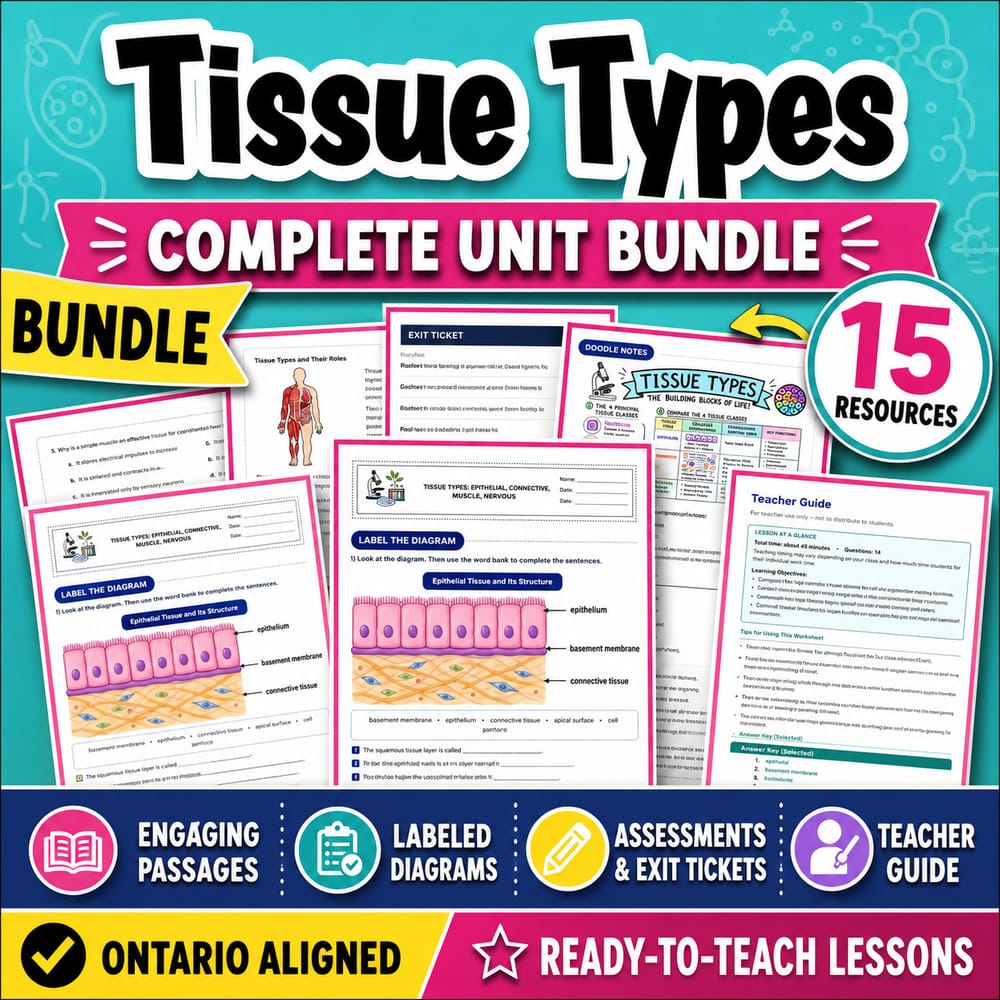
$4.00$5.00 Grade 9 Tissue Types Worksheet | Epithelial, Connective, Muscle & Nervous
- Compare the four principal tissue classes by cellular organization and key functions.
- Explain how extracellular matrix properties relate to connective tissue mechanics.
- Differentiate muscle tissue types based on contractile behavior and control.
$4.00$5.00 Grade 9 Digestive Absorption Worksheet | Small Intestine & Nutrient Transport
- Explain how mechanical and chemical digestion prepares food for nutrient absorption in the small intestine.
- Describe how villi and microvilli increase surface area to support transport of nutrients across intestinal epithelium.
- Compare facilitated and active transport of monosaccharides and amino acids, and explain how bile and micelles support lipid absorption.
$4.00$5.00 Grade 9 Health Factors Worksheet | Lifestyle, Environment & Cellular Effects
- Explain how nutrition, physical activity, tobacco exposure, pollutant inhalation, and sleep patterns can affect human health
- Describe cellular and system-level mechanisms (oxidative stress, chronic inflammation, membrane transport changes, disrupted hormonal signaling) that connect lifestyle to disease risk
- Distinguish correlation from causation by interpreting evidence and reasoning about possible reversibility of functional impairments
$4.00$5.00 Grade 9 Immune Barriers Worksheet | Innate & Adaptive Defense Ontario
- Explain how physical barriers like skin and mucosa limit pathogen entry.
- Compare innate and adaptive immune defenses, including roles of macrophages, lymphocytes, and antibodies.
- Describe how antigen recognition and inflammation support immune responses and recovery.
$4.00$5.00
Reviews & Feedback
Loading reviews...
Questions & Answers
Loading questions…
About this bundle
Related categories
Frequently asked questions
Who is Homeostasis and Human Body Systems Lesson Bundle | Grade 9 Science | Ontario designed for?
Homeostasis and Human Body Systems Lesson Bundle | Grade 9 Science | Ontario is designed for Grade 9 students and Science learners and can be used in classrooms, homeschool, or independent practice.
How do I download Homeostasis and Human Body Systems Lesson Bundle | Grade 9 Science | Ontario?
Add it to your cart and complete checkout. After payment, you can download immediately from your account, and you'll also receive a download link by email.
Similar Products

Grade 9 Science Lesson Bundle: Human Homeostasis & Cell Systems | Ontario
$36.00$45.00

Grade 9 Cell and Human Body Systems Science Daily Reading Lesson Bundle | BC
$48.00$60.00

Grade 9 Science Unit | Human Body Systems & Homeostasis Worksheet Bundle
$16.00$20.00

Grade 10 Homeostasis & Body Systems Science Worksheets Bundle | TEKS
$40.00$50.00

Human Body Homeostasis & Organ Systems Lesson Bundle | Grade 9 Science | TEKS
$40.00$50.00