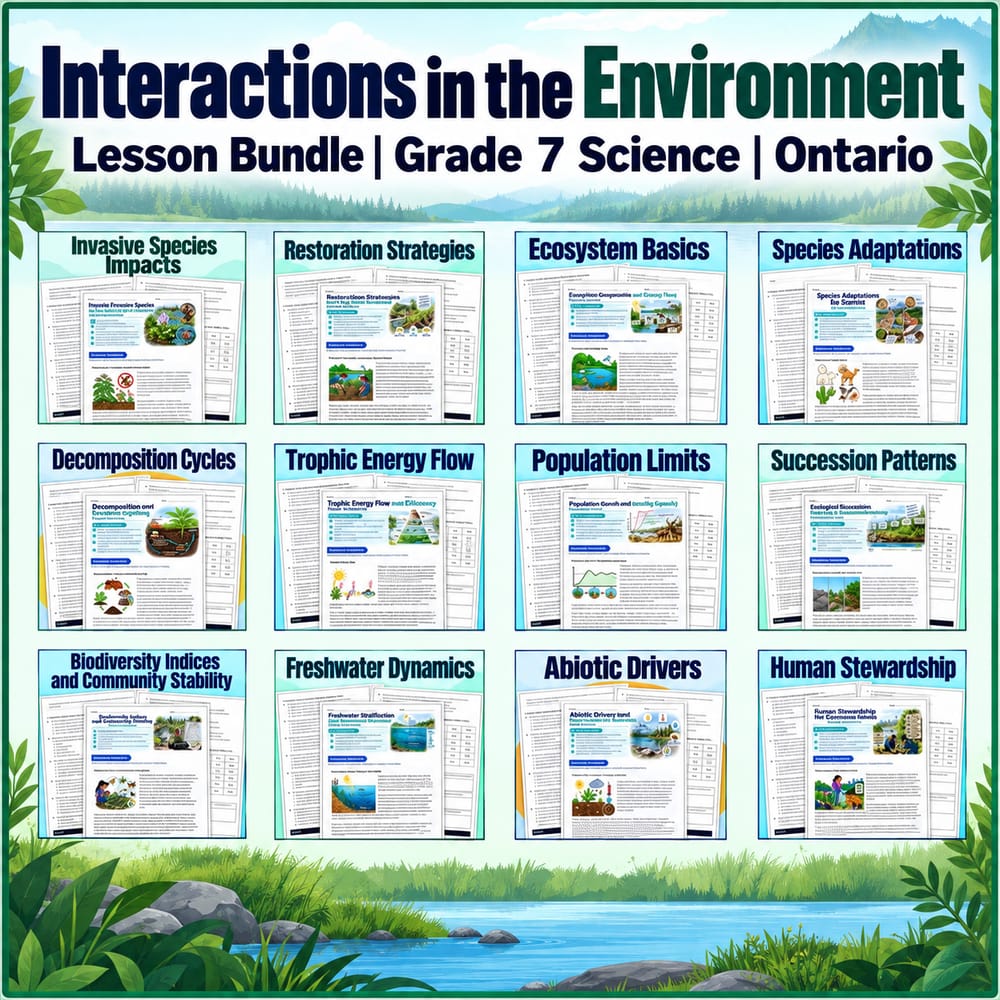
Interactions in the Environment Lesson Bundle | Grade 7 Science | Ontario — bundle cover
Interactions in the Environment Lesson Bundle | Grade 7 Science | Ontario — included worksheet 1
Interactions in the Environment Lesson Bundle | Grade 7 Science | Ontario — included worksheet 2
Interactions in the Environment Lesson Bundle | Grade 7 Science | Ontario — included worksheet 3
Interactions in the Environment Lesson Bundle | Grade 7 Science | Ontario — included worksheet 4
Interactions in the Environment Lesson Bundle | Grade 7 Science | Ontario — included worksheet 5
Interactions in the Environment Lesson Bundle | Grade 7 Science | Ontario — included worksheet 6
Interactions in the Environment Lesson Bundle | Grade 7 Science | Ontario — included worksheet 7
Interactions in the Environment Lesson Bundle | Grade 7 Science | Ontario — included worksheet 8
Interactions in the Environment Lesson Bundle | Grade 7 Science | Ontario — included worksheet 9
Interactions in the Environment Lesson Bundle | Grade 7 Science | Ontario — included worksheet 10
Interactions in the Environment Lesson Bundle | Grade 7 Science | Ontario — included worksheet 11
Interactions in the Environment Lesson Bundle | Grade 7 Science | Ontario — included worksheet 12
Grade 7 Science worksheet — Interactions in the Environment Lesson Bundle | Grade 7 Science | Ontario

Description

Overview


Interactions in the Environment in Grade 7 Science (Ontario) guides students through 12 focused lessons on how living things and ecosystems respond to change. Students investigate energy flow, species survival, population dynamics, and human and natural drivers while building skills to interpret models and explain ecological patterns using evidence.

This lesson bundle is designed for a single unit of instruction (about 1–3 weeks) and supports students in thinking like scientists: identifying variables, analyzing relationships among organisms and their environments, and connecting classroom concepts to local and global issues such as invasive species, habitat disturbance, and ecosystem stewardship.

Worksheets included: 12.

What's Included


  • ✅ Trophic Energy Flow Worksheets: Energy Transfer Grade 7 Science – Students trace how energy moves through food webs using clear, diagram-based reasoning.
  • ✅ Ecological Succession Worksheets: Disturbed Habitats Grade 7 Science – Students model how ecosystems change after disturbance and interpret succession stages.
  • ✅ Species Adaptations Worksheets: Survival Strategies Grade 7 Science – Students connect structural and behavioral adaptations to survival in specific environments.
  • ✅ Ecological Restoration Worksheets: Resilience Strategies Grade 7 Science – Students evaluate restoration approaches and predict how ecosystems recover over time.
  • ✅ Population Growth Worksheets: Carrying Capacity Grade 7 Science – Students analyze growth patterns and explain how limiting factors affect carrying capacity.
  • ✅ Invasive Species Worksheets: Ecosystem Impacts Grade 7 Science – Students predict ecological impacts by comparing native and invasive species interactions.
  • ✅ Ecosystem Stewardship Worksheets: Human Impacts Grade 7 Science – Students investigate human activities and propose evidence-based actions to protect ecosystems.
  • ✅ Freshwater Stratification Worksheets: Seasonal Turnover Grade 7 Science – Students interpret seasonal changes in freshwater layers and their effects on ecosystems.
  • ✅ Ecosystem Components & Energy Flow Worksheets Grade 7 Science – Students identify ecosystem components and explain energy transfers across trophic levels.
  • ✅ Decomposition & Nutrient Cycling Worksheets Grade 7 Science Ecosystems – Students connect decomposers to nutrient cycling and explain why matter is reused.
  • ✅ Biodiversity Indices & Community Stability Worksheets Grade 7 – Students use biodiversity indices to discuss community stability and resilience.
  • ✅ Abiotic Drivers & Environmental Templates Worksheets Grade 7 – Students organize abiotic factors and use templates to plan evidence-based ecosystem explanations.

Skills & Standards


Aligned to the Ontario Science framework, this unit emphasizes systems thinking and scientific inquiry as students explore disciplinary core ideas about ecosystems and environmental change. Learners use modeling and analytical reasoning to describe interactions among biotic and abiotic components, interpret data and diagrams, and build evidence-based explanations about cause-and-effect in ecological systems.

Throughout the unit, students practice skills such as:

  • Analyzing energy transfer through trophic levels and using models to explain how energy diminishes across transfers.
  • Interpreting ecological succession patterns and predicting how ecosystems respond to disturbance and recovery.
  • Connecting adaptations to survival, reproduction, and niche fit within particular environmental conditions.
  • Explaining population growth in terms of carrying capacity, limiting factors, and realistic constraints.
  • Evaluating invasive species impacts on ecosystem interactions and community dynamics.
  • Describing how nutrient cycling and decomposition support ecosystem functioning.
  • Using biodiversity indicators to reason about stability and resilience under changing conditions.
  • Organizing abiotic drivers (such as temperature, light availability, and water conditions) to strengthen ecological claims.

Perfect For


  • Teachers seeking structured instruction
  • Sub plans
  • Homework or review
  • Intervention or centers
  • Assessment preparation

How to Use


Plan this single unit for roughly 1–3 weeks, selecting worksheets that match your pacing guide. Consider running lessons in small clusters: (1) energy flow and ecosystem components, (2) populations and disturbances, and (3) restoration, stewardship, and abiotic drivers.

Concrete classroom routines that work well include: starting each day with a short warm-up prompt (e.g., interpreting a food web or labeling trophic levels), using guided practice with one modelling worksheet before independent completion, and ending each session with quick exit tickets where students justify an ecological claim using one piece of evidence from the worksheet.

Closing


With Interactions in the Environment, students build the reasoning they need to connect ecological concepts to thoughtful, evidence-based environmental decisions. 🌿

Interactions in the Environment Lesson Bundle | Grade 7 Science | Ontario

$28.80$36.00Save $7.20
Prism Point Learning
·2 followers·13 sales
SubjectScienceGradeGrade 7Pages145 Pages

What’s included

12 worksheets · 145 pages · Save $7.20 (20%) · prices shown inside the bundle

  1. Invasive Species Worksheets: Ecosystem Impacts Grade 7 Science
    Invasive Species Worksheets: Ecosystem Impacts Grade 7 Science

    Grade 7 · Science · 12 Pages

    • Explain how invasive species cause competitive displacement of native species
    • Describe how invasive species alter trophic relationships and nutrient dynamics
    • Identify pathways and factors that support invasive species establishment
    $2.40$3.00
  2. Ecological Restoration Worksheets: Resilience Strategies Grade 7 Science
    Ecological Restoration Worksheets: Resilience Strategies Grade 7 Science

    Grade 7 · Science · 12 Pages

    • Explain how reference conditions guide evidence-based restoration goals
    • Compare active and passive restoration approaches
    • Describe how species selection supports long-term ecological resilience
    $2.40$3.00
  3. Ecosystem Components & Energy Flow Worksheets Grade 7 Science
    Ecosystem Components & Energy Flow Worksheets Grade 7 Science

    Grade 7 · Science · 12 Pages

    • Distinguish biotic and abiotic components within an ecosystem
    • Identify producers, consumers, and decomposers in food chains
    • Explain how energy moves through trophic categories
    $2.40$3.00
  4. Species Adaptations Worksheets: Survival Strategies Grade 7 Science
    Species Adaptations Worksheets: Survival Strategies Grade 7 Science

    Grade 7 · Science · 12 Pages

    • Identify structural, physiological, and behavioral adaptations
    • Explain how selective pressures influence trait frequencies over generations
    • Compare adaptation examples across different habitat contexts
    $2.40$3.00
  5. Decomposition & Nutrient Cycling Worksheets Grade 7 Science Ecosystems
    Decomposition & Nutrient Cycling Worksheets Grade 7 Science Ecosystems

    Grade 7 · Science · 12 Pages

    • Explain how detritivores, fungi, and bacteria break down organic matter
    • Describe how carbon moves through detrital pools and producers
    • Explain how nitrogen transformations support primary producers
    $2.40$3.00
  6. Trophic Energy Flow Worksheets: Energy Transfer Grade 7 Science
    Trophic Energy Flow Worksheets: Energy Transfer Grade 7 Science

    Grade 7 · Science · 12 Pages

    • Explain how energy moves from producers through successive trophic levels
    • Calculate trophic efficiency using percent-based energy transfer examples
    • Interpret how respiration and heat reduce available energy
    $2.40$3.00
  7. Population Growth Worksheets: Carrying Capacity Grade 7 Science
    Population Growth Worksheets: Carrying Capacity Grade 7 Science

    Grade 7 · Science · 12 Pages

    • Explain how limiting factors affect population size over time
    • Compare exponential and logistic growth using carrying capacity
    • Interpret population graphs for density-dependent influences
    $2.40$3.00
  8. Ecological Succession Worksheets: Disturbed Habitats Grade 7 Science
    Ecological Succession Worksheets: Disturbed Habitats Grade 7 Science

    Grade 7 · Science · 13 Pages

    • Describe ecological succession as directional community change after disturbance
    • Distinguish primary and secondary succession using starting soil conditions
    • Explain how soil development shapes later successional stages
    $2.40$3.00
  9. Biodiversity Indices & Community Stability Worksheets Grade 7
    Biodiversity Indices & Community Stability Worksheets Grade 7

    Grade 7 · Science · 12 Pages

    • Explain what species richness and evenness measure in communities
    • Interpret biodiversity values when comparing contrasting habitats
    • Describe how habitat heterogeneity relates to niche diversity
    $2.40$3.00
  10. Freshwater Stratification Worksheets: Seasonal Turnover Grade 7 Science
    Freshwater Stratification Worksheets: Seasonal Turnover Grade 7 Science

    Grade 7 · Science · 12 Pages

    • Describe how light and dissolved oxygen change with freshwater depth
    • Explain how seasonal thermal turnover affects nutrient mixing
    • Predict vertical zonation from abiotic gradients in standing freshwater
    $2.40$3.00

Reviews & Feedback

Loading reviews...

Questions & Answers

Loading questions…

About this bundle

Related categories

Frequently asked questions

Who is Interactions in the Environment Lesson Bundle | Grade 7 Science | Ontario designed for?
Interactions in the Environment Lesson Bundle | Grade 7 Science | Ontario is designed for Grade 7 students and Science learners and can be used in classrooms, homeschool, or independent practice.
How do I download Interactions in the Environment Lesson Bundle | Grade 7 Science | Ontario?
Add it to your cart and complete checkout. After payment, you can download immediately from your account, and you'll also receive a download link by email.