
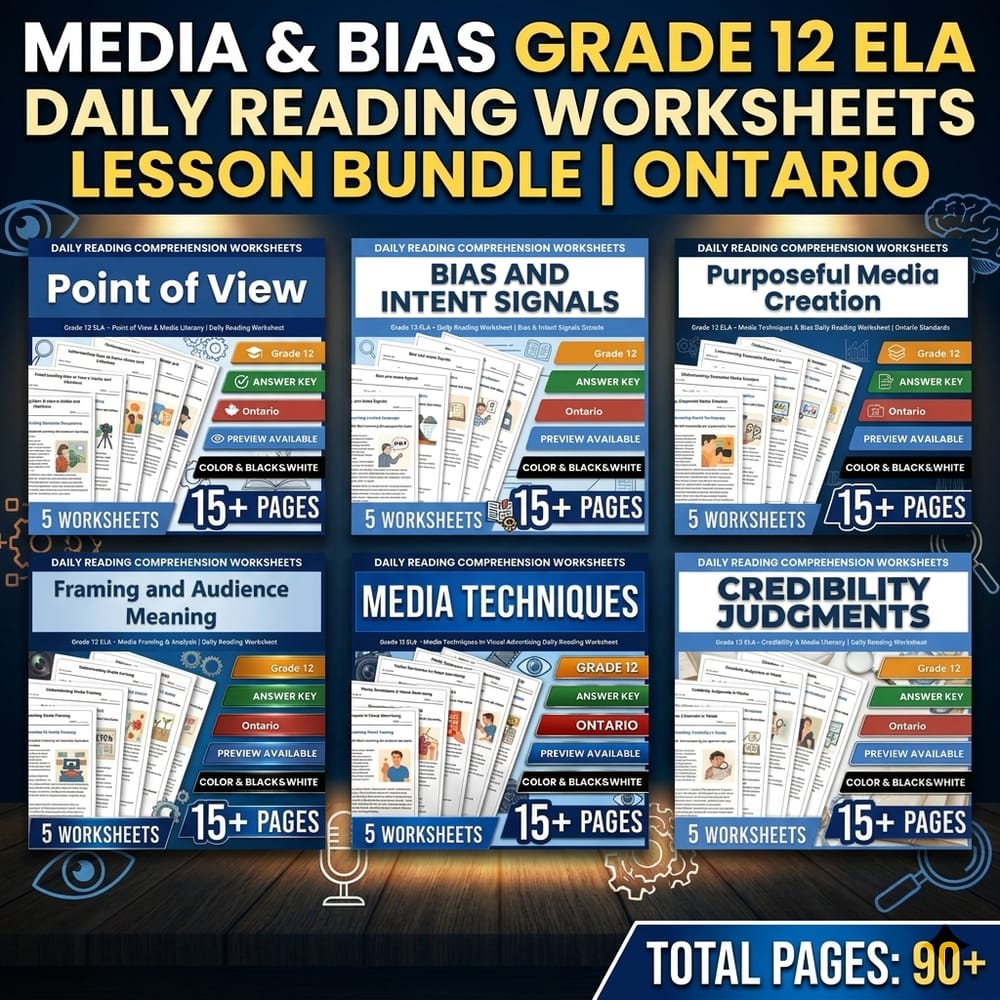
Media & Bias Grade 12 ELA Daily Reading Worksheets Lesson Bundle | Ontario
$19.20$24.00Save $4.80
Quiet Forest Education
·3 followers·20 sales
SubjectELAGradeGrade 12Pages189 Pages
What’s included
6 worksheets · 189 pages · Save $4.80 (20%) · prices shown inside the bundle
 Grade 12 ELA – Point of View & Media Literacy | Daily Reading Worksheet
- Analyze how narrative perspective influences the interpretation of a story
- Identify different points of view in media and literature
- Evaluate how camera angles, framing, and voice selection affect audience perception
$3.20$4.00 Grade 12 ELA – Daily Reading Worksheet | Bias & Intent Signals Ontario
- Identify examples of loaded language within a message.
- Understand how imagery and attribution can signal bias.
- Analyze the intent behind persuasive messages.
$3.20$4.00 Grade 12 ELA – Media Techniques & Bias Daily Worksheet | Ontario Standards
- Understand key concepts related to ELA
- Apply knowledge through practice questions
- Demonstrate comprehension of the material
$3.20$4.00 Grade 12 ELA – Media Framing & Analysis | Daily Reading Worksheet
- Identify different media framing techniques used in various forms of communication.
- Analyze how sequencing, emphasis, and wording influence audience perception.
- Evaluate the impact of visual and textual elements in shaping interpretation.
$3.20$4.00 Grade 12 ELA – Media Techniques in Visual Advertising Daily Reading Worksheet
- Identify how visual elements like framing and imagery influence viewer perception.
- Analyze the use of repetition, emotional appeals, and selective presentation in media messages.
- Describe observable media choices and connect them to their effects on tone and implied values.
$3.20$4.00 Grade 12 ELA – Credibility & Media Literacy | Daily Reading Worksheet
- Identify key indicators of source credibility
- Differentiate between evidence types supporting claims
- Evaluate the intent and transparency of media messages
$3.20$4.00
Reviews & Feedback
Loading reviews...
Questions & Answers
Loading questions…
About this bundle
Related categories
Frequently asked questions
Who is Media & Bias Grade 12 ELA Daily Reading Worksheets Lesson Bundle | Ontario designed for?
Media & Bias Grade 12 ELA Daily Reading Worksheets Lesson Bundle | Ontario is designed for Grade 12 students and ELA learners and can be used in classrooms, homeschool, or independent practice.
How do I download Media & Bias Grade 12 ELA Daily Reading Worksheets Lesson Bundle | Ontario?
Add it to your cart and complete checkout. After payment, you can download immediately from your account, and you'll also receive a download link by email.
Similar Products

Media Studies Grade 11 ELA Daily Reading Worksheets Lesson Bundle | Ontario
$16.00$20.00

Grade 12 ELA Daily Reading & Literary Media Literacy Lesson Bundle | Ontario
$112.00$160.00

Grade 4 Media Literacy Lesson Bundle | Ontario ELA Worksheets
$12.00$15.00

Grade 10 Media Literacy ELA Lesson Bundle Daily Reading Worksheets | Ontario
$16.00$20.00

Grade 6 ELA Media Literacy Worksheets | Framing & Bias | Ontario
$12.00$15.00