
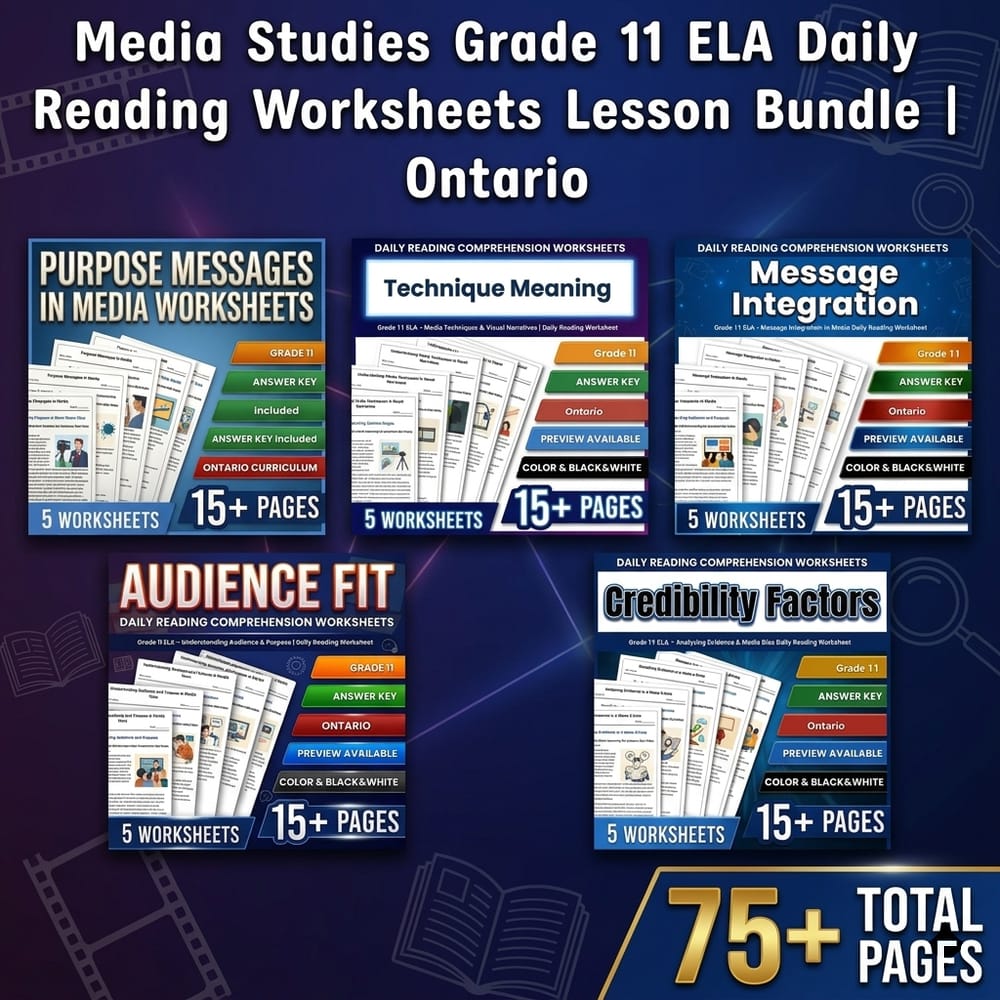
Media Studies Grade 11 ELA Daily Reading Worksheets Lesson Bundle | Ontario
$16.00$20.00Save $4.00
Quiet Forest Education
·3 followers·20 sales
SubjectELAGradeGrade 11Pages156 Pages
What’s included
5 worksheets · 156 pages · Save $4.00 (20%) · prices shown inside the bundle
 Grade 11 ELA – Purpose Messages in Media | Daily Reading Worksheet
- Identify the main purpose of media messages such as news clips, PSAs, and social media captions.
- Analyze how tone, topic emphasis, and motifs contribute to understanding message intent.
- Distinguish among different purposes: to inform, persuade, entertain, or recruit support.
$3.20$4.00 Grade 11 ELA – Media Techniques & Visual Narratives | Daily Reading Worksheet
- Understand key concepts related to ELA
- Apply knowledge through practice questions
- Demonstrate comprehension of the material
$3.20$4.00 Grade 11 ELA – Message Integration in Media Daily Reading Worksheet
- Analyze how media messages are tailored for specific audiences and purposes.
- Identify techniques used in framing, tone, and visuals to support a message.
- Evaluate potential biases introduced through emphasis, omission, or persuasive language.
$3.20$4.00 Grade 11 ELA – Understanding Audience & Purpose | Daily Reading Worksheet
- Identify the target audience for various media texts
- Determine the purpose behind different media formats
- Analyze how form, style, and conventions serve audience needs
$3.20$4.00 Grade 11 ELA – Analyzing Evidence & Media Bias Daily Reading Worksheet
- Understand how to assess the credibility of evidence in media sources.
- Learn how to identify bias and point of view in articles.
- Practice critical thinking by evaluating the support and framing of claims.
$3.20$4.00
Reviews & Feedback
Loading reviews...
Questions & Answers
Loading questions…
About this bundle
Related categories
Frequently asked questions
Who is Media Studies Grade 11 ELA Daily Reading Worksheets Lesson Bundle | Ontario designed for?
Media Studies Grade 11 ELA Daily Reading Worksheets Lesson Bundle | Ontario is designed for Grade 11 students and ELA learners and can be used in classrooms, homeschool, or independent practice.
How do I download Media Studies Grade 11 ELA Daily Reading Worksheets Lesson Bundle | Ontario?
Add it to your cart and complete checkout. After payment, you can download immediately from your account, and you'll also receive a download link by email.
Similar Products

Grade 11 Media Studies Bundle | Ontario Media Studies Resources
$12.00$15.00

Media Messages & Discussion Norms Grade 8 ELA Daily Reading Lesson Bundle | TEKS
$16.00$20.00

Grade 12 ELA Daily Reading & Literary Media Literacy Lesson Bundle | Ontario
$112.00$160.00

Grade 4 Media Literacy Lesson Bundle | Ontario ELA Worksheets
$12.00$15.00

Media & Bias Grade 12 ELA Daily Reading Worksheets Lesson Bundle | Ontario
$19.20$24.00