
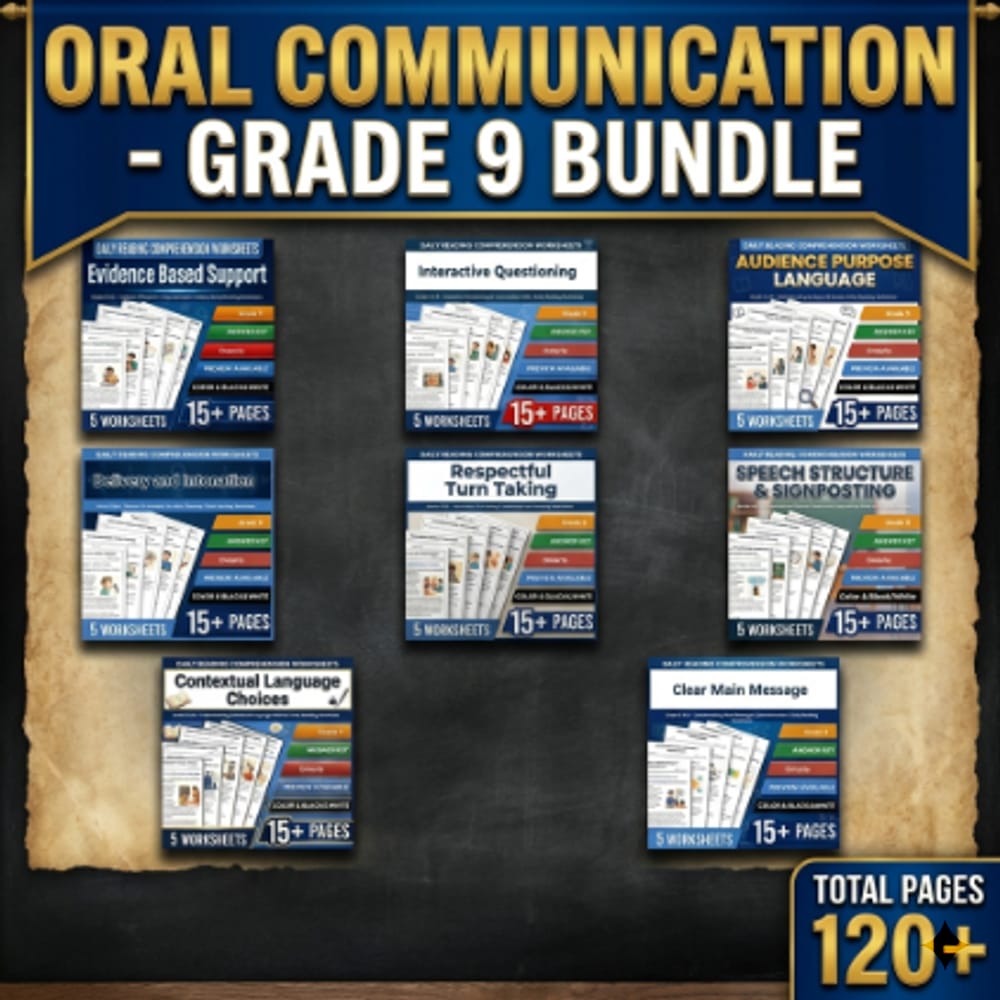
Oral Communication Grade 9 ELA Daily Reading Worksheets Lesson Bundle | Ontario
$25.60$32.00Save $6.40
Quiet Forest Education
·3 followers·20 sales
SubjectELAGradeGrade 9Pages240 Pages
What’s included
8 worksheets · 240 pages · Save $6.40 (20%) · prices shown inside the bundle
 Grade 9 ELA – Evidence & Support in Argumentative Writing | Daily Worksheet
- Understand the importance of relevant evidence in supporting claims.
- Identify different types of evidence used in arguments.
- Learn how to organize supporting points logically to strengthen arguments.
$3.20$4.00 Grade 9 ELA – Interactive Questioning & Conversation Skills | Daily Worksheet
- Understand the importance of clarification in discussions
- Identify ways to rephrase ideas for clarity
- Practice answering purposeful questions directly
$3.20$4.00 Grade 9 ELA – Understanding Audience & Purpose Daily Reading Worksheet
- Identify different audiences in oral communication.
- Recognize purposes behind spoken messages.
- Understand how language adapts to fit audience and purpose.
$3.20$4.00 Grade 9 ELA – Delivery & Intonation in Public Speaking | Daily Reading Worksheet
- Understand key concepts related to ELA
- Apply knowledge through practice questions
- Demonstrate comprehension of the material
$3.20$4.00 Grade 9 ELA – Respectful Turn Taking & Listening | Daily Reading Worksheet
- Understand the importance of respectful listening during conversations.
- Identify key behaviors that demonstrate respectful turn-taking.
- Develop skills to respond appropriately and maintain a cooperative dialogue.
$3.20$4.00 Grade 9 ELA – Understanding Speech Structure & Signposting | Daily Worksheet
- Identify the parts of a speech: introduction, body, conclusion
- Recognize signposting language that enhances clarity
- Understand how structure supports effective communication
$3.20$4.00 Grade 9 ELA – Understanding Contextual Language Choices | Daily Worksheet
- Identify differences between formal and informal language
- Analyze how context influences language tone and style
- Apply appropriate language register based on audience and purpose
$3.20$4.00 Grade 9 ELA – Understanding Main Message & Communication | Daily Worksheet
- Understand key concepts related to ELA
- Apply knowledge through practice questions
- Demonstrate comprehension of the material
$3.20$4.00
Reviews & Feedback
Loading reviews...
Questions & Answers
Loading questions…
About this bundle
Related categories
Frequently asked questions
Who is Oral Communication Grade 9 ELA Daily Reading Worksheets Lesson Bundle | Ontario designed for?
Oral Communication Grade 9 ELA Daily Reading Worksheets Lesson Bundle | Ontario is designed for Grade 9 students and ELA learners and can be used in classrooms, homeschool, or independent practice.
How do I download Oral Communication Grade 9 ELA Daily Reading Worksheets Lesson Bundle | Ontario?
Add it to your cart and complete checkout. After payment, you can download immediately from your account, and you'll also receive a download link by email.
Similar Products

Grade 12 Oral Communication Bundle | Ontario Communication Lessons
$19.20$24.00

Grade 4 Ontario ELA Oral Communication & Listening Lesson Bundle
$14.40$18.00

Oral Communication Grade 11 ELA Daily Reading Worksheets Lesson Bundle | Ontario
$22.40$28.00

Grade 3 Oral Communication & Active Listening Lesson Bundle | Ontario ELA
$14.40$18.00

Oral Communication Skills Lesson Bundle | Grade 9 ELA | Ontario
$19.20$24.00