
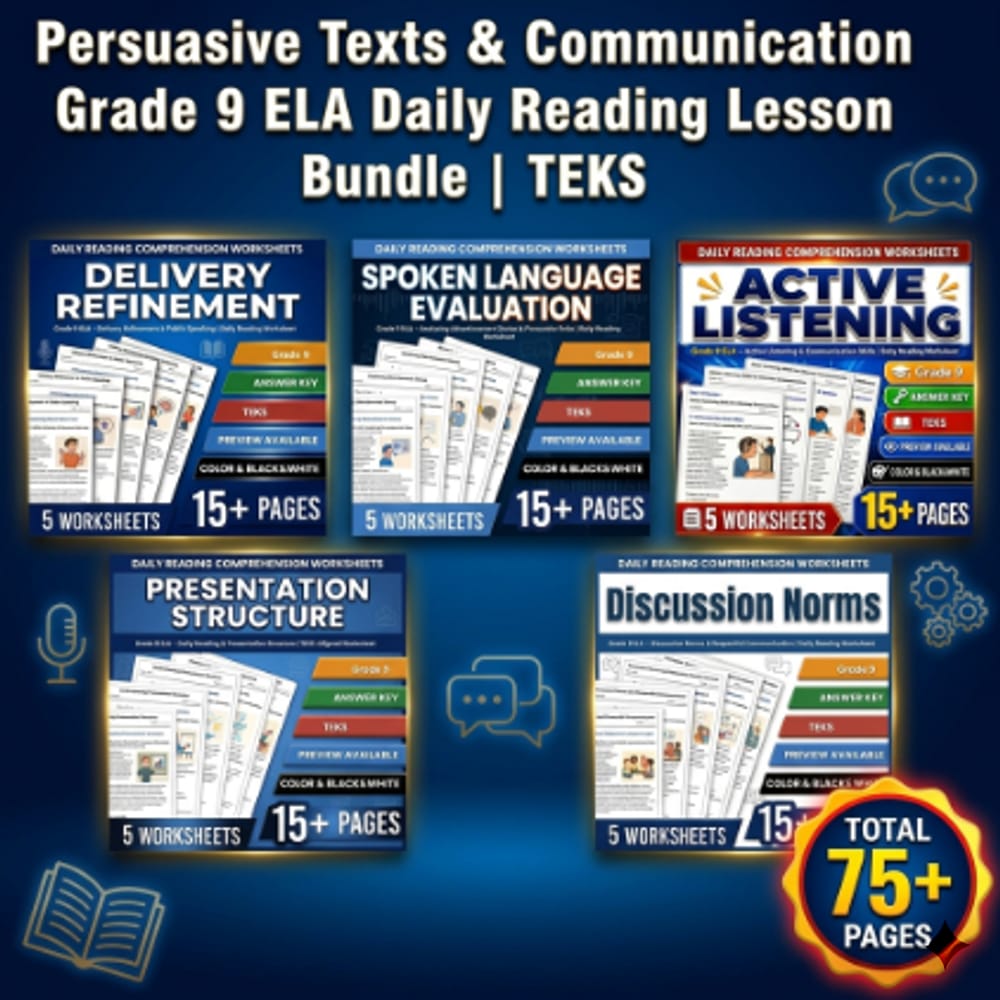
Persuasive Texts & Communication Grade 9 ELA Daily Reading Lesson Bundle | TEKS
$16.00$20.00Save $4.00
Quiet Forest Education
·3 followers·20 sales
SubjectELAGradeGrade 9Pages155 Pages
What’s included
5 worksheets · 155 pages · Save $4.00 (20%) · prices shown inside the bundle
 Grade 9 ELA – Delivery Refinement & Public Speaking | Daily Reading Worksheet
- Understand the role of vocal expression in effective delivery
- Learn how to align tone, pacing, and emphasis with message
- Identify techniques to enhance presentations with visual and oral support
$3.20$4.00 Grade 9 ELA – Analyzing Advertisement Claims & Persuasive Texts | DailyWorksheet
- Identify claims made in spoken advertisements.
- Assess whether supporting evidence effectively backs these claims.
- Detect bias and loaded language in spoken messages.
$3.20$4.00 Grade 9 ELA – Active Listening & Communication Skills | Daily Reading Worksheet
- Identify main ideas in spoken content
- Recognize supporting details within a conversation
- Understand how speakers clarify or modify claims
$3.20$4.00 Grade 9 ELA – Daily Reading & Presentation Structure | TEKS-Aligned Worksheet
- Identify the key parts of a presentation: introduction, main points, transitions, and conclusion.
- Understand how each part supports the overall purpose of a presentation.
- Explain the importance of organized structure when delivering spoken messages.
$3.20$4.00 Grade 9 ELA – Discussion Norms & Respectful Communication | Daily Reading Worksheet
- Understand key concepts related to ELA
- Apply knowledge through practice questions
- Demonstrate comprehension of the material
$3.20$4.00
Reviews & Feedback
Loading reviews...
Questions & Answers
Loading questions…
About this bundle
Related categories
Frequently asked questions
Who is Persuasive Texts & Communication Grade 9 ELA Daily Reading Lesson Bundle | TEKS designed for?
Persuasive Texts & Communication Grade 9 ELA Daily Reading Lesson Bundle | TEKS is designed for Grade 9 students and ELA learners and can be used in classrooms, homeschool, or independent practice.
How do I download Persuasive Texts & Communication Grade 9 ELA Daily Reading Lesson Bundle | TEKS?
Add it to your cart and complete checkout. After payment, you can download immediately from your account, and you'll also receive a download link by email.
