
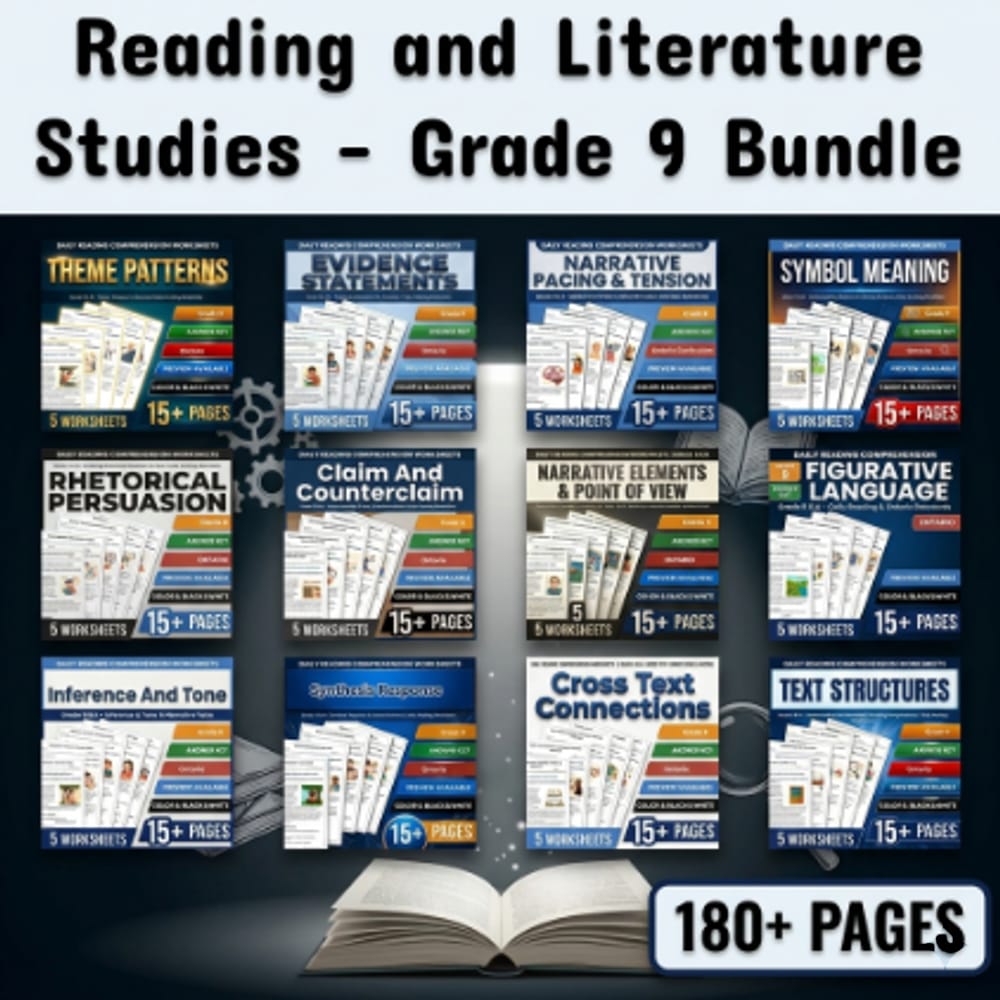


Reading and Literature Studies Grade 9 ELA Daily Reading Lesson Bundle | Ontario
$38.40$48.00Save $9.60
Quiet Forest Education
·3 followers·20 sales
SubjectELAGradeGrade 9Pages374 Pages
What’s included
12 worksheets · 374 pages · Save $9.60 (20%) · prices shown inside the bundle
 Grade 9 ELA – Theme Patterns in Literature Daily Reading Worksheet
- Understand key concepts related to ELA
- Apply knowledge through practice questions
- Demonstrate comprehension of the material
$3.20$4.00 Grade 9 ELA – Evidence Statements & Literature | Daily Reading Worksheet
- Identify quotations that support a central claim
- Explain the significance of textual evidence
- Distinguish between factual details and interpretive insights
$3.20$4.00 Grade 9 ELA – Character Depth & Analysis | Daily Reading Worksheet
- Analyze how characters are developed through their actions, dialogue, and motivations.
- Differentiate between direct and indirect characterization.
- Understand how relationships influence character decisions.
$3.20$4.00 Grade 9 ELA – Understanding Symbols & Literary Analysis | Daily Worksheet
- Understand key concepts related to ELA
- Apply knowledge through practice questions
- Demonstrate comprehension of the material
$3.20$4.00 Grade 9 ELA – Analyzing Rhetorical Persuasion & Texts | Daily Reading Worksheet
- Understand key concepts related to ELA
- Apply knowledge through practice questions
- Demonstrate comprehension of the material
$3.20$4.00 Grade 9 ELA – Understanding Claims & Counterclaims | Daily Reading Worksheet
- Identify claims within a paragraph or passage.
- Recognize counterclaims and opposing views.
- Differentiate between strong and weak supporting reasons.
$3.20$4.00 Grade 9 ELA – Narrative Elements & Point of View | Daily Reading Worksheet
- Identify different narrative perspectives in stories.
- Analyze how point of view influences the reader's understanding.
- Describe the effect of perspective on the mood and tone of a story.
$3.20$4.00 Grade 9 ELA – Daily Worksheet & Understanding Figurative Language | Ontario
- Identify examples of imagery, similes, and metaphors in a text
- Analyze how figurative language enhances tone and meaning
- Explain the impact of figurative devices on characterization and mood
$3.20$4.00 Grade 9 ELA – Inference & Tone in Narrative Texts | Daily Reading Worksheet
- Identify implied meanings through clues such as word choice, pacing, and details.
- Analyze how tone signals attitudes like irony, concern, optimism, or skepticism.
- Explain reasoning from evidence to conclusion while respecting the text's wording and context.
$3.20$4.00 Grade 9 ELA – Synthesis Response & Comprehension | Daily Reading Worksheet
- Understand key concepts related to ELA
- Apply knowledge through practice questions
- Demonstrate comprehension of the material
$3.20$4.00
Reviews & Feedback
Loading reviews...
Questions & Answers
Loading questions…
About this bundle
Related categories
Frequently asked questions
Who is Reading and Literature Studies Grade 9 ELA Daily Reading Lesson Bundle | Ontario designed for?
Reading and Literature Studies Grade 9 ELA Daily Reading Lesson Bundle | Ontario is designed for Grade 9 students and ELA learners and can be used in classrooms, homeschool, or independent practice.
How do I download Reading and Literature Studies Grade 9 ELA Daily Reading Lesson Bundle | Ontario?
Add it to your cart and complete checkout. After payment, you can download immediately from your account, and you'll also receive a download link by email.
Similar Products

Grade 12 ELA Reading Worksheets | Ontario Literature Studies Bundle
$33.60$42.00

Reading and Literature Studies Lesson Bundle | Grade 8 ELA | Ontario
$28.80$36.00

Oral Communication Grade 9 ELA Daily Reading Worksheets Lesson Bundle | Ontario
$25.60$32.00

Writing Grade 9 ELA Daily Reading Worksheets Lesson Bundle | Ontario
$38.40$48.00

Grade 11 ELA Full-Year Bundle | Ontario Daily Reading Worksheets
$112.00$160.00