
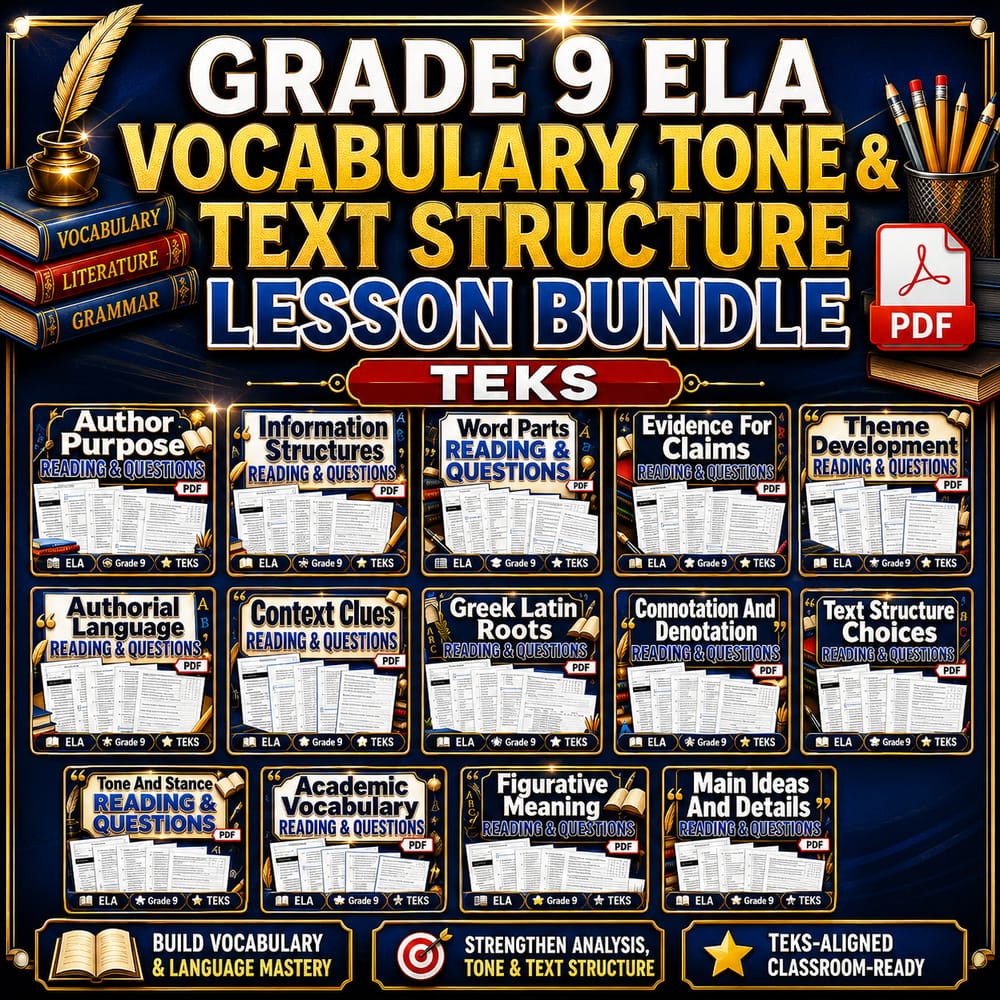


Reading/Vocabulary Development Lesson Bundle | Grade 9 ELA | TEKS
$44.80$56.00Save $11.20
Golden Apple Studio
New·2 followers·3 sales
SubjectELAGradeGrade 9
What’s included
14 worksheets · Save $11.20 (20%) · prices shown inside the bundle
 Grade 9 Author Purpose Worksheet | TEKS ELA Reading Comprehension
- Identify an author’s purpose by analyzing evidence, tone, and organization in a text.
- Distinguish between informing, persuading, analyzing, and entertaining purposes using key textual signals.
- Explain how audience and emphasis on emotion vs. logic shape meaning.
$3.20$4.00 Grade 9 Information Structures Worksheet | TEKS ELA Text Structure Analysis
- Identify how informational texts organize ideas using structures such as cause and effect, compare and contrast, problem and solution, and chronology.
- Use structural clues (headings, topic sentences, transitions) to predict where key information appears in nonfiction.
- Explain how supporting evidence is placed to balance claims and explanations in informational writing.
$3.20$4.00 Grade 9 Word Parts Worksheet | TEKS Vocabulary & Morphology Skills
- Identify how prefixes, roots, and suffixes contribute to a word’s meaning.
- Use word parts to infer the meaning of unfamiliar words in context.
- Recognize how suffixes can signal a word’s category or role in a sentence.
$3.20$4.00 Grade 9 Evidence for Claims Worksheet | TEKS ELA Argument Writing
- Identify the difference between a claim and the evidence that supports it.
- Evaluate whether evidence directly supports a claim or is loosely related.
- Explain how reasoning connects evidence to meaning in an argument.
$3.20$4.00 Grade 9 Theme Development Worksheet | TEKS ELA Literary Analysis
- Explain how themes develop through patterns in events, character decisions, and recurring ideas.
- Support a theme claim with evidence from the text and explain how that evidence points beyond plot summary.
- Distinguish a theme (broader message) from a topic or a single quote taken out of context.
$3.20$4.00 Authorial Language Worksheet for Grade 9 ELA | TEKS Literary Analysis
- Identify how authorial language signals relationships such as cause, effect, reason, contrast, and qualification.
- Interpret how logical connectors (e.g., therefore, although, for instance, as a result) change the meaning of sentences in complex paragraphs.
- Explain a writer’s idea development by citing the sentence-level signals that link claims, support, and conclusions.
$3.20$4.00 Context Clues Worksheet for Grade 9 ELA | TEKS Vocabulary Skills
- Identify word meaning using definition, example, and contrast context clues.
- Use pronoun reference and causal wording (because/therefore/so) to infer meaning.
- Select the best answer that matches how context narrows possible meanings of an unknown word.
$3.20$4.00 Greek and Latin Roots Worksheet for Grade 9 ELA | TEKS Vocabulary
- Identify common Greek and Latin roots and explain how they contribute to word meaning.
- Determine how prefixes and suffixes change or refine the meaning of a root in context.
- Use root meanings to interpret academic vocabulary in informational and argumentative writing.
$3.20$4.00 Grade 9 Connotation and Denotation Worksheet | TEKS ELA Vocabulary
- Distinguish denotation (literal meaning) from connotation (emotional or cultural associations).
- Analyze how word choice reveals an author’s stance in evaluative contexts.
- Determine whether a given interpretation depends on denotation, connotation, or both.
$3.20$4.00 Text Structure Choices Worksheet for Grade 9 ELA | TEKS Reading Skills
- Identify how narrative and informational text structures affect pacing, emphasis, and the order of ideas.
- Explain how structural choices influence a reader’s understanding of characters, themes, and purpose.
- Use structural clues (chronology, flashbacks, headings, transitions) to make accurate inferences about meaning.
$3.20$4.00
Reviews & Feedback
Loading reviews...
Questions & Answers
Loading questions…
About this bundle
Related categories
Frequently asked questions
Who is Reading/Vocabulary Development Lesson Bundle | Grade 9 ELA | TEKS designed for?
Reading/Vocabulary Development Lesson Bundle | Grade 9 ELA | TEKS is designed for Grade 9 students and ELA learners and can be used in classrooms, homeschool, or independent practice.
How do I download Reading/Vocabulary Development Lesson Bundle | Grade 9 ELA | TEKS?
Add it to your cart and complete checkout. After payment, you can download immediately from your account, and you'll also receive a download link by email.
Similar Products

Theme, Text Evidence & Character Development Lesson Bundle | Grade 4 ELA | Common Core
$19.20$24.00

Reading, Evidence & Argument Development Lesson Bundle | Grade 7 ELA | CCSS
$25.60$32.00

Grade 12 Reading Informational ELA Lesson Bundle for Daily Reading | General ELA
$19.20$24.00

Reading Grade 10 ELA Daily Reading Worksheets Lesson Bundle | TEKS
$32.00$40.00

Media Messages & Persuasion Grade 7 ELA Daily Reading Worksheets Bundle | TEKS
$16.00$20.00