
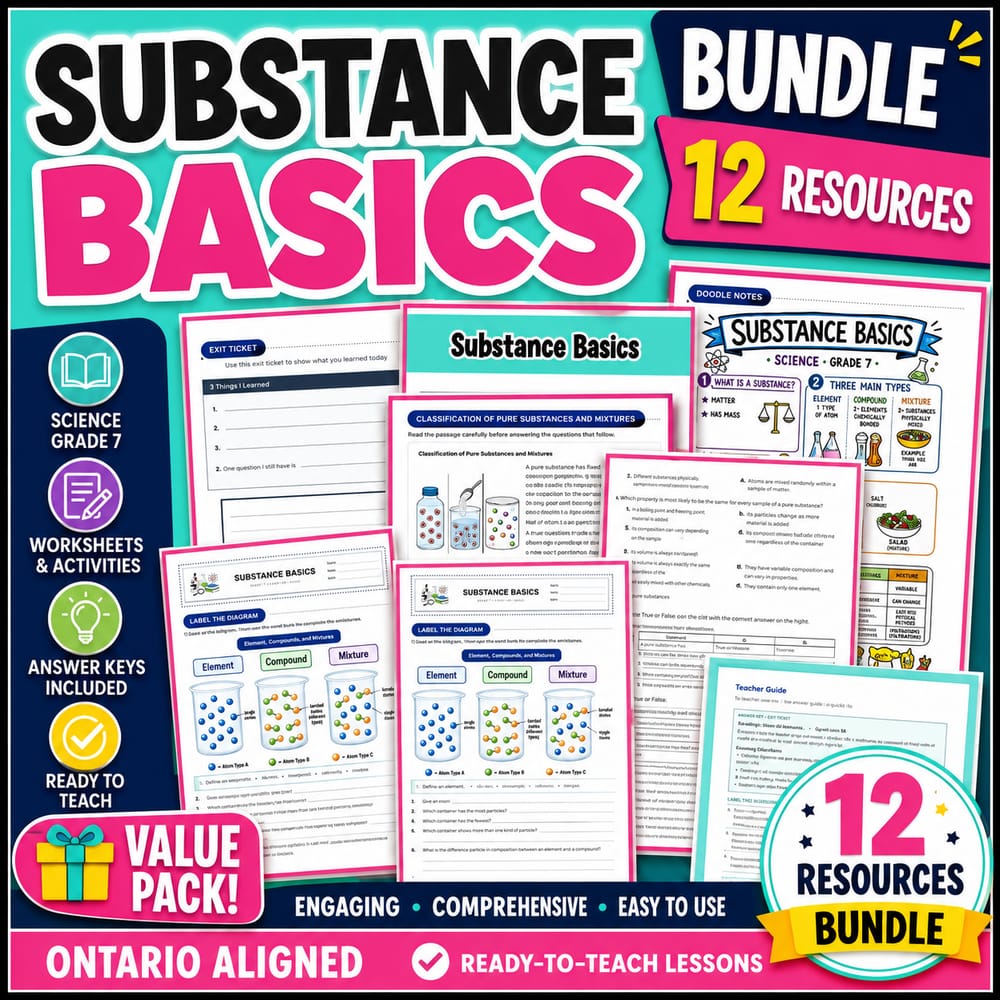


Separation of Mixtures & Matter Properties Lesson Bundle – Grade 7 Science
$48.00$60.00Save $12.00
Chalk and Compass
·5 followers·13 sales
SubjectScienceGradeGrade 7
What’s included
12 worksheets · Save $12.00 (20%) · prices shown inside the bundle
 Grade 7 Filtration Methods Worksheet | Separation of Mixtures Science
- Explain how filtration and sedimentation separate mixtures using particle size, shape, and phase differences.
- Describe how porous media and pore size affect flow behavior during filtration.
- Identify the limitations of filtration for dissolved solutes and fine particles like colloids.
$4.00$5.00 Physical Properties Worksheet Grade 7 Science Ontario + Doodle Note
- Define physical properties and distinguish them from physical changes.
- Use measurements such as mass, volume, and density to identify and compare materials.
- Explain how melting and boiling points, conductivity, and optical clarity support material classification.
$4.00$5.00 Density Separation Worksheet Grade 7 Science | Ontario Curriculum
- Explain how density differences allow mixtures to be separated using decanting, flotation, and centrifugation.
- Describe how buoyant force, sedimentation rate, and centrifugal acceleration relate to particle size and density contrast.
- Choose an appropriate density-separation method by comparing what each method uses (gravity, buoyancy, or acceleration).
$4.00$5.00 Chemical Properties Worksheet Grade 7 Science | Reactions & Evidence
- Describe how chemical properties determine how substances behave during chemical changes.
- Identify observable indicators of chemical reactions, including gas evolution, color change, and precipitate formation.
- Explain relationships among reactivity, combustion, oxidation/corrosion, and pH-related transformations.
$4.00$5.00 Purity Assessment Worksheet Grade 7 Science | Ontario Chemistry Unit
- Identify how melting point, boiling point, conductivity, refractive index, and gravimetric residue can indicate impurities in a sample.
- Explain why different purity tests may give different results and how using multiple lines of evidence improves confidence.
- Apply purity concepts to evaluate whether a suspected substance is likely pure or contaminated.
$4.00$5.00 Mixture Types Worksheet Grade 7 Science | Solutions Colloids Suspensions
- Classify mixtures as solutions, colloids, or suspensions using particle size and uniformity.
- Explain how light scattering and stability help distinguish mixture types.
- Predict how mixtures behave during simple separation processes.
$4.00$5.00 Evaporation Crystallization Worksheet Grade 7 Science Ontario
- Explain how evaporation and controlled cooling lead to nucleation and crystal growth.
- Describe how evaporation rate, cooling profile, and impurities affect crystal size and purity.
- Relate recrystallization to improved purity using well-ordered crystal lattices.
$4.00$5.00 Chromatography Techniques Worksheet Grade 7 Science Investigation
- Explain how chromatography separates mixtures using a stationary phase and a mobile phase.
- Describe how molecular polarity and differential partitioning lead to different migration distances.
- Interpret retention factors (Rf) and use resolution ideas to compare separations.
$4.00$5.00 Elements vs Compounds Worksheet Grade 7 Science Ontario Unit
- Compare elements and compounds using atomic composition, chemical formulas, and bonding
- Explain how chemical combination changes observable properties such as melting point and conductivity
- Identify substances as elements or compounds based on particle type and fixed ratios
$4.00$5.00 Simple Distillation Worksheet Grade 7 Science Separation of Mixtures
- Explain how vapor pressure and boiling point differences allow separation of miscible liquids using simple distillation.
- Describe the roles of condensation and collection in producing a distillate with higher purity.
- Identify common limitations of distillation, including close boiling points and azeotropes.
$4.00$5.00
Reviews & Feedback
Loading reviews...
Questions & Answers
Loading questions…
About this bundle
Related categories
Frequently asked questions
Who is Separation of Mixtures & Matter Properties Lesson Bundle – Grade 7 Science designed for?
Separation of Mixtures & Matter Properties Lesson Bundle – Grade 7 Science is designed for Grade 7 students and Science learners and can be used in classrooms, homeschool, or independent practice.
How do I download Separation of Mixtures & Matter Properties Lesson Bundle – Grade 7 Science?
Add it to your cart and complete checkout. After payment, you can download immediately from your account, and you'll also receive a download link by email.


