
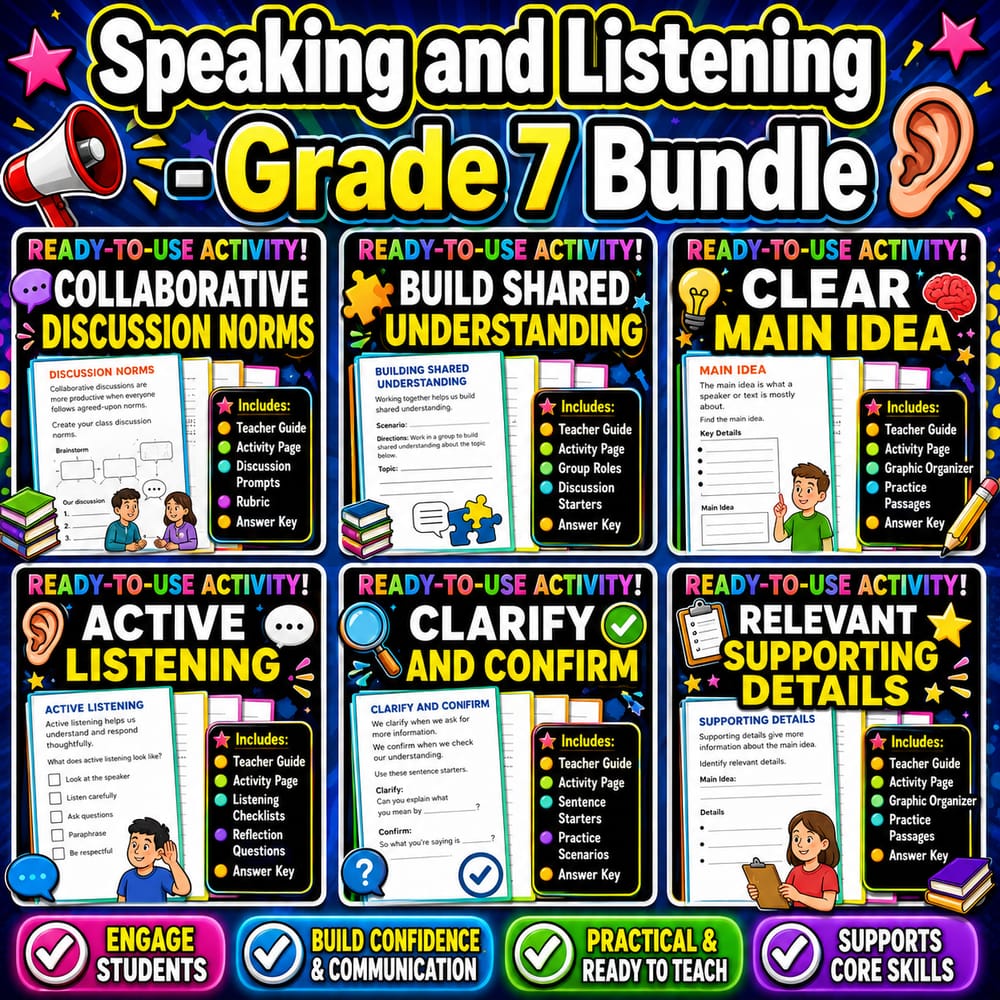
Speaking and Listening Lesson Bundle | Grade 7 English Language Arts | Alberta
$14.40$18.00Save $3.60
Sunny Desk Resources
·2 followers·18 sales
SubjectELAGradeGrade 7Pages66 Pages
What’s included
6 worksheets · 66 pages · Save $3.60 (20%) · prices shown inside the bundle
 Collaborative Discussion Norms Worksheet for Grade 7 ELA Practice
- Identify key discussion norms for collaborative small-group conversations (turn-taking, respectful language, and staying on topic).
- Use evidence and active listening strategies to respond to a peer’s ideas rather than ignoring them.
- Apply discussion norms to structured group formats and explain why they improve shared understanding.
$2.40$3.00 Build Shared Understanding Worksheet Pack | Grade 7 ELA Practice
- Identify communication signals that show how ideas connect during discussion (linking words, summaries, and references).
- Explain how synthesis helps discussions move forward when new information is added.
- Use reasoning and relevant details to disagree respectfully and maintain a coherent group stance.
$2.40$3.00 Clear Main Idea Worksheet Pack | Grade 7 ELA Practice and Assessment
- Identify the main idea in an oral or written message by focusing on the topic, purpose, and central claim.
- Analyze how an introduction, logical sequence, and concluding statement support clarity.
- Evaluate whether details are relevant or off-topic and weaken understanding.
$2.40$3.00 Active Listening Worksheet Pack | Grade 7 ELA Practice
- Identify how tone, emphasis, and key points affect the meaning of what someone says
- Paraphrase and summarize spoken ideas to show accurate understanding
- Use active-listening responses (acknowledge, clarify, and adjust) during class discussions and retells
$2.40$3.00 Clarify And Confirm Worksheet Pack | Grade 7 ELA Practice
- Use clarifying questions to target uncertain points in a conversation
- Restate a speaker’s idea accurately using different wording to confirm meaning
- Verify details when instructions, claims, or sequences are unclear
$2.40$3.00 Relevant Supporting Details Worksheet Pack | Grade 7 ELA Activities
- Explain how relevant supporting details strengthen an oral presentation by connecting directly to the main idea
- Distinguish between claims and reasons using accurate evidence
- Use transitions and concluding remarks to organize a timed or structured explanation
$2.40$3.00
Reviews & Feedback
Loading reviews...
Questions & Answers
Loading questions…
About this bundle
Related categories
Frequently asked questions
Who is Speaking and Listening Lesson Bundle | Grade 7 English Language Arts | Alberta designed for?
Speaking and Listening Lesson Bundle | Grade 7 English Language Arts | Alberta is designed for Grade 7 students and ELA learners and can be used in classrooms, homeschool, or independent practice.
How do I download Speaking and Listening Lesson Bundle | Grade 7 English Language Arts | Alberta?
Add it to your cart and complete checkout. After payment, you can download immediately from your account, and you'll also receive a download link by email.
Similar Products

Grade 9 Speaking & Listening Lesson Bundle | General English Language Arts
$12.00$15.00

Grade 10 Speaking & Listening ELA Daily Worksheets Lesson Bundle | General ELA
$16.00$20.00

Grade 12 ELA Speaking & Listening Lesson Bundle | TEKS Framework
$16.00$20.00

Speaking & Listening Grade 10 ELA Daily Reading Worksheets Lesson Bundle | CCSS
$19.20$24.00

Speaking and Listening Lesson Bundle | Grade 8 ELA | General ELA
$12.00$15.00