
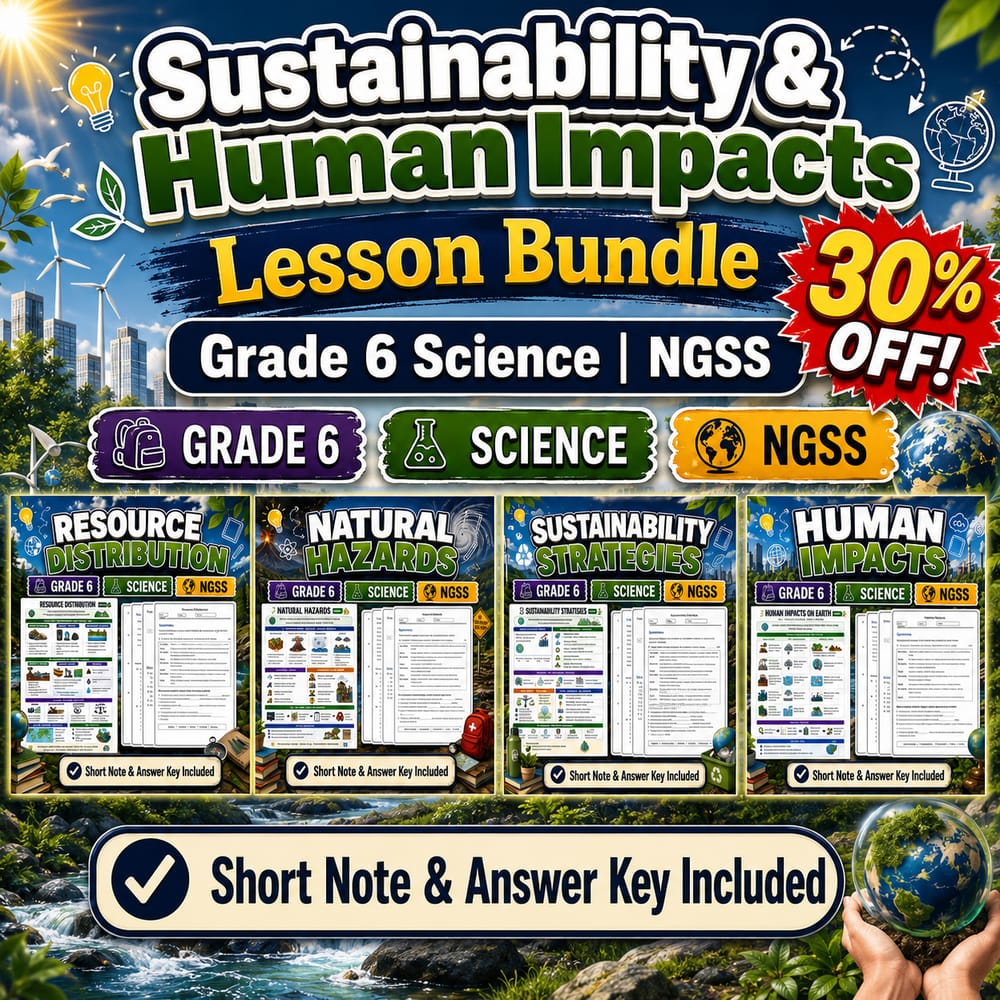
Sustainability & Human Impacts Lesson Bundle | Grade 6 Science | NGSS
$16.00$20.00Save $4.00
Northstar Worksheets
New·0 followers·0 sales
SubjectScienceGradeGrade 6
What’s included
4 worksheets · Save $4.00 (20%) · prices shown inside the bundle
 Grade 6 Resource Distribution Worksheet | NGSS Earth Science & Answer Key
- Explain how geoscience processes like plate tectonics, sedimentation, and weathering can affect where mineral and energy resources form.
- Describe how groundwater flow and hydrologic conditions influence the location and availability of aquifers.
- Evaluate how demand, extraction impacts, and technology affect trade-offs in resource allocation and long-term availability.
$4.00$5.00 Grade 6 Natural Hazards Worksheet | NGSS Earth Science Activity & Answer Key
- Explain how tectonic, atmospheric, and hydrologic processes contribute to the formation of natural hazards.
- Describe patterns in hazard frequency, intensity, and spatial distribution using evidence such as records and data.
- Analyze cause-and-effect relationships between natural hazard events and impacts on communities and infrastructure.
$4.00$5.00 Grade 6 Sustainability Strategies Worksheet | NGSS Environmental Science & Answer Key
- Explain how population trends and per-capita resource use can affect Earth systems.
- Compare sustainability strategies such as renewable energy, conservation, circular resource use, and land-management approaches.
- Evaluate trade-offs among environmental, economic, and social priorities when choosing sustainability solutions.
$4.00$5.00 Grade 6 Human Impacts Worksheet | NGSS Earth Science Activity & Answer Key
- Explain how land-use change, fossil fuel combustion, agriculture, and waste management alter Earth systems.
- Describe how human activities can modify biogeochemical cycles and climate drivers.
- Use cause-and-effect reasoning to connect an activity to an environmental trend over time and space.
$4.00$5.00
Reviews & Feedback
Loading reviews...
Questions & Answers
Loading questions…
About this bundle
Related categories
Frequently asked questions
Who is Sustainability & Human Impacts Lesson Bundle | Grade 6 Science | NGSS designed for?
Sustainability & Human Impacts Lesson Bundle | Grade 6 Science | NGSS is designed for Grade 6 students and Science learners and can be used in classrooms, homeschool, or independent practice.
How do I download Sustainability & Human Impacts Lesson Bundle | Grade 6 Science | NGSS?
Add it to your cart and complete checkout. After payment, you can download immediately from your account, and you'll also receive a download link by email.
Similar Products

Grade 6 Human Impacts & Sustainability Science Lesson Bundle Workbook NGSS
$16.00$20.00

Grade 7 Science Unit | Natural & Human Impacts Worksheets NGSS-Aligned (PDF)
$12.00$15.00

Grade 6 Science | Sustainability, Resource Distribution & Human Impacts Unit
$7.20$9.00

Grade 6 Science Unit | Natural Hazards & Human Impacts Worksheet Pack (NGSS)
$9.60$12.00

Grade 9 Science NGSS Lesson Bundle | Earth and Human Activity Unit
$14.40$18.00