
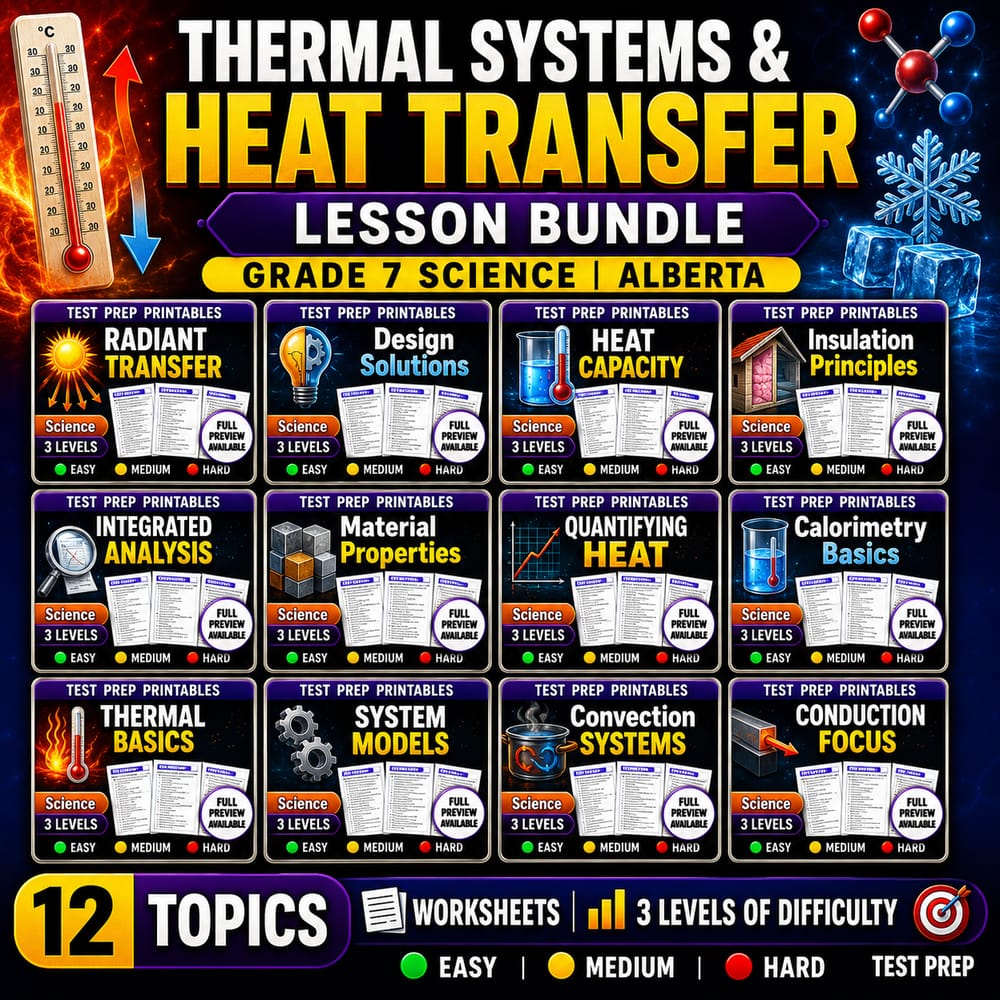


Thermal Systems & Heat Transfer Lesson Bundle | Grade 7 Science | Alberta
$56.00$70.00Save $14.00
Prism Point Learning
·2 followers·13 sales
SubjectScienceGradeGrade 7
What’s included
15 worksheets · Save $14.00 (20%) · prices shown inside the bundle
 Radiant Transfer Worksheet | Grade 7 Science Practice
- Explain how radiant transfer moves energy using electromagnetic waves without needing matter contact.
- Describe how solar radiation intensity, surface absorptivity, and emissivity affect net radiative heating and cooling.
- Apply emissivity and absorptivity ideas to predict daytime warming and nocturnal cooling of landscapes and buildings.
$4.00$5.00 Design Solutions Worksheet | Grade 7 Science | Alberta Standards Practice
- Explain how building orientation, the thermal envelope, and mechanical systems affect heat flow and seasonal energy use.
- Identify design strategies that improve comfort and reduce thermal bridges in cold Alberta climates.
- Describe trade-offs between upfront materials and ongoing energy/comfort needs.
$4.00$5.00 Heat Capacity Worksheet | Grade 7 Science Practice
- Explain the meaning of specific heat capacity and how it relates to thermal energy changes.
- Use the heat equation Q = m c ΔT with correct units (grams, degrees Celsius, Joules or kilojoules).
- Convert between Joules and kilojoules and interpret temperature-change measurements.
$4.00$5.00 Insulation Principles Worksheet | Grade 7 Science Activities
- Explain how insulation reduces heat transfer between inside and outside environments.
- Relate R-value, thickness, and construction details to thermal resistance and comfort.
- Describe how thermal bridges and air leaks can increase heat flow even when insulation is present.
$4.00$5.00 Integrated Analysis Worksheet Pack | Grade 7 Science Activities
- Use an energy budget to connect conduction, convection, and radiation to system energy performance
- Apply conservation of energy to compare net heat gain and required fuel energy in building or district heating systems
- Interpret how storage and conversion losses affect predicted temperature responses
$4.00$5.00 Material Properties Worksheet Pack | Grade 7 Science Activities
- Explain how thermal conductivity and specific heat capacity affect heat flow through common building materials
- Use material properties such as density and porosity to predict how moisture and temperature change in building assemblies
- Compare trade-offs between insulation performance and structural considerations for Alberta climates
$4.00$5.00 Quantitative Heat Worksheet Pack | Grade 7 Science Activities
- Use specific heat, mass, and temperature change to quantify energy transfer in Joules and kilojoules.
- Explain how thermal energy calculations connect to practical situations and energy budgets.
- Interpret basic claims about heating, melting, and energy units using quantitative reasoning.
$4.00$5.00 Calorimetry Basics Worksheet | Grade 7 Science Activities
- Explain how calorimetry uses temperature change to determine energy transfer.
- Apply the idea of energy conservation to heat gained or lost by substances.
- Use specific heat concepts to compare heating, cooling, melting, and thermal losses.
$4.00$5.00 Thermal Basics Worksheet | Grade 7 Science Activities
- Explain how temperature relates to average kinetic energy and how heat relates to energy transfer.
- Describe how heat moves from warmer to cooler objects through conduction, convection, and radiation.
- Use Alberta winter/practice examples to connect thermal transfer to real-world situations.
Free System Models Worksheet | Grade 7 Science Activities
- Explain how energy inputs, useful outputs, and losses can be traced in system models
- Use energy flow ideas (including waste heat) to discuss conservation of energy in real systems
- Interpret simple Sankey-style energy pathways and calculate or compare conversion efficiency
$4.00$5.00
Reviews & Feedback
Loading reviews...
Questions & Answers
Loading questions…
About this bundle
Related categories
Frequently asked questions
Who is Thermal Systems & Heat Transfer Lesson Bundle | Grade 7 Science | Alberta designed for?
Thermal Systems & Heat Transfer Lesson Bundle | Grade 7 Science | Alberta is designed for Grade 7 students and Science learners and can be used in classrooms, homeschool, or independent practice.
How do I download Thermal Systems & Heat Transfer Lesson Bundle | Grade 7 Science | Alberta?
Add it to your cart and complete checkout. After payment, you can download immediately from your account, and you'll also receive a download link by email.
Similar Products

Grade 7 Thermal Systems Models and Heat Transfer Science Lesson Bundle – Alberta
$60.00$75.00

Grade 7 Thermal Energy & Heat Transfer Science Lesson Bundle: Ontario
$48.00$60.00

Energy, Heat and Thermal Processes Lesson Bundle: Grade 7 Science Alberta
$60.00$75.00

Grade 7 Science Lesson Group | Thermal Effects and Heat Transfer Worksheets
$28.80$36.00

Grade 7 Science Lesson Group: Ontario Curriculum | Thermal & Heat Transfer
$28.80$36.00