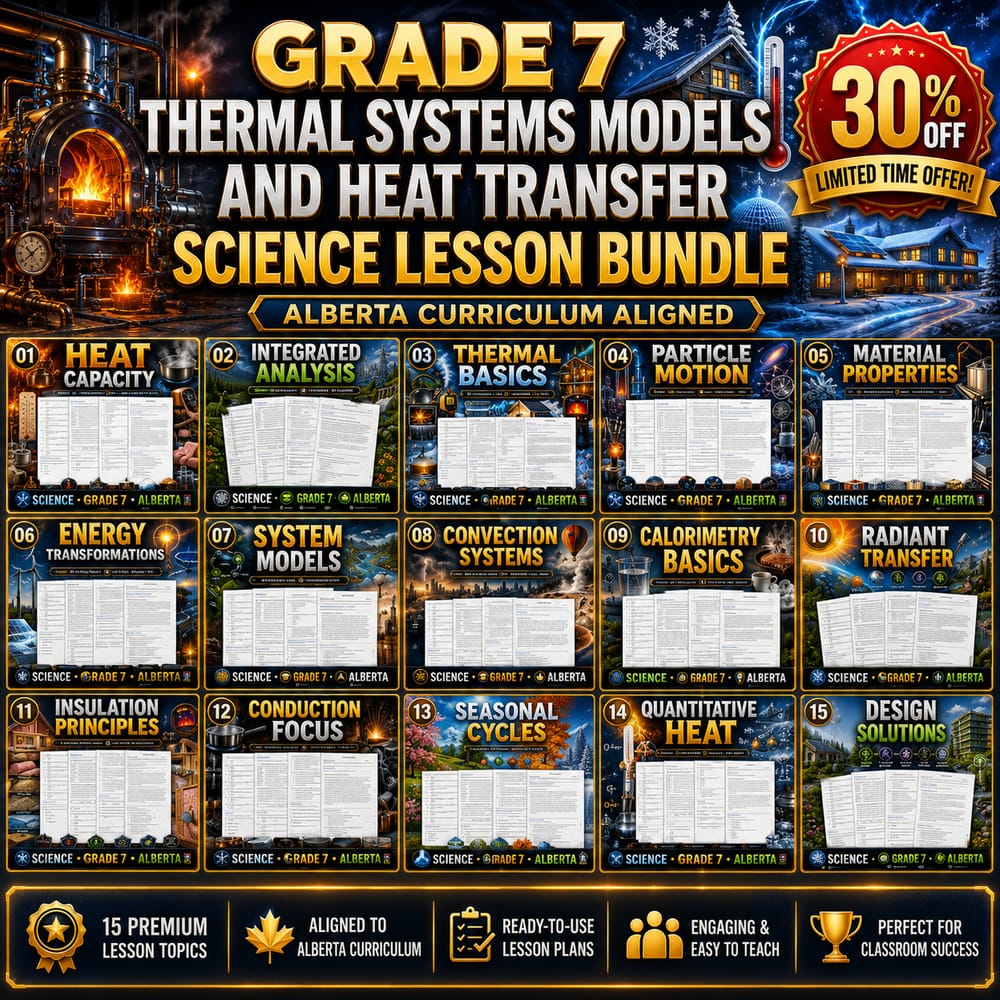
Grade 7 Thermal Systems Models and Heat Transfer Science Lesson Bundle – Alberta — bundle cover
Grade 7 Thermal Systems Models and Heat Transfer Science Lesson Bundle – Alberta — included worksheet 1
Grade 7 Thermal Systems Models and Heat Transfer Science Lesson Bundle – Alberta — included worksheet 2
Grade 7 Thermal Systems Models and Heat Transfer Science Lesson Bundle – Alberta — included worksheet 3
Grade 7 Thermal Systems Models and Heat Transfer Science Lesson Bundle – Alberta — included worksheet 4
Grade 7 Thermal Systems Models and Heat Transfer Science Lesson Bundle – Alberta — included worksheet 5
Grade 7 Thermal Systems Models and Heat Transfer Science Lesson Bundle – Alberta — included worksheet 6
Grade 7 Thermal Systems Models and Heat Transfer Science Lesson Bundle – Alberta — included worksheet 7
Grade 7 Thermal Systems Models and Heat Transfer Science Lesson Bundle – Alberta — included worksheet 8
Grade 7 Thermal Systems Models and Heat Transfer Science Lesson Bundle – Alberta — included worksheet 9
Grade 7 Thermal Systems Models and Heat Transfer Science Lesson Bundle – Alberta — included worksheet 10
Grade 7 Thermal Systems Models and Heat Transfer Science Lesson Bundle – Alberta — included worksheet 11
Grade 7 Thermal Systems Models and Heat Transfer Science Lesson Bundle – Alberta — included worksheet 12
Grade 7 Thermal Systems Models and Heat Transfer Science Lesson Bundle – Alberta — included worksheet 13
Grade 7 Thermal Systems Models and Heat Transfer Science Lesson Bundle – Alberta — included worksheet 14
Grade 7 Thermal Systems Models and Heat Transfer Science Lesson Bundle – Alberta — included worksheet 15
Grade 7 Science worksheet — Grade 7 Thermal Systems Models and Heat Transfer Science Lesson Bundle – Alberta

Description

Overview


Grade 7 science thermal systems models and heat transfer lesson bundle materials help students connect observations to explanations using Alberta-aligned practice. With 15 worksheets, this science unit bundle supports consistent skill development in thermal concepts, from radiant and conductive transfer to convection systems and energy changes 🌡️.

Use the set as a focused mini-unit resource for teaching heat flow through models, particle motion, and quantitative reasoning while keeping expectations clear for learners.

What’s Included


  • ✅ Grade 7 Science – System Models Worksheet (Alberta Standards) (PDF) – Build clear system models for thermal processes.
  • ✅ Grade 7 Science – Radiant Transfer Worksheet (Alberta Standards) (PDF) – Practice identifying how radiation moves energy.
  • ✅ Grade 7 Science | Integrated Analysis Worksheet (Alberta Standards) (PDF) – Combine multiple ideas to analyze a thermal scenario.
  • ✅ Grade 7 Science – Design Solutions Worksheet (Alberta Standards) (PDF) – Apply thermal principles to propose and justify a solution.
  • ✅ Grade 7 Science | Convection Systems Worksheet (Alberta Standards PDF) – Investigate convection in thermal systems.
  • ✅ Grade 7 Science – Calorimetry Basics Worksheet (Alberta Standards PDF) – Introduce basics of measuring heat transfer with calorimetry.
  • ✅ Grade 7 Science | Thermal Basics Worksheet (Alberta Standards) (PDF) – Review core thermal vocabulary and foundational ideas.
  • ✅ Grade 7 Science Worksheet | Seasonal Cycles & Thermal Patterns (PDF) – Relate seasonal patterns to thermal changes.
  • ✅ Grade 7 Science – Quantitative Heat Worksheet (PDF) Alberta Standards – Strengthen quantitative thinking about heat energy.
  • ✅ Grade 7 Science Particle Motion Worksheet – Alberta Standards (PDF) – Connect particle motion to temperature and thermal energy.
  • ✅ Grade 7 Science | Material Properties Worksheet (Alberta Standard, PDF) – Examine how material properties affect heat transfer.
  • ✅ Grade 7 Science | Insulation Principles Worksheet (Alberta Standard, PDF) – Use insulation concepts to predict thermal outcomes.
  • ✅ Grade 7 Science Worksheet | Understanding Heat Capacity (PDF) – Alberta Standards – Explain heat capacity using evidence-based reasoning.
  • ✅ Grade 7 Science | Energy Transformations Worksheet (Alberta Standards) (PDF) – Track energy transformations during thermal events.
  • ✅ Grade 7 Science – Conduction Worksheet (Alberta Standards) (PDF) – Interpret conduction in solids and everyday examples.

Skills & Standards


Designed to support Alberta expectations for grade 7 science, this resource emphasizes crosscutting concepts such as systems and system models and cause and effect, along with disciplinary core ideas about energy, thermal interactions, and energy transformations. Students practice modeling by representing thermal systems, then use analytical reasoning to compare transfer methods (radiation, conduction, and convection) and to reason through particle motion. Many prompts ask for evidence-based explanations that connect data, observations, and scientific relationships to make claims they can defend.

Perfect For


  • Teachers seeking structured instruction
  • Sub plans
  • Homework or review
  • Intervention or centers
  • Assessment preparation

How to Use


For a lesson bundle, consider multi-day pacing by grouping worksheets into 3 mini-lessons: (1) build thermal system models and foundations, (2) focus on transfer types and particle motion, and (3) apply ideas to quantitative heat, heat capacity, and insulation/design tasks. Assign two worksheets per class period for guided practice, then use one worksheet as an exit ticket or center rotation to check analytical reasoning and model quality.

Closing


Download this Grade 7 science lesson bundle to help students explain heat transfer using thermal systems models and evidence-based reasoning aligned to Alberta.

Grade 7 Thermal Systems Models and Heat Transfer Science Lesson Bundle – Alberta

$60.00$75.00Save $15.00
Silver Birch Teaching
New·0 followers·0 sales
SubjectScienceGradeGrade 7

What’s included

15 worksheets · Save $15.00 (20%) · prices shown inside the bundle

  1. Grade 7 Science Worksheet | Understanding Heat Capacity (PDF) – Alberta Standards
    Grade 7 Science Worksheet | Understanding Heat Capacity (PDF) – Alberta Standards

    Grade 7 · Science · 8 Pages

    • Define specific heat capacity and explain what its units mean in terms of energy and temperature change.
    • Use the heat equation to describe how mass, specific heat, and temperature change affect the energy transferred.
    • Convert between joules and kilojoules and between grams and kilograms when solving heat-related problems.
    $4.00$5.00
  2. Grade 7 Science | Integrated Analysis Worksheet (Alberta Standards) (PDF)
    Grade 7 Science | Integrated Analysis Worksheet (Alberta Standards) (PDF)

    Grade 7 · Science · 8 Pages

    • Explain how conduction, convection, and radiation contribute to heat transfer in energy systems.
    • Use energy budget ideas and conservation concepts to interpret net heat gain and energy losses.
    • Connect component-level heat transfer information to system-level predictions (e.g., temperature response).
    $4.00$5.00
  3. Grade 7 Science | Thermal Basics Worksheet (Alberta Standards) (PDF)
    Grade 7 Science | Thermal Basics Worksheet (Alberta Standards) (PDF)

    Grade 7 · Science · 8 Pages

    • Explain how particle motion relates to temperature and thermal energy.
    • Distinguish heat from temperature and describe heat transfer by conduction, convection, and radiation.
    • Apply thermal transfer concepts to real-world Alberta climate examples.
    $4.00$5.00
  4. Grade 7 Science Particle Motion Worksheet – Alberta Standards (PDF)
    Grade 7 Science Particle Motion Worksheet – Alberta Standards (PDF)

    Grade 7 · Science · 8 Pages

    • Explain how temperature relates to the average random kinetic energy of particles.
    • Describe how thermal energy depends on both particle motion and the number of particles.
    • Use the idea of a molecular speed distribution to interpret temperature differences and heat transfer.
    $4.00$5.00
  5. Grade 7 Science | Material Properties Worksheet (Alberta Standard, PDF)
    Grade 7 Science | Material Properties Worksheet (Alberta Standard, PDF)

    Grade 7 · Science

    • Explain how thermal conductivity, specific heat capacity, density, and phase change influence heat transfer in materials.
    • Compare common building insulation materials and construction components using their material properties and practical trade-offs.
    • Use property vocabulary (porosity, moisture content, thermal bridging, conductivity) to justify material selection for seasonal performance.
    $4.00$5.00
  6. Grade 7 Science | Energy Transformations Worksheet (Alberta Standards) (PDF)
    Grade 7 Science | Energy Transformations Worksheet (Alberta Standards) (PDF)

    Grade 7 · Science · 8 Pages

    • Explain energy transformations using the idea that total energy is conserved.
    • Identify common forms of energy (mechanical, chemical, electrical, and thermal) and describe how they change during real processes.
    • Use simple energy bookkeeping to predict what energy form increases or decreases in a system.
    $4.00$5.00
  7. Grade 7 Science – System Models Worksheet (Alberta Standards) (PDF)
    Grade 7 Science – System Models Worksheet (Alberta Standards) (PDF)

    Grade 7 · Science · 8 Pages

    • Explain how system models trace energy pathways and transformations in mechanical and industrial contexts.
    • Use energy accounting to identify inputs, useful outputs, and waste (thermal) losses in a system.
    • Interpret energy flow diagrams (including Sankey-style ideas) to calculate and compare conversion efficiencies.
    $4.00$5.00
  8. Grade 7 Science | Convection Systems Worksheet (Alberta Standards PDF)
    Grade 7 Science | Convection Systems Worksheet (Alberta Standards PDF)

    Grade 7 · Science · 8 Pages

    • Explain how temperature changes create density differences that drive convection in fluids
    • Differentiate natural convection from forced convection using real-world examples
    • Identify key features of convection systems such as buoyancy and boundary layers
    $4.00$5.00
  9. Grade 7 Science – Calorimetry Basics Worksheet (Alberta Standards PDF)
    Grade 7 Science – Calorimetry Basics Worksheet (Alberta Standards PDF)

    Grade 7 · Science

    • Explain how calorimetry uses temperature change to determine energy transferred in joules.
    • Apply the relationship Q = mcΔT and energy conservation to interpret heat gained and heat lost.
    • Identify common assumptions in calorimetry (such as negligible heat loss to the surroundings).
    $4.00$5.00
  10. Grade 7 Science – Radiant Transfer Worksheet (Alberta Standards) (PDF)
    Grade 7 Science – Radiant Transfer Worksheet (Alberta Standards) (PDF)

    Grade 7 · Science

    • Explain how radiant transfer moves energy using electromagnetic waves without needing direct contact.
    • Describe how absorptivity, emissivity, and solar intensity affect heating and cooling of surfaces.
    • Interpret how different surface types (roofs, vegetation, snow) can create microclimate differences.
    $4.00$5.00

Reviews & Feedback

Loading reviews...

Questions & Answers

Loading questions…

About this bundle

Related categories

Frequently asked questions

Who is Grade 7 Thermal Systems Models and Heat Transfer Science Lesson Bundle – Alberta designed for?
Grade 7 Thermal Systems Models and Heat Transfer Science Lesson Bundle – Alberta is designed for Grade 7 students and Science learners and can be used in classrooms, homeschool, or independent practice.
How do I download Grade 7 Thermal Systems Models and Heat Transfer Science Lesson Bundle – Alberta?
Add it to your cart and complete checkout. After payment, you can download immediately from your account, and you'll also receive a download link by email.