
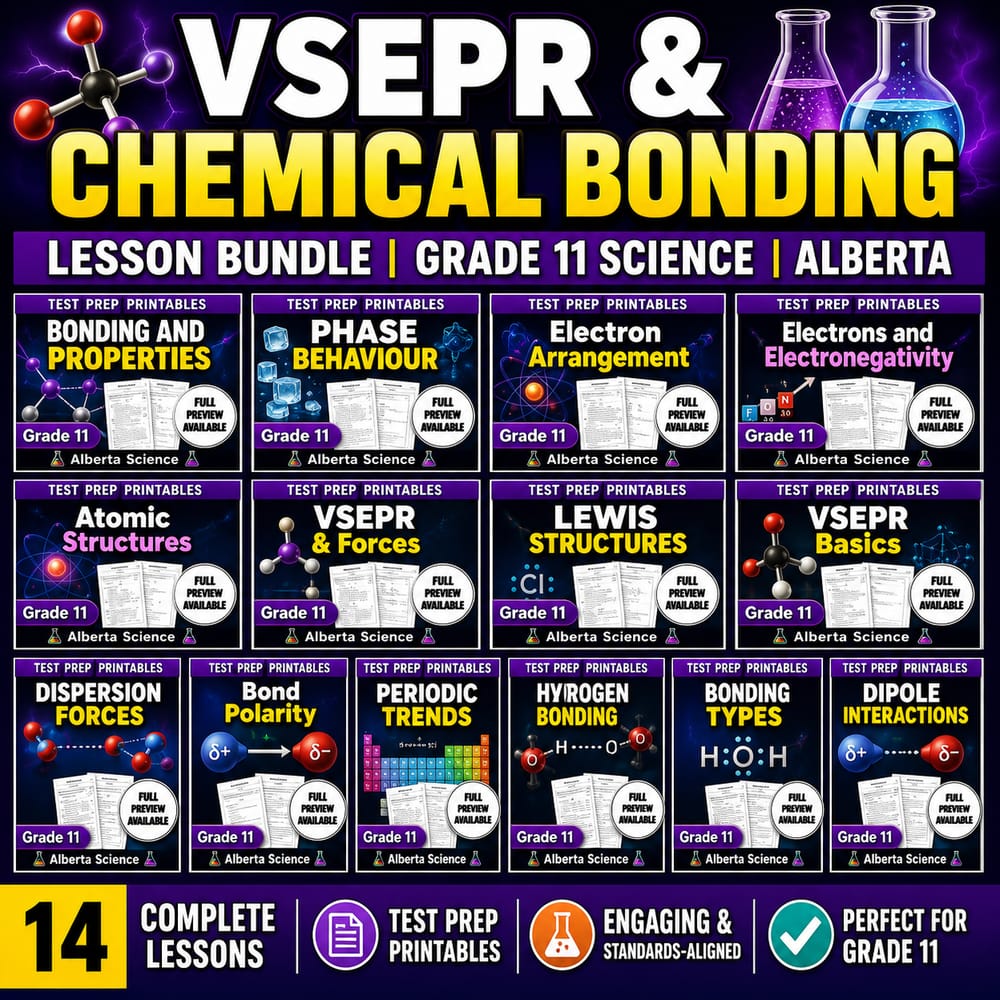


VSEPR & Chemical Bonding Lesson Bundle | Grade 11 Science | Alberta
$60.00$75.00Save $15.00
Prism Point Learning
·2 followers·14 sales
SubjectScienceGradeGrade 11Pages482 Pages
What’s included
15 worksheets · 482 pages · Save $15.00 (20%) · prices shown inside the bundle
 Bonding and Properties Worksheet Pack | Grade 11 Science Activities
- Compare ionic, covalent, and metallic bonding using particle-level ideas
- Predict physical properties such as melting point, conductivity, hardness, and solubility from bonding type
- Use real-world examples (e.g., salt for winter, steel in infrastructure, diamond/graphite materials) to justify property trends
$4.00$5.00 Phase Behaviour Worksheet | Grade 11 Science Activities
- Explain how intermolecular forces influence boiling point, vapor pressure, and phase changes.
- Interpret how molecular size, polarity, and temperature affect volatility and phase diagrams.
- Connect phase behaviour concepts to real-world examples such as petroleum fractions and atmospheric transport of organic compounds in Alberta.
$4.00$5.00 Electron Arrangement Worksheet | Grade 11 Science Practice
- Explain how valence electron distribution relates to molecular polarity and dipole moments
- Use electronegativity and electron-density ideas to predict whether molecules are polar or nonpolar
- Connect molecular polarity to observable intermolecular interactions, such as hydrogen bonding and dispersion forces
$4.00$5.00 Electronegativity Worksheet | Grade 11 Science Activities
- Explain what electronegativity measures and how it relates to electron attraction in a bond.
- Use electronegativity differences to predict bond polarity and identify polar vs. nonpolar covalent bonds.
- Describe periodic trends in electronegativity across periods and down groups.
$4.00$5.00 Atomic Structure Worksheet | Grade 11 Science Assessments
- Explain how protons, neutrons, and electrons determine atomic identity and charge
- Describe how electron arrangements (shells, subshells, and valence electrons) influence bonding and ion formation
- Connect atomic structure to common real-world examples such as sodium in road salt and carbon in hydrocarbons
$4.00$5.00 VSEPR & Forces Worksheet Practice | Grade 11 Science Activities
- Use VSEPR to predict molecular shape and relate shape to polarity and dipole alignment
- Compare intermolecular forces (London dispersion, dipole-dipole, and hydrogen bonding) using molecular examples
- Explain how intermolecular forces affect melting and boiling points, including real-world regional phenomena
$4.00$5.00 Lewis Structures Worksheet | Grade 11 Science Activities
- Draw Lewis structures showing valence electrons, bonding pairs, and lone pairs for common molecules.
- Use formal charge to select the most likely Lewis structure and minimize overall charge.
- Identify when resonance structures are needed to represent electron delocalization.
$4.00$5.00 VSEPR Basics Worksheet | Grade 11 Science Activities
- Use VSEPR electron-pair repulsion to predict molecular geometry from bonding and nonbonding pairs.
- Relate molecular shape to bond angles and predict relative polarity based on symmetry.
- Identify the electron-pair geometry vs. the molecular geometry for common VSEPR families.
$4.00$5.00 Dispersion Forces Worksheet | Grade 11 Science Activities
- Explain how London dispersion forces arise from instantaneous electron fluctuations in nonpolar substances
- Describe how dispersion strength depends on molar mass and molecular surface contact
- Connect dispersion forces to macroscopic properties such as melting point, viscosity, and phase behavior
$4.00$5.00 Bond Polarity Worksheet | Grade 11 Science Activities
- Explain how electronegativity differences create polar covalent bonds with partial charges.
- Distinguish polar bonds from polar molecules by using bond dipoles and molecular dipole vectors.
- Predict how molecular polarity affects interactions such as solubility and intermolecular forces.
$4.00$5.00
Reviews & Feedback
Loading reviews...
Questions & Answers
Loading questions…
About this bundle
Related categories
Frequently asked questions
Who is VSEPR & Chemical Bonding Lesson Bundle | Grade 11 Science | Alberta designed for?
VSEPR & Chemical Bonding Lesson Bundle | Grade 11 Science | Alberta is designed for Grade 11 students and Science learners and can be used in classrooms, homeschool, or independent practice.
How do I download VSEPR & Chemical Bonding Lesson Bundle | Grade 11 Science | Alberta?
Add it to your cart and complete checkout. After payment, you can download immediately from your account, and you'll also receive a download link by email.
