
Reading comprehension Worksheets
40,289 type resources
Grade 10 Science – Electromagnetic Forces & Fields | Daily Reading Worksheet
 Created byBright Mind Resources
Learning Objectives
- Understand the concept of electric fields and how they are represented
- Identify how electric field lines indicate the direction and strength of electric fields
- Explain the interaction between charges within an electric field
Also included in: Forces & Motion Grade 10 Science Daily Reading Worksheets Lesson Bundle | NGSS +2 more
Instant download
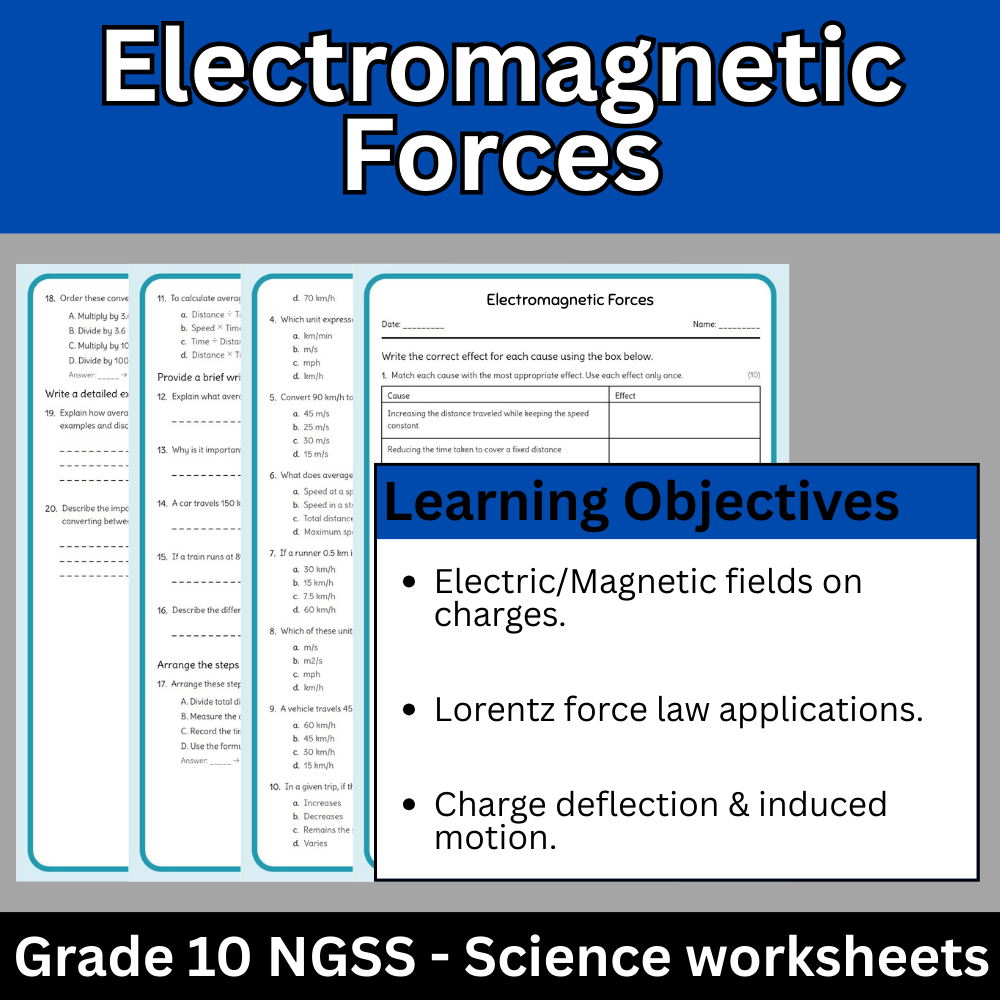
Grade 10 Science – Electromagnetic Forces Worksheet (Answer Key) | NGSS Aligned
Created byBright Mind ResourcesLearning Objectives
- Describe the role of electric and magnetic fields in forces on charges and currents.
- Explain the Lorentz force law and how it applies in simple contexts.
- Identify phenomena involving charge deflection, magnetic interactions, and electromagnet-induced motion.
Instant download
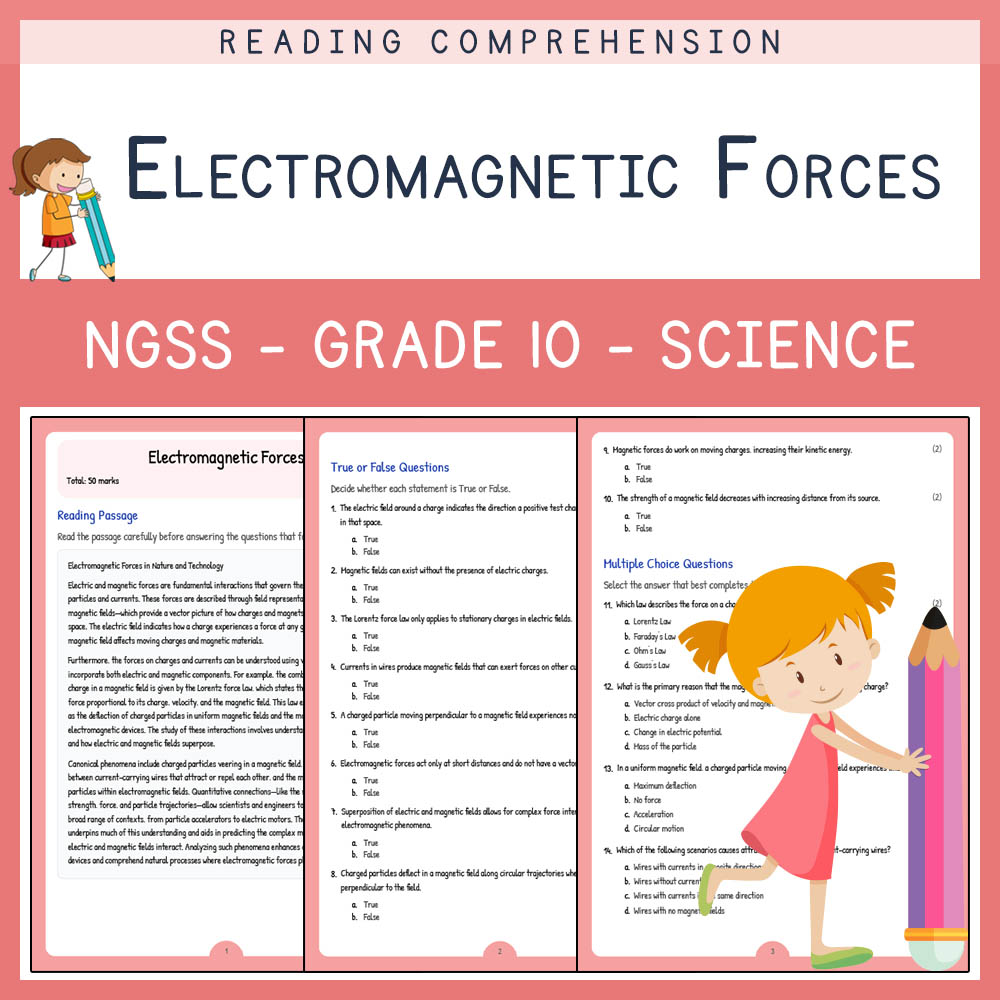
Grade 10 Science | Electromagnetic Forces Worksheet & Answer Key (NGSS Aligned)
 Created byLumora Learning
Learning Objectives
- Understand the principles of electric and magnetic fields and their vector relationships.
- Analyze forces on charges and currents within electric and magnetic fields, including the Lorentz force law.
- Apply concepts to phenomena such as charged particle deflection and magnetic interactions between current-carrying wires.
Instant download

Grade 10 Science | Electromagnetic Forces - Daily Reading Comprehension
 Created byCoral Reef Learning
Learning Objectives
- Understand the concept of electric fields and how they are represented
- Identify and interpret electric field lines and their directions
- Explore the forces exerted by electric fields on charges
Instant download
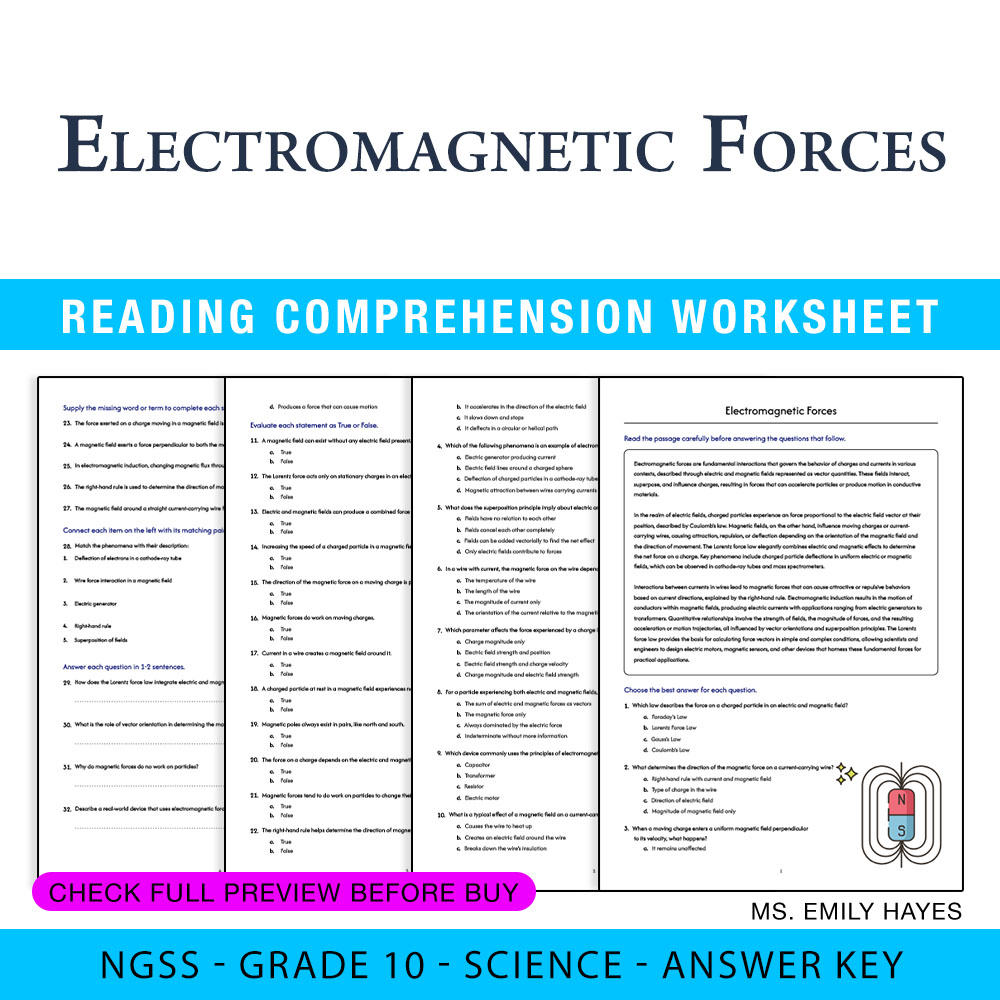
Grade 10 Science | Electromagnetic Forces Worksheet (PDF+ Answer Key)
 Created byCopper Leaf Classroom
Learning Objectives
- Describe the fundamental concepts of electric and magnetic fields and their interactions.
- Explain how forces on charges and currents are determined using vector relationships and the Lorentz force law.
- Identify and analyze canonical phenomena such as charge deflection, wire interactions, and electromagnet-induced motion.
Instant download

Grade 10 Science | Electromagnetic Forces Worksheet & Answer Key (Printable PDF)
Created byCoral Reef LearningLearning Objectives
- Describe the interactions of electric and magnetic fields.
- Explain the forces acting on charges and currents in fields.
- Apply the Lorentz force law in simple contexts involving particles and wires.
Also included in: Grade 10 Science Unit Worksheet Bundle | Forces,Motion & Space NGSS(Answer Keys) +1 more
Instant download
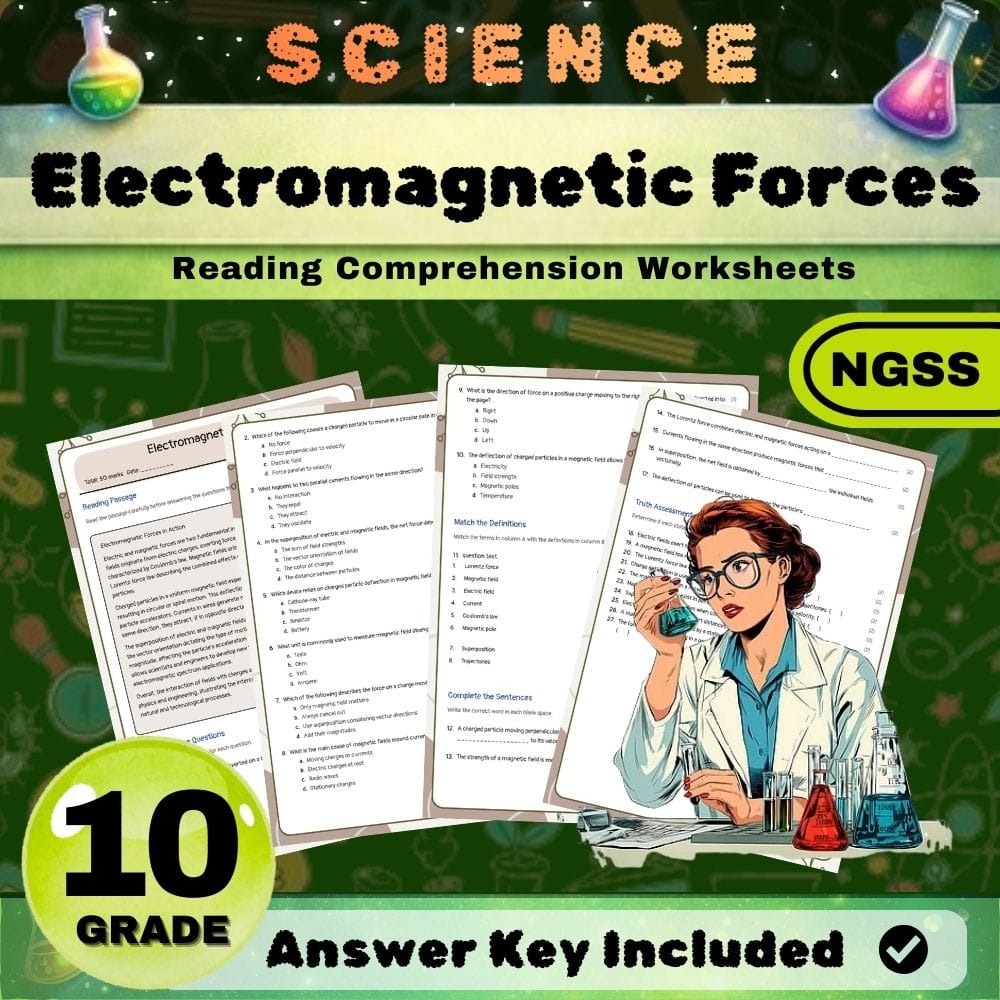
Grade 10 Science | Electromagnetic Forces Worksheet (NGSS PDF)
 Created byMaple Path Learning
Learning Objectives
- Describe how electric and magnetic fields interact with charges and currents.
- Explain the Lorentz force law and its application in simple contexts.
- Identify phenomena such as charged particle deflection and magnetic interactions between wires.
Also included in: Grade 10 Science Motion and Stability Forces and Interactions NGSS Lesson Bundle +1 more
Instant download

Phase Changes Worksheet Grade 8 Science Assessment | States of Matter
 Created byPrism Point Learning
Learning Objectives
- Explain how phase changes involve energy transfer even when temperature does not change immediately.
- Differentiate between melting, freezing, evaporation, and condensation using particle behavior.
- Describe real-life examples of phase changes and connect them to particle arrangement and motion.
Instant download

Grade 8 Science | Understanding Phase Changes - Reading Comprehension Practice
Created byCoral Reef LearningLearning Objectives
- Identify properties of melting and describe energy transfer during melting
- Recognize examples of melting in everyday life
- Explain the energy changes involved in phase changes
Instant download

Grade 8 Science | Phase Changes Worksheet | NGSSS Aligned
Created byLumora LearningLearning Objectives
- Explain how energy transfer during phase changes affects particle arrangement and motion
- Differentiate melting, freezing, evaporation, and condensation in terms of what happens to particles
- Identify which phase change involves energy being absorbed versus energy being released
Instant download

Phase Changes Worksheet | Grade 8 Science NGSSS Matter Changes + Key
 Created byEvergreen Desk Education
Learning Objectives
- Explain how energy transfer during phase changes affects particle arrangement and motion.
- Distinguish melting, freezing, evaporation, condensation, and boiling using particle behavior and energy changes.
- Use evidence from temperature trends to describe when energy is being used for rearranging particles versus changing temperature.
Instant download

Phase Changes Assessment | Florida NGSSS Grade 8 Science Standards
Created byPrism Point LearningLearning Objectives
- Explain how energy transfer is involved in phase changes such as melting, freezing, evaporation, and condensation.
- Describe particle-level arrangements and motion during different phase changes.
- Use evidence from everyday examples (ice melting, water droplets forming) to identify the phase change occurring.
Instant download

Text Inferences Practice Worksheet | Grade 6 ELA Review and Assessment
 Created byMeadowlark Worksheets
Learning Objectives
- Make inferences by using clues from events, dialogue, word choice, and tone.
- Support an inference with evidence from the text rather than using guesswork.
- Determine the most reasonable conclusion when more than one interpretation is possible.
Also included in: Grade 6 Text Evidence and Inference ELA Lesson Bundle for Alberta +1 more
Instant download

Text Inferences Worksheet Pack Grade 6 ELA Activities
 Created bySunny Desk Resources
Learning Objectives
- Identify clues in text (events, dialogue, word choice, and tone) that support an inference.
- Distinguish between what the text says directly and what can be reasonably inferred.
- Explain how evidence leads to a conclusion when multiple possibilities exist.
Also included in: Grade 6 Reading and Viewing Lesson Bundle | Alberta ELA Framework +1 more
Instant download

Grade 6 ELA | Text Inferences Worksheet | Alberta Assessment
Created byLumora LearningLearning Objectives
- Make reasonable inferences about characters’ motivations using clues from events, dialogue, and word choice
- Use textual evidence to support an inference when multiple explanations are possible
- Infer likely outcomes or implied relationships by connecting details across the passage
Instant download

Grade 7 Science | Equilibrium in Physics - Daily Reading Comprehension
Created byCoral Reef LearningLearning Objectives
- Define equilibrium as the state where the net force on an object is zero.
- Differentiate between static and dynamic equilibrium.
- Identify forces such as normal, gravitational, and tension in objects at equilibrium.
Instant download
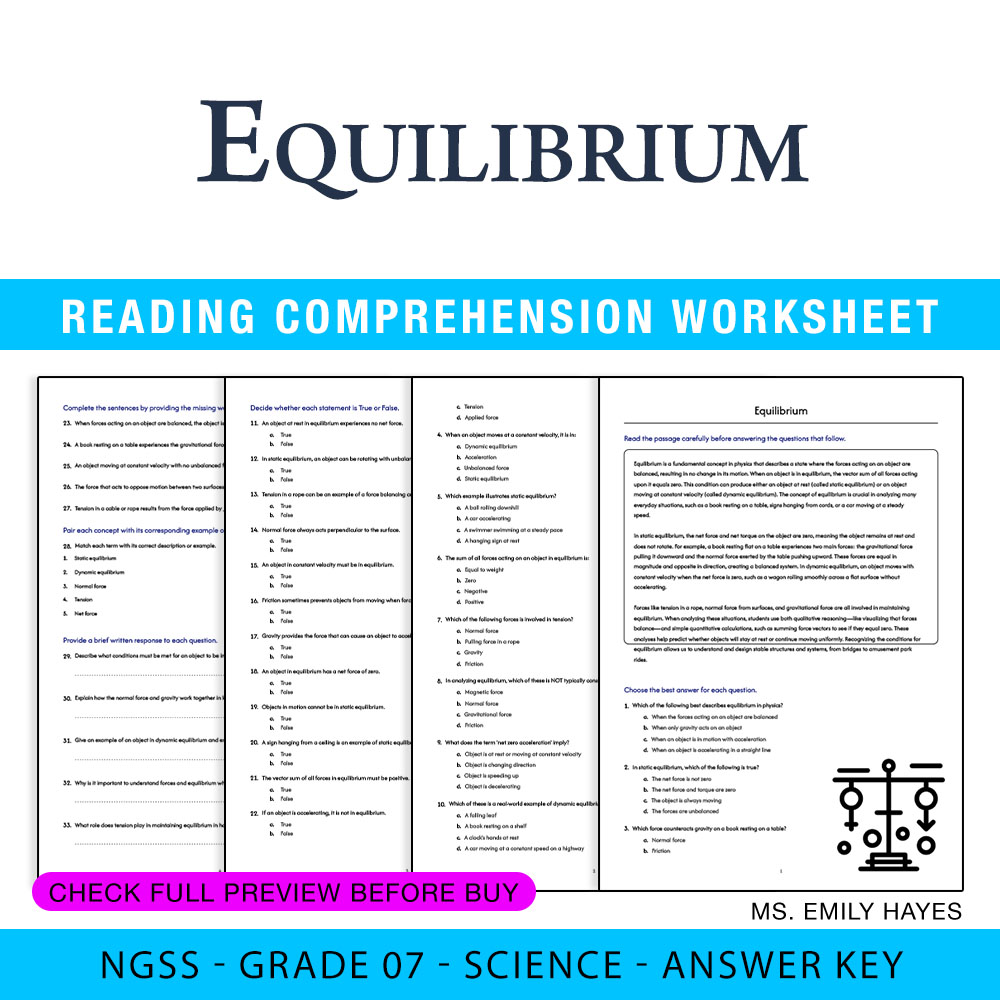
7th Grade Science | Equilibrium Worksheet (PDF+ Answer Key)
Created byCopper Leaf ClassroomLearning Objectives
- Understand the concept of equilibrium as the balance of forces acting on an object
- Differentiate between static and dynamic equilibrium
- Identify real-world examples of equilibrium in everyday objects
Instant download
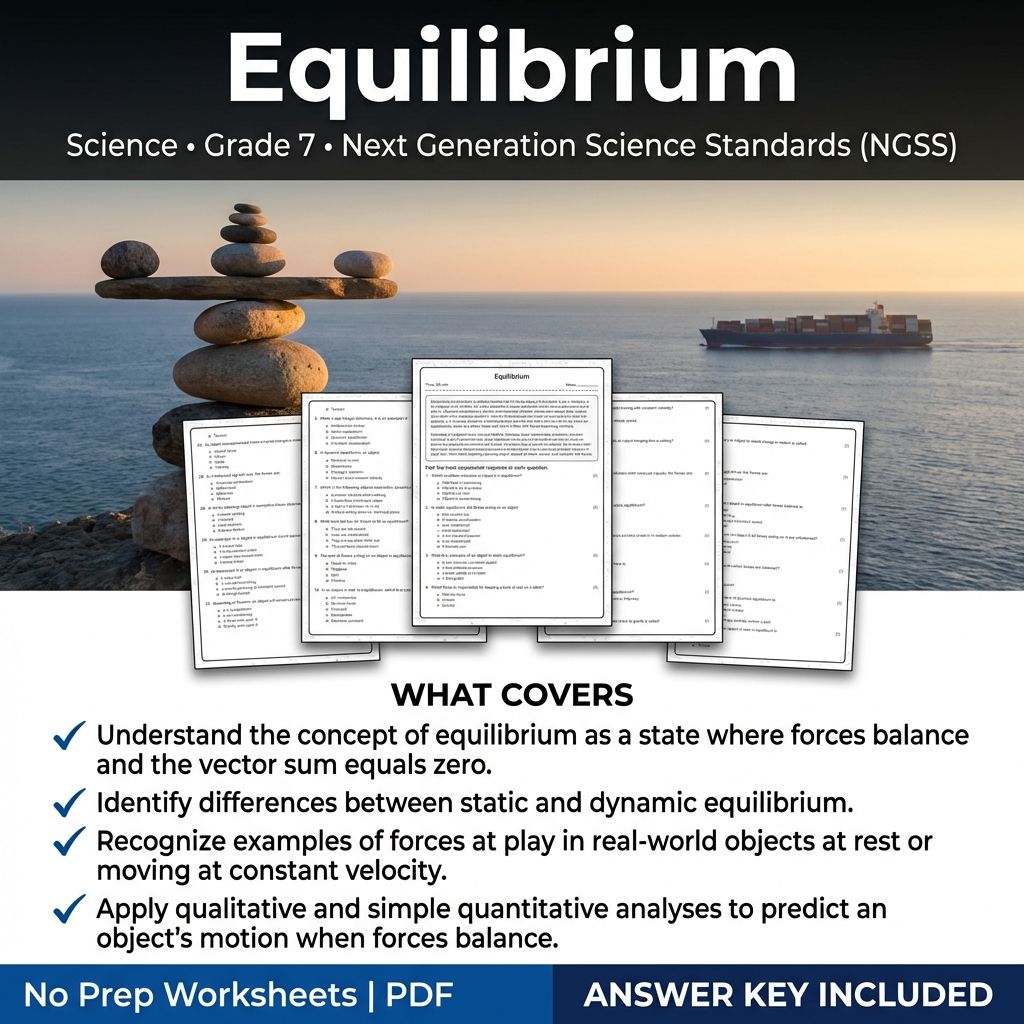
Grade 7 Science Worksheet | Equilibrium Concepts & Practice (PDF + Answer Key)
Created byCoral Reef LearningLearning Objectives
- Understand the concept of equilibrium as a state where forces balance and the vector sum equals zero.
- Identify differences between static and dynamic equilibrium.
- Recognize examples of forces at play in real-world objects at rest or moving at constant velocity.
Instant download
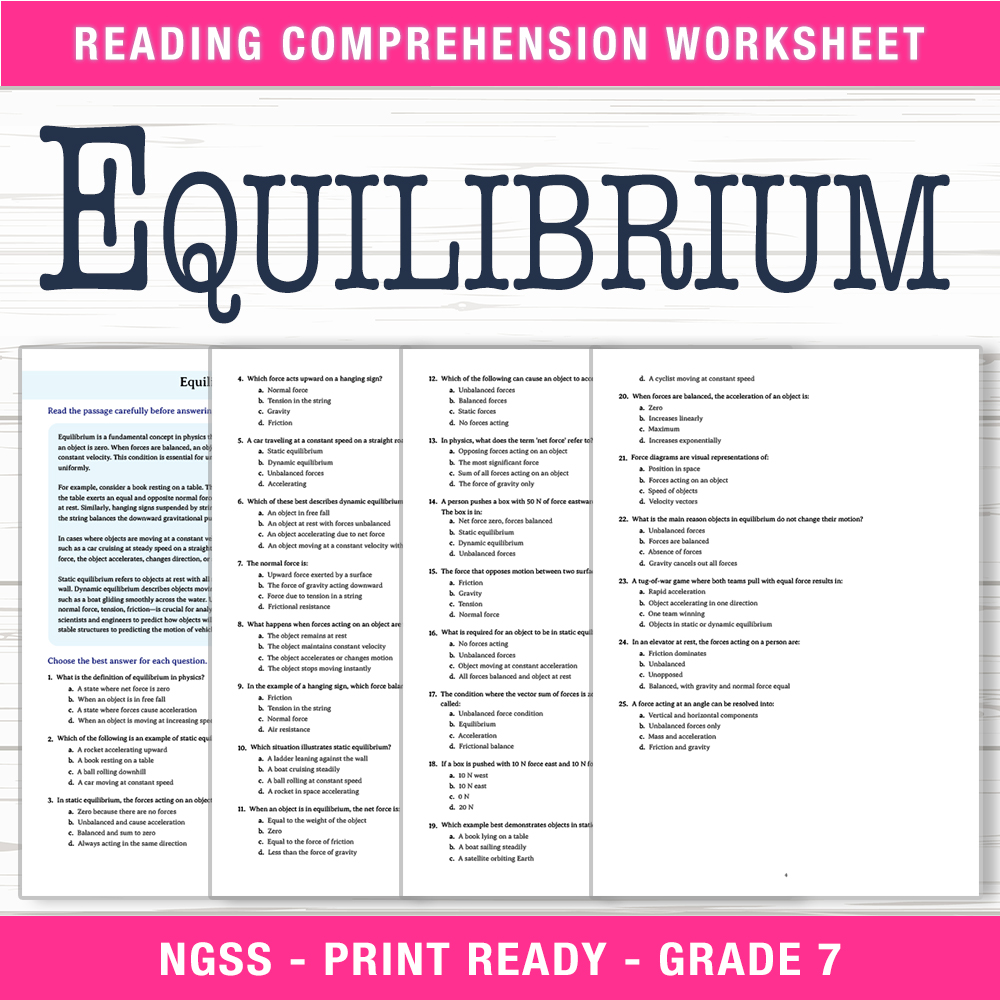
Grade 7 Science – Equilibrium Worksheet (PDF + Answer Key)
 Created byRiverstone Classroom
Learning Objectives
- Describe the concept of equilibrium as the balance of forces acting on an object.
- Differentiate between static and dynamic equilibrium with real-world examples.
- Apply qualitative and simple quantitative analyses to determine if forces are balanced in various situations.
Instant download
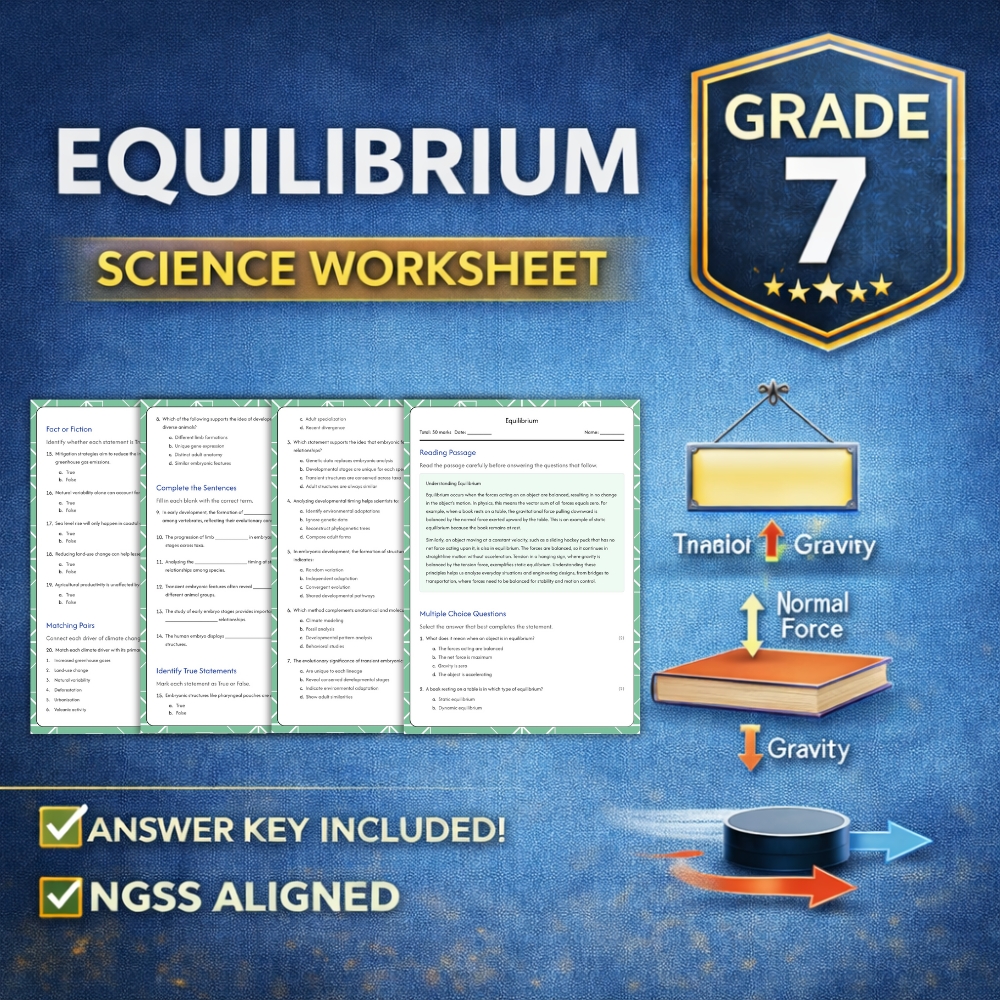
7th Grade Science | Equilibrium Worksheet (NGSS) with Answer Key
 Created byCedar Grove Learning
Learning Objectives
- Describe the concept of equilibrium as a state where forces balance and the vector sum of forces equals zero.
- Differentiate between static and dynamic equilibrium using real-world examples.
- Analyze forces such as normal force, gravitational force, tension, and their roles in maintaining equilibrium.
Instant download
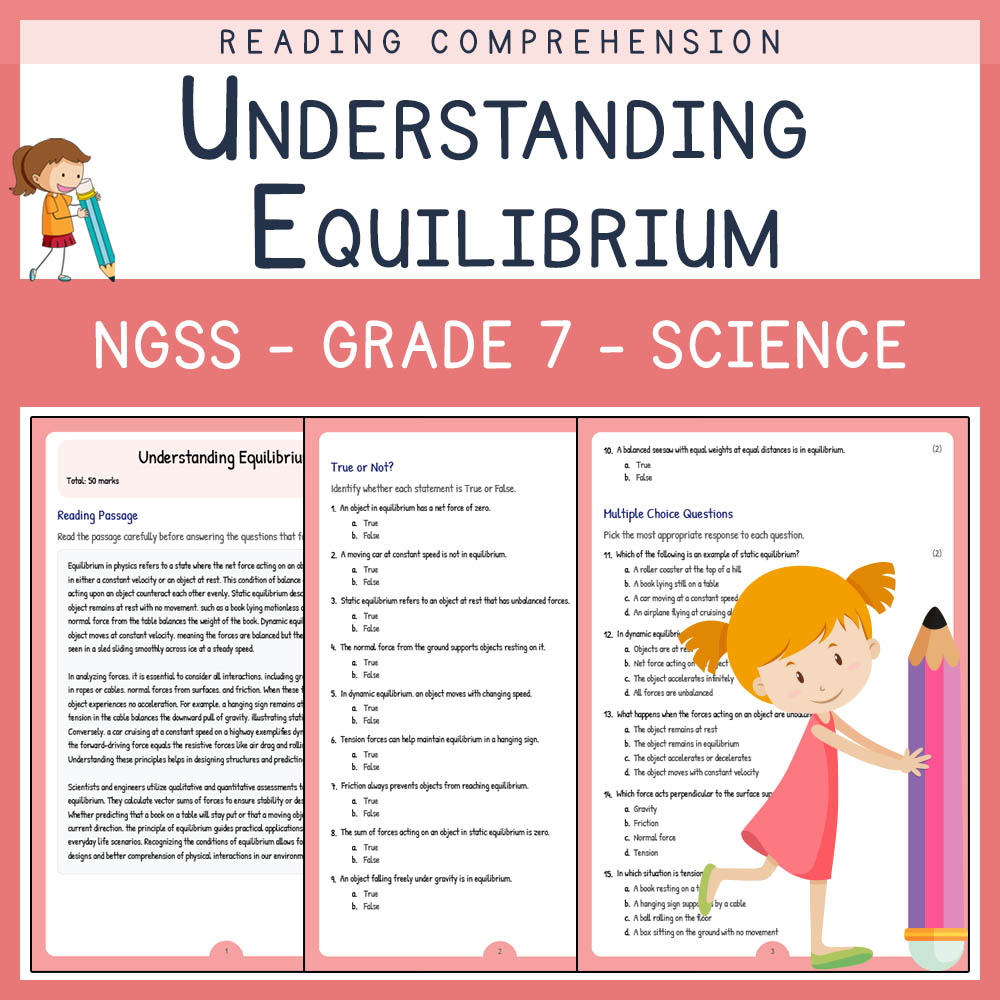
Grade 7 Science | Understanding Equilibrium Worksheet & Answer Key (PDF)
Created byLumora LearningLearning Objectives
- Explain the concept of equilibrium as the balance of forces in an object.
- Differentiate between static and dynamic equilibrium with real-world examples.
- Describe the roles of normal, gravitational forces, tension, and net zero acceleration in equilibrium.
Instant download
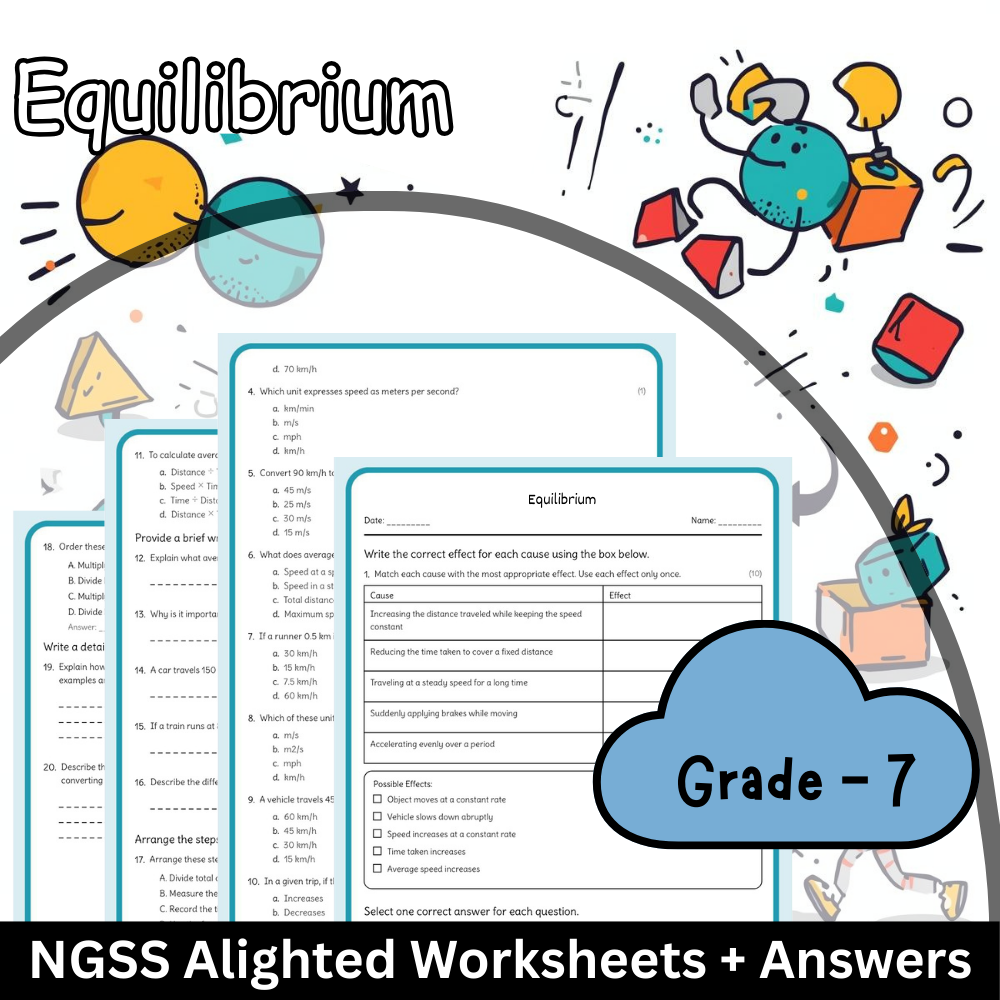
Grade 7 Science – Equilibrium Concept Worksheet (NGSS Aligned) (PDF)
Created byBright Mind ResourcesLearning Objectives
- Understand the concept of equilibrium as the balance of forces acting on an object.
- Differentiate between static and dynamic equilibrium.
- Identify forces involved in equilibrium such as gravity, normal force, tension, and net zero acceleration.
Instant download
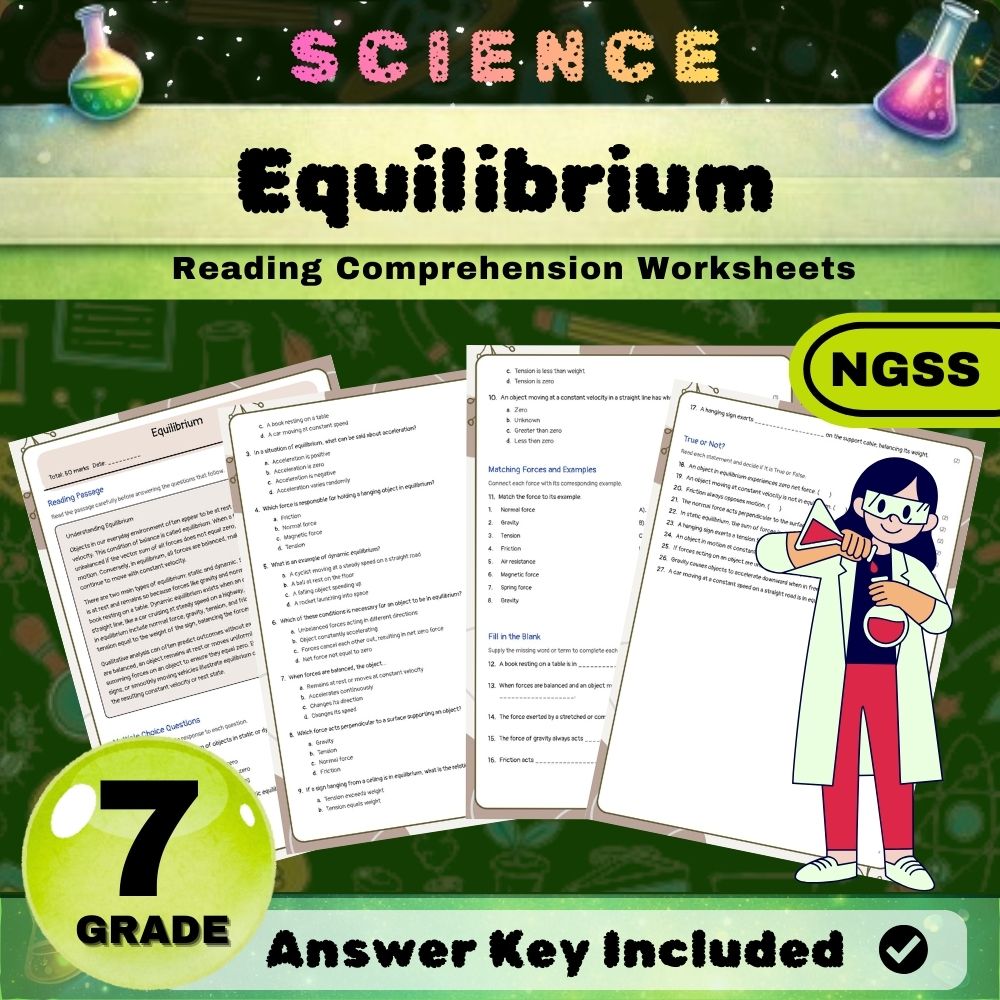
Grade 7 Science | Equilibrium NGSS Worksheet (Answer Key) - PDF
Created byMaple Path LearningLearning Objectives
- Define equilibrium as the condition where the vector sum of forces equals zero.
- Distinguish between static and dynamic equilibrium through examples and analysis.
- Describe roles of forces such as normal, gravitational, tension, and net force in achieving equilibrium.
Instant download

Equilibrium Practice Worksheet | Grade 7 Science NGSS Review
Created byPrism Point LearningLearning Objectives
- Explain equilibrium as a condition where the vector sum of forces is zero, resulting in constant velocity or rest
- Differentiate static equilibrium and dynamic equilibrium using examples involving normal and gravitational forces
- Use qualitative reasoning to predict how motion changes when net force and net acceleration are (or are not) zero
Also included in: Grade 7 Forces & Interactions Science Lesson Bundle for NGSS Review
Instant download
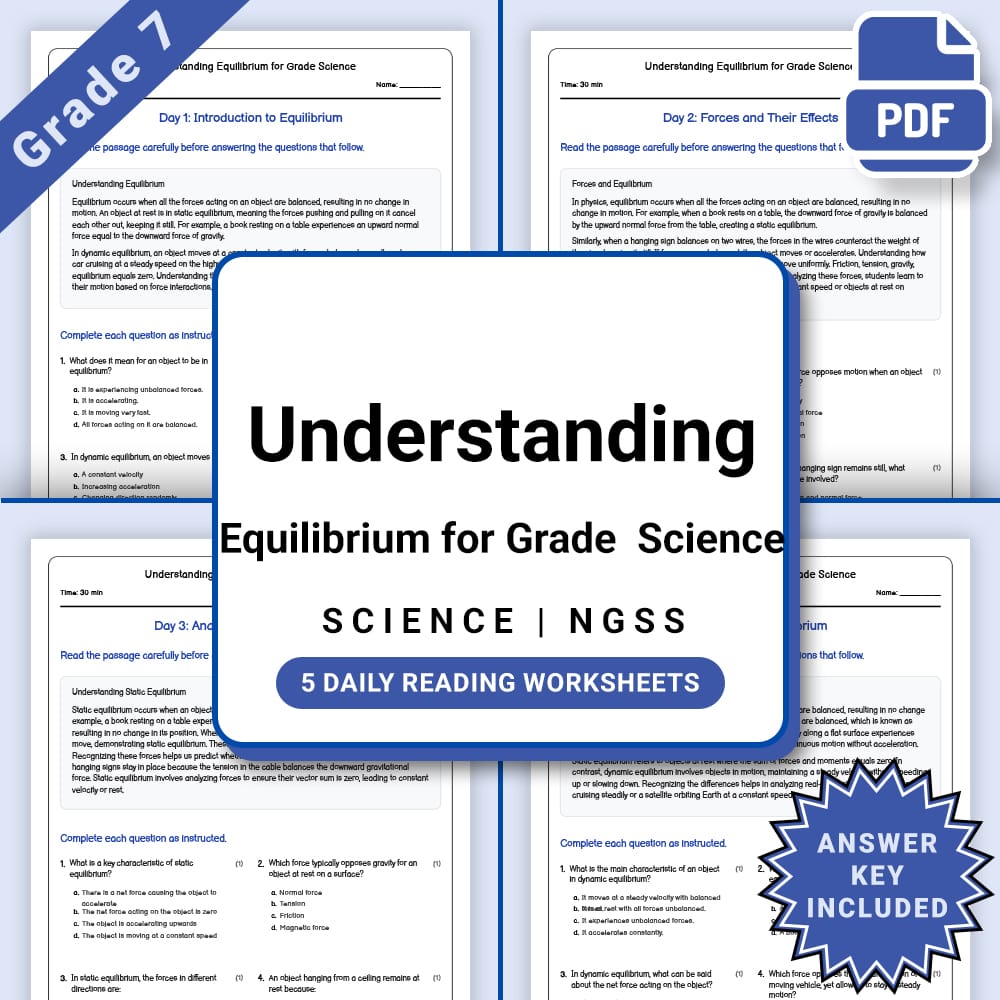
Grade 7 Science – Understanding Equilibrium Worksheet(PDF + Answer Key)
Created byCopper Leaf ClassroomLearning Objectives
- Define equilibrium and identify its key characteristics.
- Differentiate between static and dynamic equilibrium.
- Recognize forces involved in equilibrium, such as gravity, normal force, and tension.
Instant download
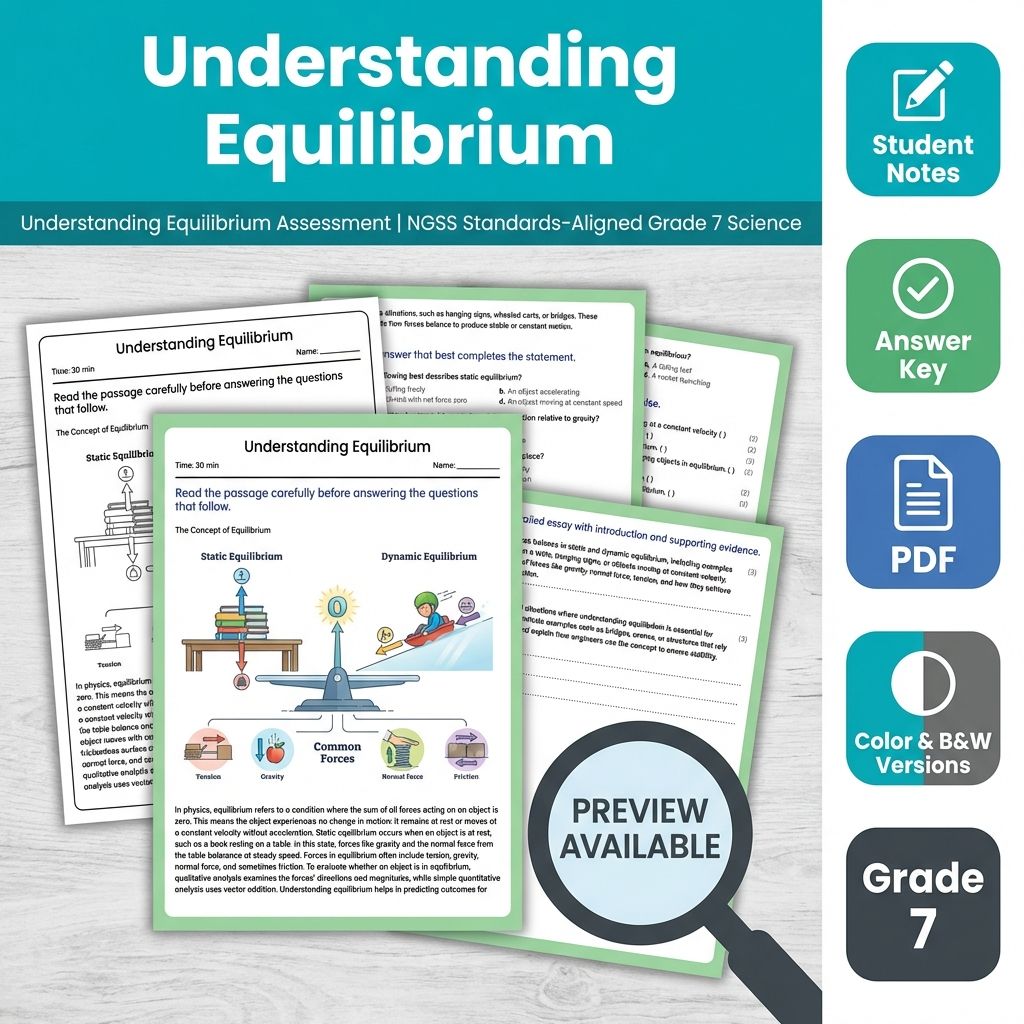
Understanding Equilibrium Assessment | NGSS Standards-Aligned Grade 7 Science
Created byPrism Point LearningLearning Objectives
- Explain the concept of equilibrium as the balance of forces in an object.
- Differentiate between static and dynamic equilibrium in real-world scenarios.
- Apply qualitative and simple quantitative analyses to predict objects' behavior at rest or moving with constant velocity.
Also included in: Grade 7 Science Mini Bundle – Forces & Interactions NGSS Unit (Printable) +1 more
Instant download
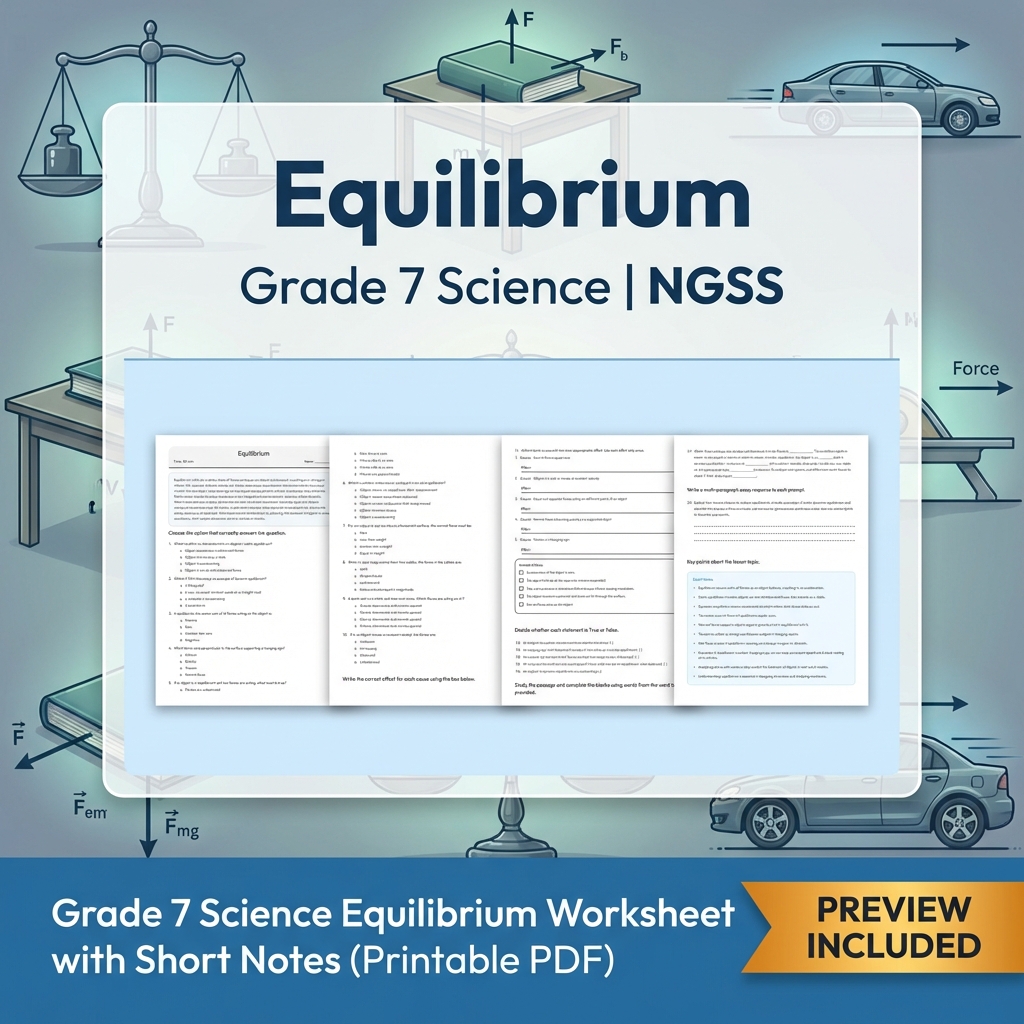
Grade 7 Science Equilibrium Worksheet with Short Notes (Printable PDF)
Created byMeadowlark WorksheetsLearning Objectives
- Understand the concept of forces in equilibrium and how they balance to produce constant velocity or rest.
- Identify the differences between static and dynamic equilibrium in various scenarios.
- Apply qualitative and simple quantitative analyses to predict outcomes of objects at rest or moving uniformly.
Also included in: Grade 7 Science | Motion and Stability Forces & Interactions NGSS Unit Bundle +1 more
Instant download

Figurative Connotation Worksheet Grade 8 ELA Literary Analysis
Created bySunny Desk ResourcesLearning Objectives
- Distinguish literal from figurative meanings and identify how figurative language works in context.
- Explain how a word’s connotation shapes tone, mood, or an author’s attitude.
- Infer meaning using sentence-level relationships and surrounding details rather than isolated definitions.
Also included in: Language Grade 8 Lesson Bundle | General ELA Grammar & Vocabulary Skills +1 more
Instant download

Grade 8 Science | DNA & Traits - Daily Reading Comprehension
Created byCoral Reef LearningLearning Objectives
- Identify the basic components of DNA and their functions.
- Understand how DNA sequences encode proteins.
- Explain the processes of transcription and translation.
Instant download

DNA and Traits Worksheet | Grade 8 Science Printable PDF Assessment
Learning Objectives
- Explain the molecular basis of inheritance, linking DNA sequence to protein synthesis and traits.
- Describe gene structure, transcription, translation, and how mutations affect proteins.
- Analyze examples like sickle cell anemia and gene variants to see how genetics influence phenotype.
Also included in: Grade 8 Heredity Lesson Bundle | Inheritance and Trait Variation NGSS +1 more
Instant download

Grade 8 Science – DNA & Traits Daily Reading Worksheet | NGSS Aligned
Created byBright Mind ResourcesLearning Objectives
- Understand the structure of DNA and its role in storing genetic information.
- Describe how DNA sequences are transcribed and translated into proteins.
- Explain how mutations can affect protein structure and phenotypes.
Also included in: Grade 8 Genetics Science Daily Reading Worksheets Lesson Bundle | NGSS +1 more
Instant download
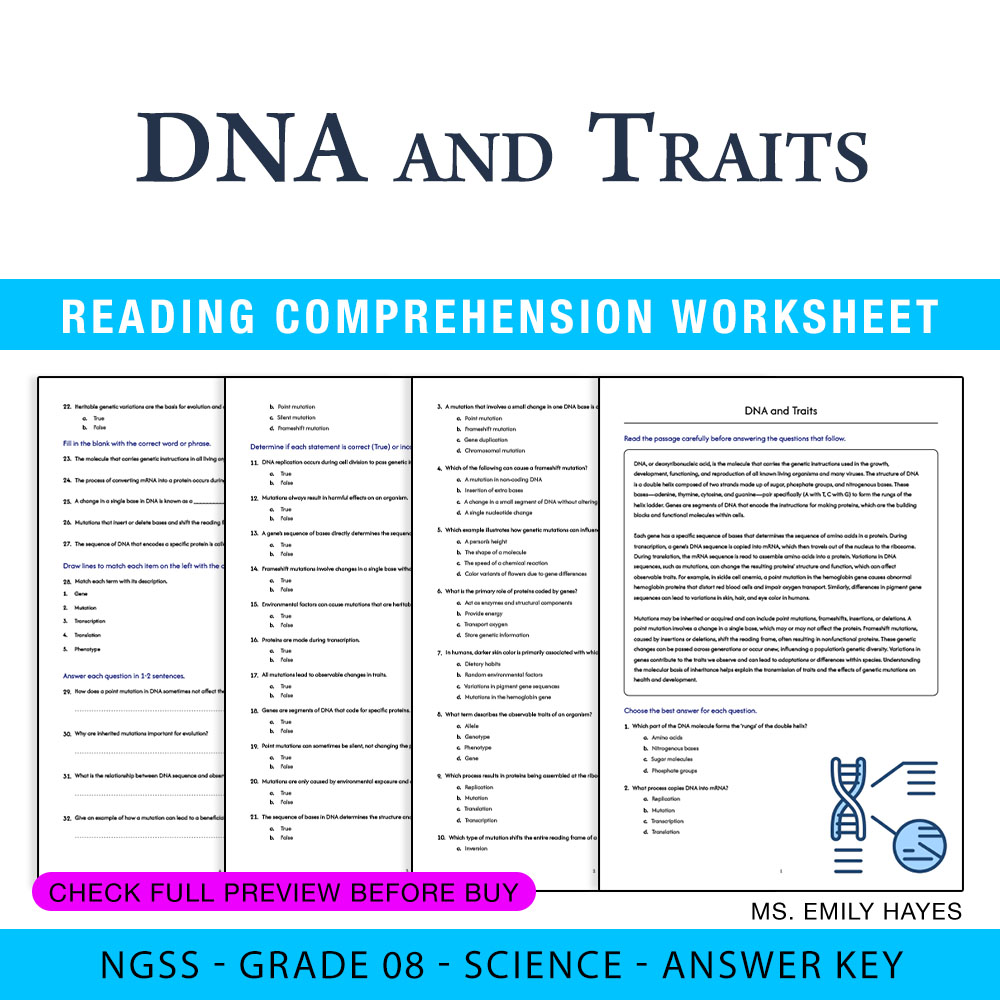
8th Grade Science | DNA and Traits Worksheet (PDF+ Answer Key)
Created byCopper Leaf ClassroomLearning Objectives
- Explain the relationship between DNA sequences, proteins, and observable traits.
- Describe the structure of genes and their role in inheritance.
- Analyze how mutations such as point mutations and frameshifts affect protein function and phenotypes.
Instant download
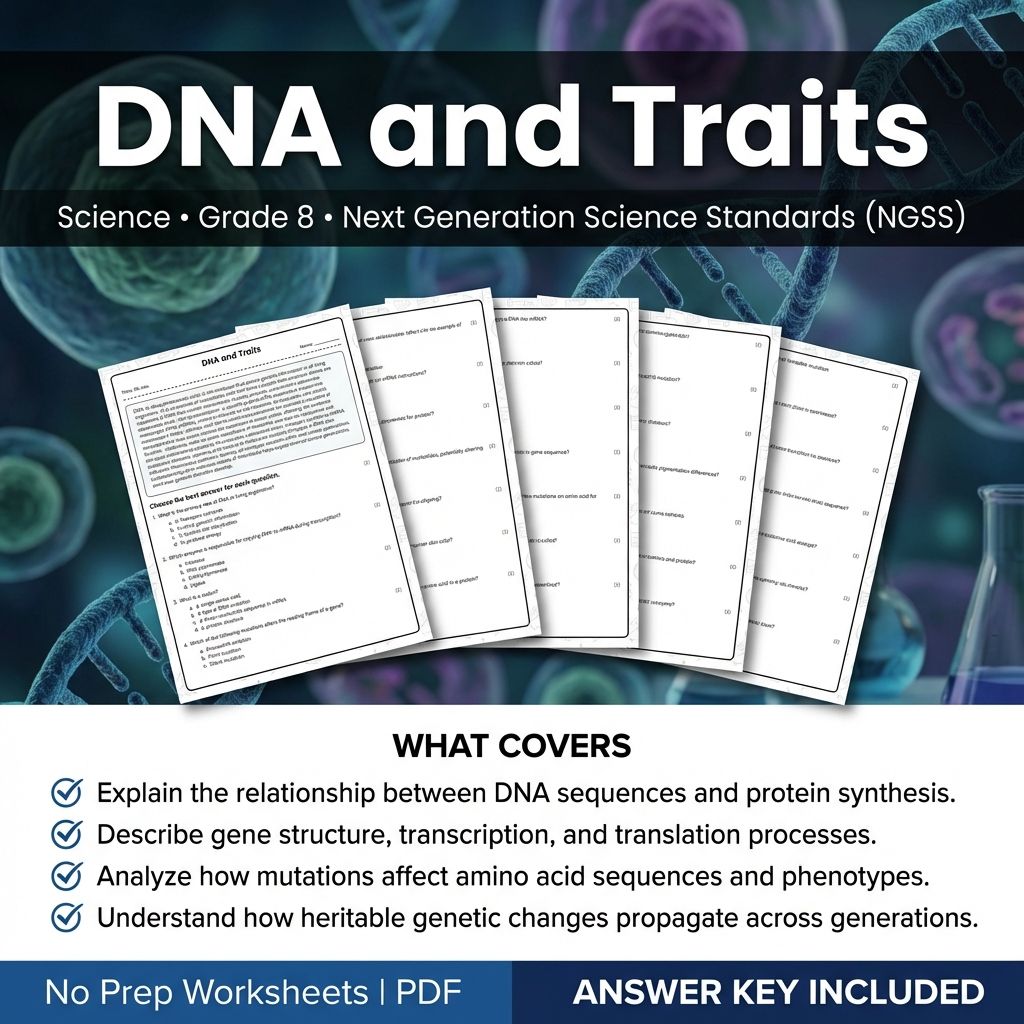
8th Grade Science | DNA and Traits Worksheet with Answer Key (Printable PDF)
Created byCoral Reef LearningLearning Objectives
- Explain the relationship between DNA sequences and protein synthesis.
- Describe gene structure, transcription, and translation processes.
- Analyze how mutations affect amino acid sequences and phenotypes.
Instant download
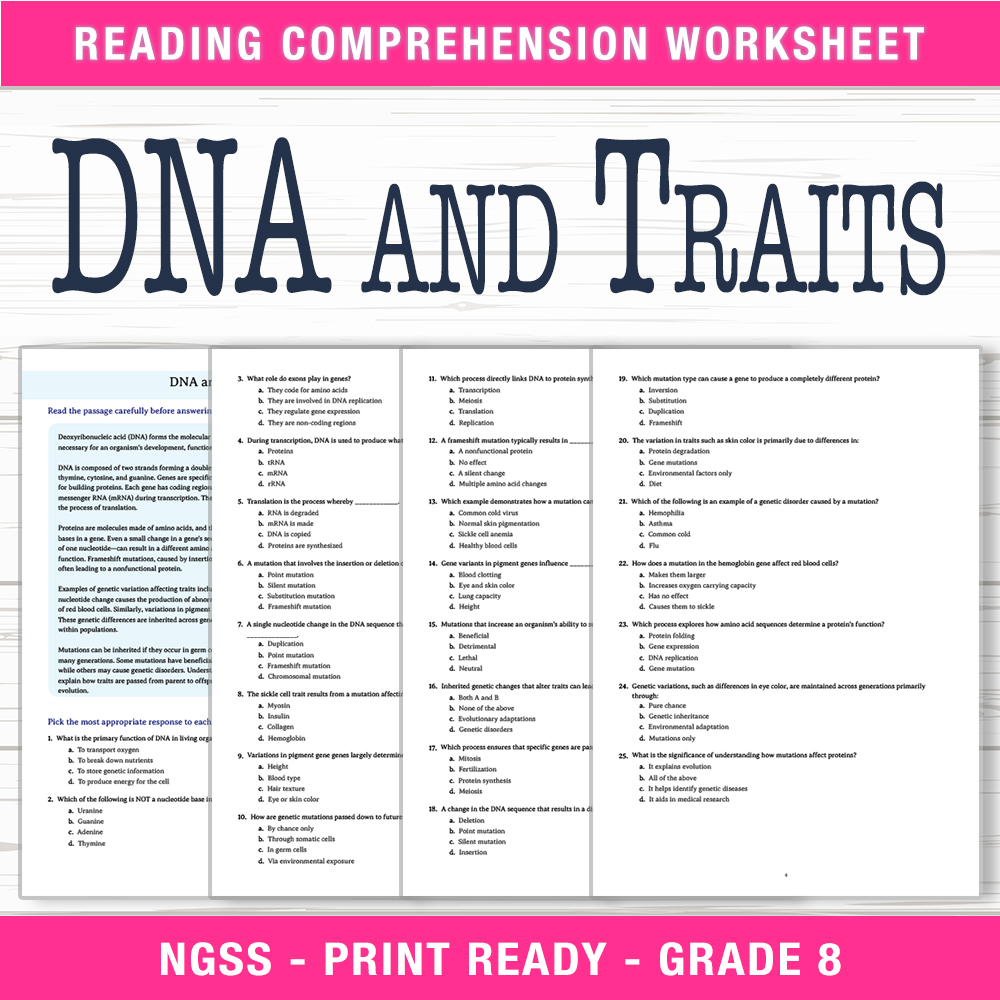
Grade 8 Science | DNA and Traits Worksheet (PDF + Answer Key)
Created byRiverstone ClassroomLearning Objectives
- Explain the molecular basis of inheritance by linking DNA sequences to proteins and observable traits.
- Describe the structure of genes, including coding sequences, and the processes of transcription and translation.
- Analyze how mutations such as point mutations and frameshifts affect amino acid sequences and protein function.
Instant download
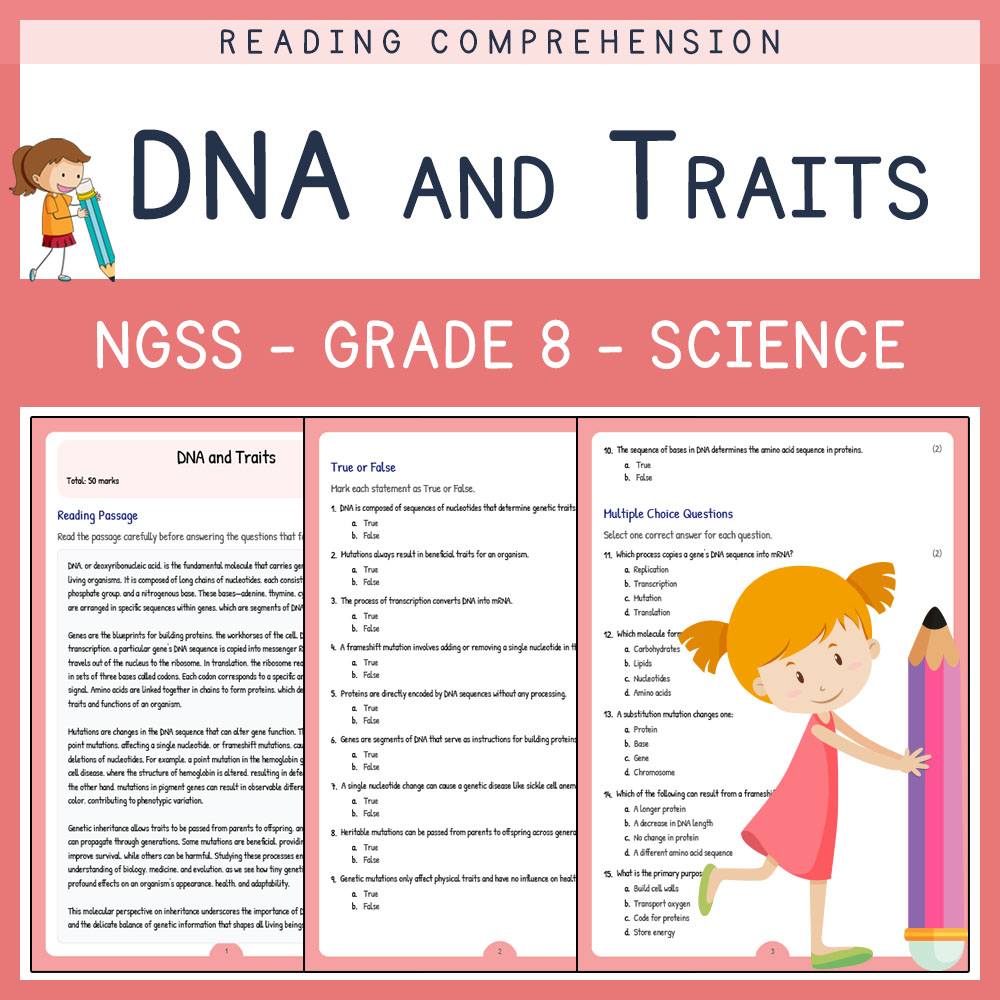
Grade 8 Science | DNA and Traits Worksheet (PDF + Answer Key) NGSS-Aligned
Created byLumora LearningLearning Objectives
- Explain the relationship between DNA sequence and protein structure.
- Describe how gene structure and mutations affect observable traits.
- Illustrate the processes of transcription and translation.
Instant download

Grade 8 Science | DNA and Traits Worksheet (NGSS-Aligned, PDF)
Created byBright Mind ResourcesLearning Objectives
- Describe the relationship between DNA sequences and protein synthesis.
- Explain how mutations can alter amino acid sequences and affect traits.
- Identify key components of gene structure, transcription, and translation.
Also included in: Grade 8 Science Unit | DNA, Traits & Mendelian Patterns Worksheet Bundle - NGSS +2 more
Instant download
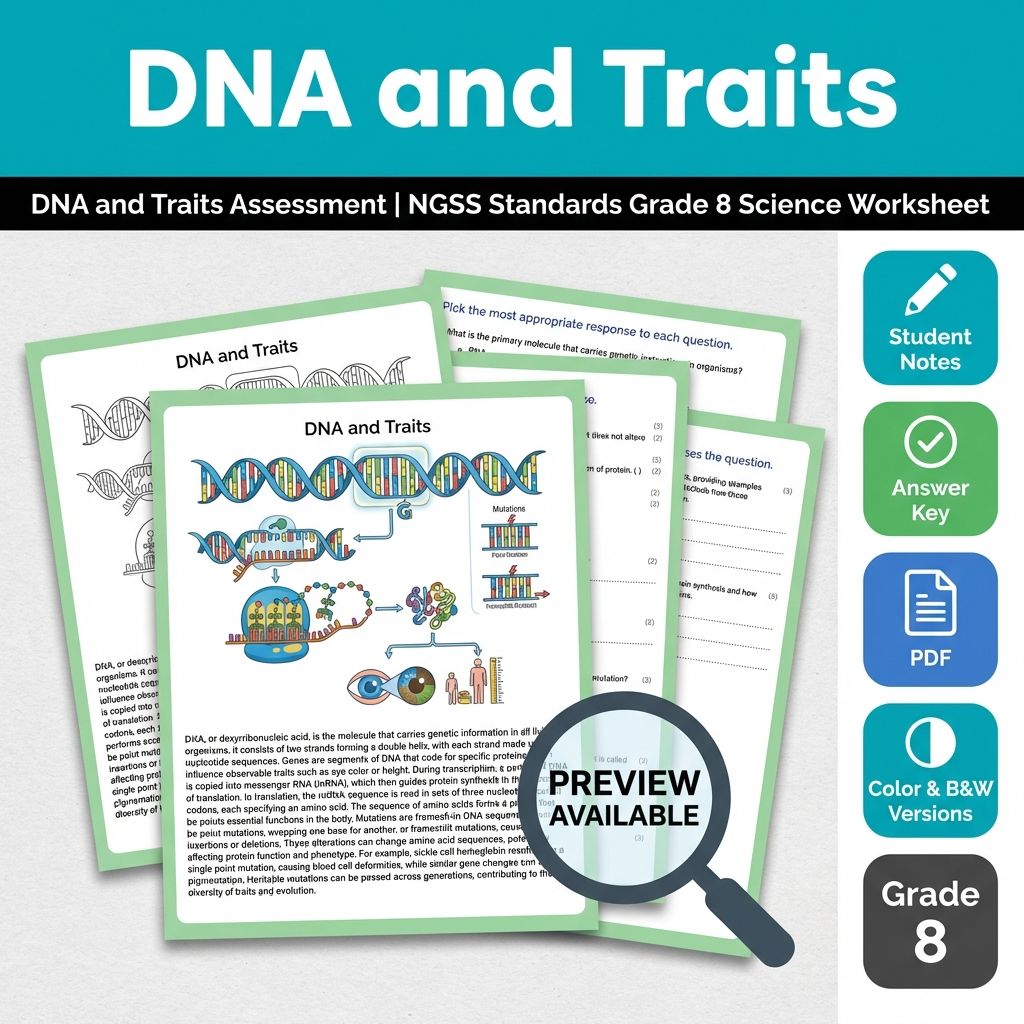
DNA and Traits Assessment | NGSS Standards Grade 8 Science Worksheet
Created byPrism Point LearningLearning Objectives
- Explain the relationship between DNA sequences and protein synthesis.
- Identify how mutations can alter amino acid sequences and affect traits.
- Describe gene structure, transcription, translation, and mutation effects.
Also included in: Grade 8 Science Mini Bundle – Heredity: Inheritance and Variation Not specified +1 more
Instant download
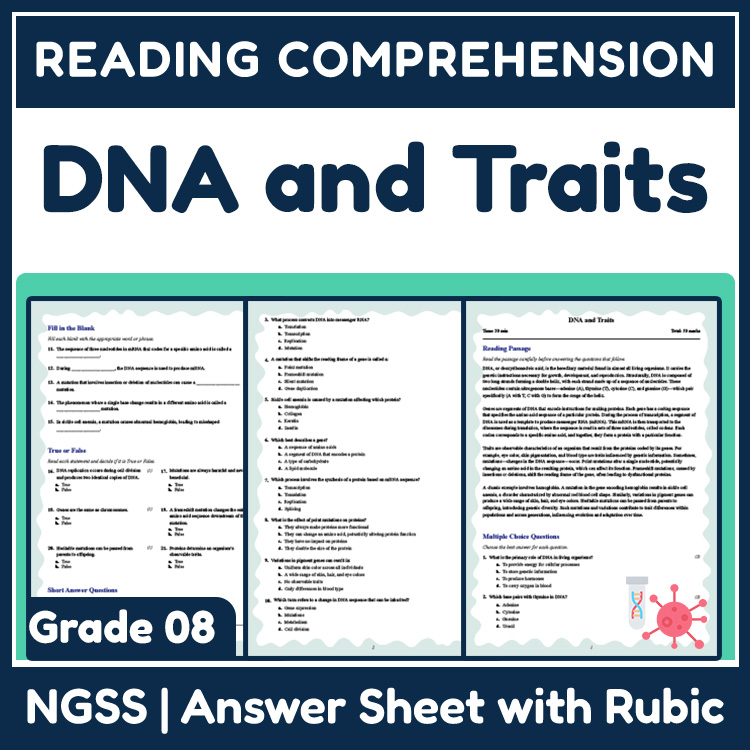
Grade 8 Science | DNA and Traits Reading Worksheet (NGSS Aligned + Answer Key)
JCreated byJ.S SheetsLearning Objectives
- Understand the molecular basis of inheritance and how DNA sequences determine traits
- Learn about gene structure, transcription, translation, and mutations
- Analyze examples of genetic variation and mutation effects on phenotype
Instant download

Grade 8 Science | DNA and Traits NGSS Worksheet (PDF)
Created byMaple Path LearningLearning Objectives
- Explain how DNA sequences determine the proteins and observable traits of an organism.
- Describe the structure of genes and the processes of transcription and translation.
- Analyze how mutations such as point mutations and frameshifts can alter protein function and phenotype.
Also included in: Grade 8 Science | Heredity Unit Bundle – Inheritance & Trait Variation NGSS +1 more
Instant download
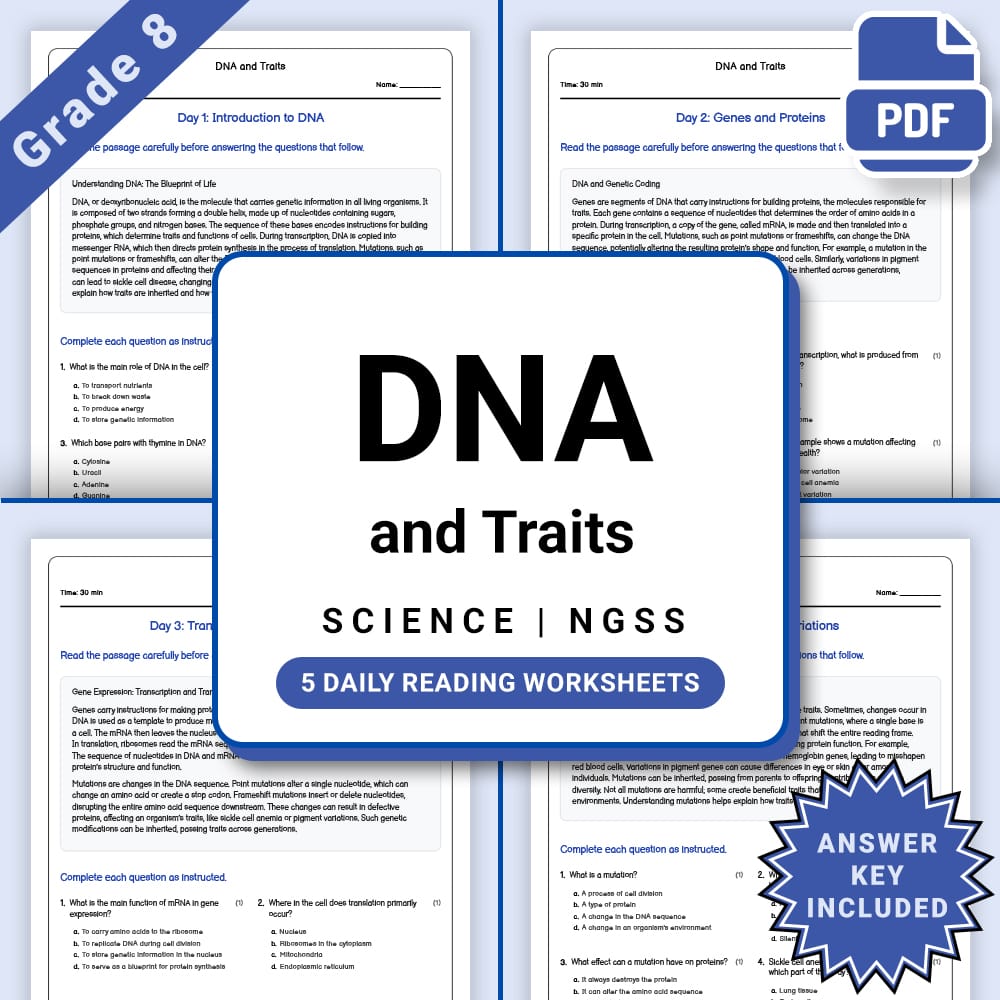
Grade 8 Science – DNA and Traits Daily Reading Worksheet(PDF + Answer Key)
Created byCopper Leaf ClassroomLearning Objectives
- Understand the basic structure and function of DNA
- Explain how DNA sequences determine traits
- Describe the processes of transcription and translation
Instant download

DNA and Traits Assessment Worksheet | Grade 8 Science NGSS Review
Created byPrism Point LearningLearning Objectives
- Explain how DNA sequence information becomes proteins and then observable traits.
- Describe gene structure and the roles of coding sequences, transcription, and translation.
- Predict how point mutations and frameshifts can change amino acids and protein function.
Also included in: Grade 8 Genetics Lesson Bundle: Mendelian Patterns & DNA Traits (NGSS)
Instant download

Grade 8 Science | DNA and Traits Worksheet with Short Notes (Printable PDF)
Created byMeadowlark WorksheetsLearning Objectives
- Explain the molecular basis of inheritance and how DNA sequences determine traits.
- Describe gene structure, transcription, translation, and how mutations affect proteins.
- Use examples like sickle cell hemoglobin to illustrate mutation impacts.
Also included in: Grade 8 Science Heredity: Inheritance & Variation UNIT Bundle (NGSS Worksheets) +1 more
Instant download

Grade 11 Science | Conservation Analysis Worksheet with Short Notes (PDF)
Created byMeadowlark WorksheetsLearning Objectives
- Understand the principles of conservation laws in isolated systems.
- Apply algebraic balances and vector diagrams to analyze collisions.
- Extract and interpret center-of-mass motion from system contributions.
Also included in: Grade 11 Science NGSS Motion and Stability Forces & Interactions Unit Bundle +1 more
Instant download
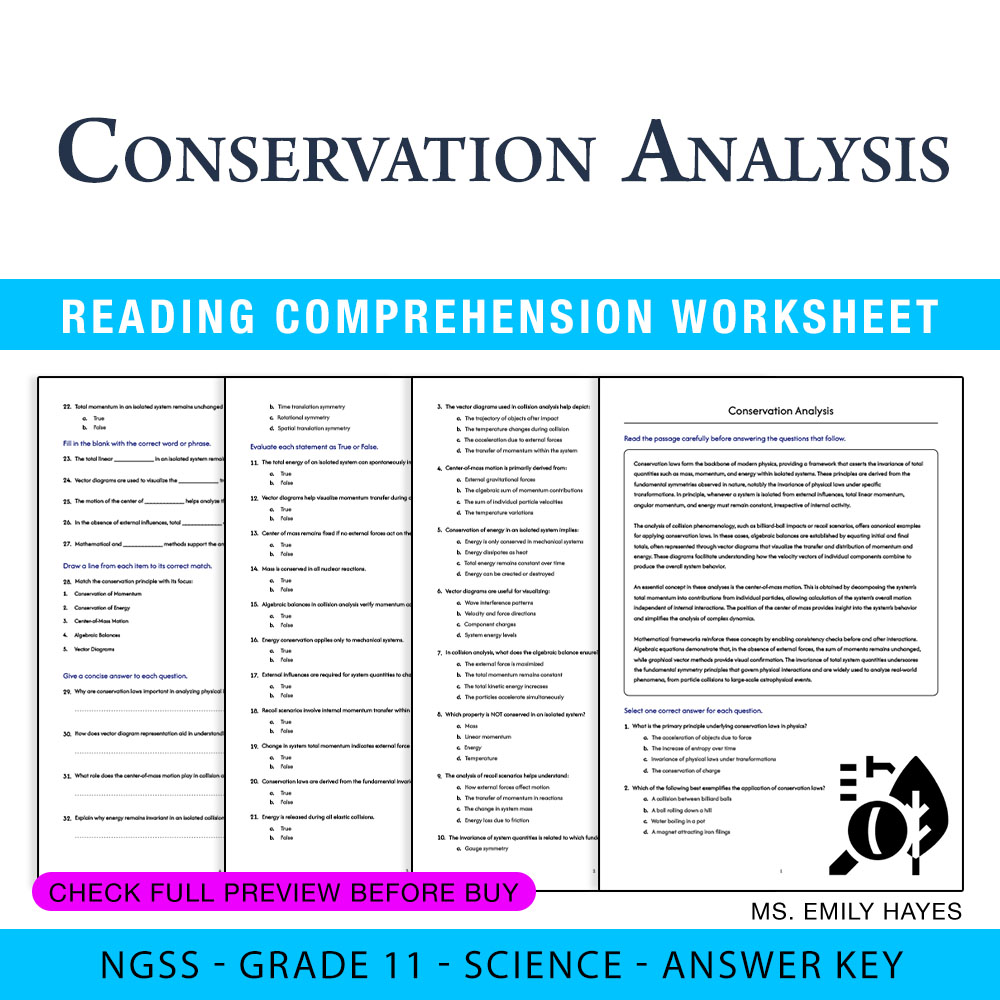
11th Grade Science | Conservation Analysis Worksheet (PDF+ Answer Key)
Created byCopper Leaf ClassroomLearning Objectives
- Understand the fundamental principles of conservation laws in physics.
- Apply algebraic and vector methods to analyze isolated interactions and collision scenarios.
- Explain the concept of center-of-mass motion and how it is derived from system components.
Instant download
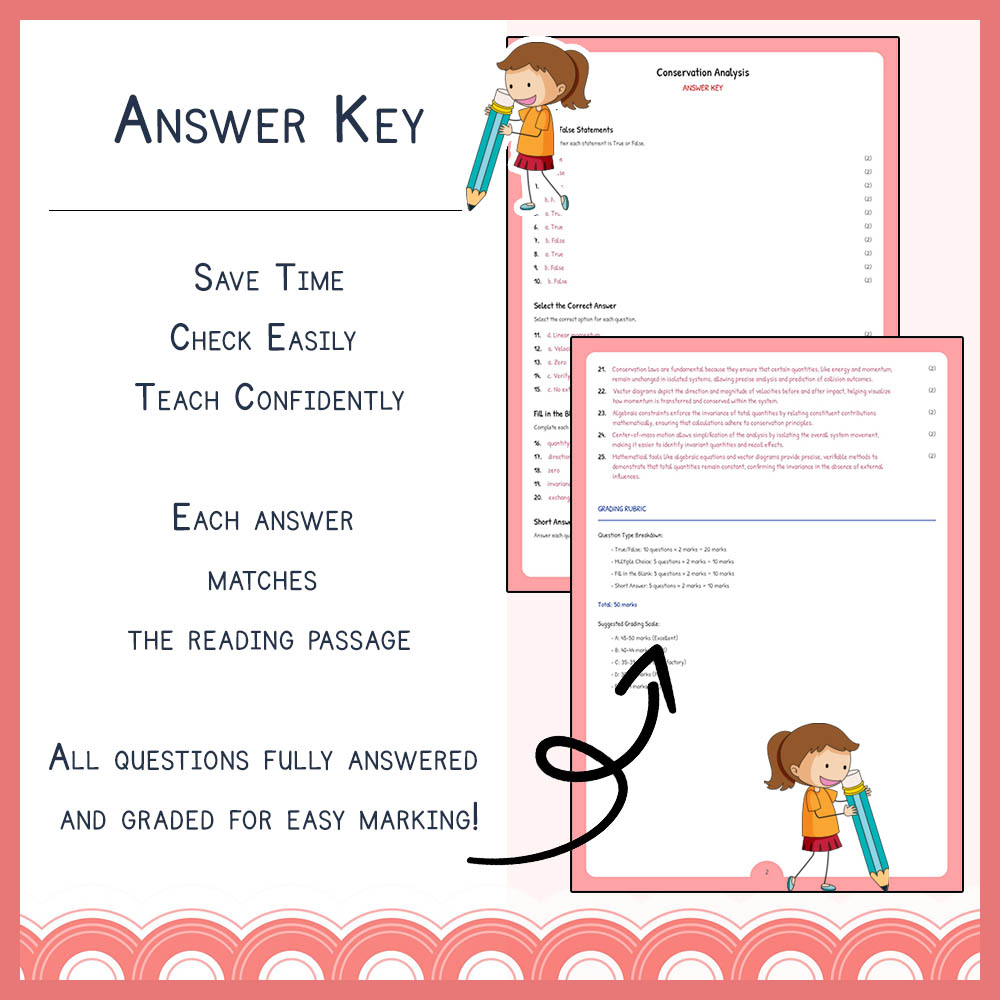
Grade 11 Science | Conservation Analysis Worksheet (Answer Key & Rubric)
Created byLumora LearningLearning Objectives
- Understand the principles of conservation laws in physics
- Analyze closed-system interactions using algebraic and vector methods
- Apply conservation concepts to collision scenarios and recoil mechanisms
Instant download
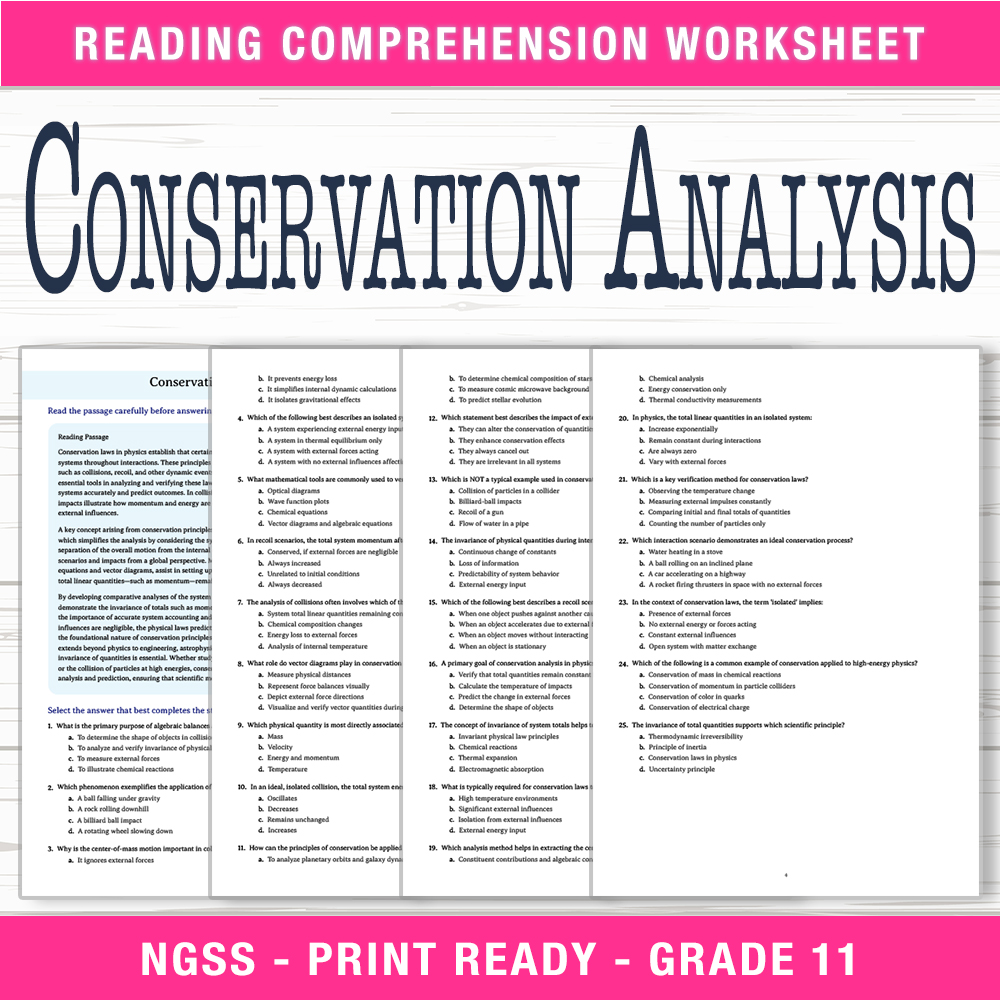
Grade 11 Science – Conservation Analysis Worksheet (PDF + Answer Key)
Created byRiverstone ClassroomLearning Objectives
- Understand the fundamental principles of conservation laws in physics.
- Apply algebraic balances and vector diagrams to analyze collision phenomena.
- Extract and interpret center-of-mass motion from system contributions.
Instant download

Grade 11 Science – Conservation Laws & Analysis | Daily Reading Worksheet
Created byBright Mind ResourcesLearning Objectives
- Understand the fundamental principles of conservation laws in physics.
- Apply algebraic and vector balances to analyze isolated systems.
- Recognize examples of conservation in collision phenomena and recoil scenarios.
Also included in: Grade 11 Forces & Conservation Laws Science Lesson Bundle Daily Reading | NGSS +2 more
Instant download
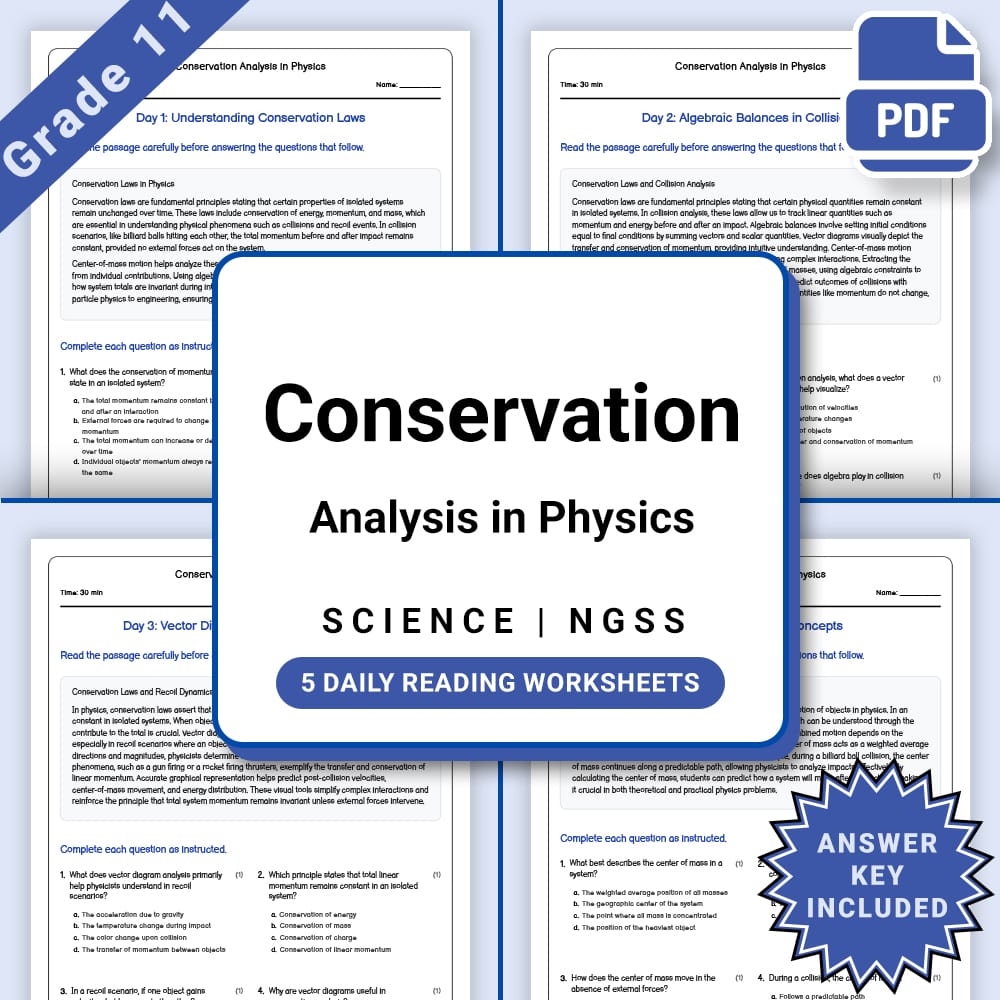
Grade 11 Science – Conservation Analysis in Physics Worksheet (PDF +Answer Key)
Created byCopper Leaf ClassroomLearning Objectives
- Understand the principles of conservation laws in physics
- Identify examples of conservation in collision and recoil scenarios
- Analyze system independence from external influences using vector diagrams and algebraic balances
Instant download
Browse more categories
About Reading comprehension Worksheets
Find reading comprehension worksheets for class practice, homework, or self-study. All 40,289 are instant PDF downloads.
Each resource here is built by an independent educator and reviewed for quality. Worksheets print straight from PDF and suit classroom use, homework, or extra practice; most come with answer keys, and you can preview before purchasing.