
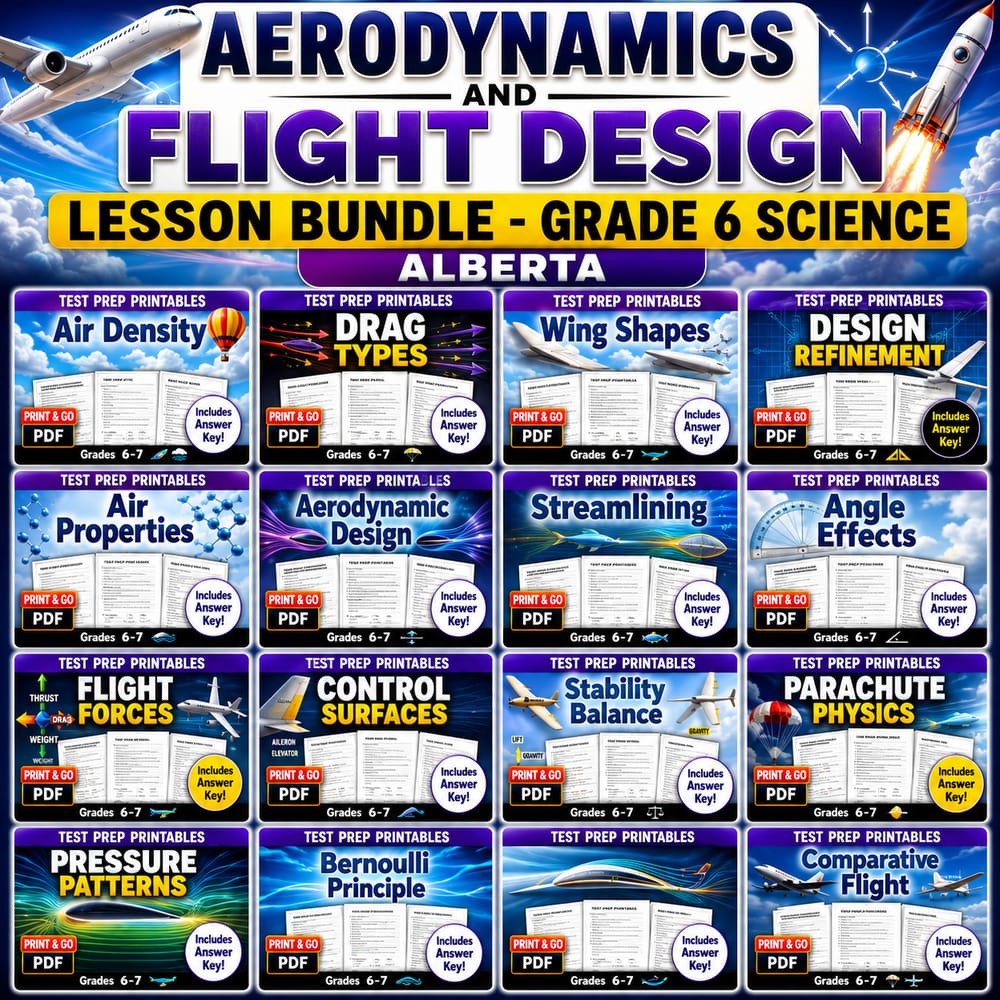


Aerodynamics and Flight Design Lesson Bundle – Grade 6 Science Alberta
$60.00$75.00Save $15.00
Prism Point Learning
·2 followers·13 sales
SubjectScienceGradeGrade 6
What’s included
15 worksheets · Save $15.00 (20%) · prices shown inside the bundle
 Air Density Worksheet | Grade 6 Science Activities
- Explain how temperature, humidity, and altitude affect air density.
- Describe how air density influences buoyancy and aerodynamic lift.
- Use science vocabulary to compare atmospheric conditions in different places.
$4.00$5.00 Drag Types Worksheet | Grade 6 Science Activities
- Explain how friction and pressure differences contribute to drag.
- Differentiate parasitic drag and induced drag using examples.
- Describe how reducing drag can lower required thrust and energy demands.
$4.00$5.00 Wing Shapes Worksheet Pack | Grade 6 Science Activities
- Explain how wing features like camber, thickness, and aspect ratio affect lift and stall behavior.
- Compare wing designs for different mission profiles, such as gliders versus short-field agricultural aircraft.
- Use evidence from a passage to answer questions about pressure, drag, and maneuverability.
$4.00$5.00 Design Refinement Worksheet | Grade 6 Science Activities
- Explain how incremental design changes can improve aerodynamic performance while maintaining safety.
- Identify trade-offs between speed, stability, and payload during design refinement.
- Describe how consistent observation of flight paths and simple measurements support testing decisions.
$4.00$5.00 Air Properties Worksheet | Grade 6 Science Practice and Assessment
- Explain how air composition, density, pressure, and temperature help describe how air behaves.
- Predict how changes in altitude and temperature can affect air density and pressure.
- Describe how collisions between gas molecules create pressure and relate this to everyday weather.
$4.00$5.00 Aerodynamic Design Worksheet | Grade 6 Science Practice
- Explain how shape, smoothness, and angle affect lift, drag, and stability in flight.
- Describe how design changes to wings (curvature, aspect ratio, and surface area) can improve performance.
- Connect real-world examples of model gliders and kites to aerodynamic principles.
$4.00$5.00 Streamlining Worksheet | Grade 6 Science Activities
- Explain how streamlined shapes reduce aerodynamic resistance by changing airflow behavior.
- Describe how smooth surfaces and gradual shape changes can delay flow separation.
- Connect streamlining to real-world examples such as farm equipment and aircraft parts.
$4.00$5.00 Angle Effects Worksheet | Grade 6 Science Activities
- Explain how changing the angle of attack affects lift and drag.
- Describe what happens at the critical point when airflow separates and a stall occurs.
- Use real-world examples (kites or small gliders) to predict how adjusting angle changes performance.
$4.00$5.00 Flight Forces Worksheet | Grade 6 Science Activities
- Describe how lift, thrust, drag, and weight affect motion through air
- Explain how balancing forces can lead to steady flight or controlled descent
- Use real-world examples (kites, aircraft, parachutes) to connect forces to motion
$4.00$5.00 Control Surfaces Worksheet | Grade 6 Science Practice
- Explain how ailerons, elevators, and rudders change airflow to create aerodynamic moments.
- Describe how control-surface deflection affects rolling, pitching, and yawing motions.
- Connect control-surface use to real aviation situations such as crosswinds and short-field takeoffs.
$4.00$5.00
Reviews & Feedback
Loading reviews...
Questions & Answers
Loading questions…
About this bundle
Related categories
Frequently asked questions
Who is Aerodynamics and Flight Design Lesson Bundle – Grade 6 Science Alberta designed for?
Aerodynamics and Flight Design Lesson Bundle – Grade 6 Science Alberta is designed for Grade 6 students and Science learners and can be used in classrooms, homeschool, or independent practice.
How do I download Aerodynamics and Flight Design Lesson Bundle – Grade 6 Science Alberta?
Add it to your cart and complete checkout. After payment, you can download immediately from your account, and you'll also receive a download link by email.
Similar Products

Grade 6 Science Aviation Unit Aerodynamics & Flight Testing Lesson Bundle
$48.00$60.00

Grade 6 Aerodynamics & Flight Forces Science Lesson Bundle: Alberta
$60.00$75.00

Grade 6 Air and Aerodynamics Science Lesson Bundle (Alberta Framework)
$60.00$75.00

Grade 6 Aerodynamics | Flight - Science Lesson Bundle – Ontario Framework
$48.00$60.00

Grade 6 Flight & Aerodynamics Science Lesson Bundle Worksheets (Ontario)
$38.40$48.00