
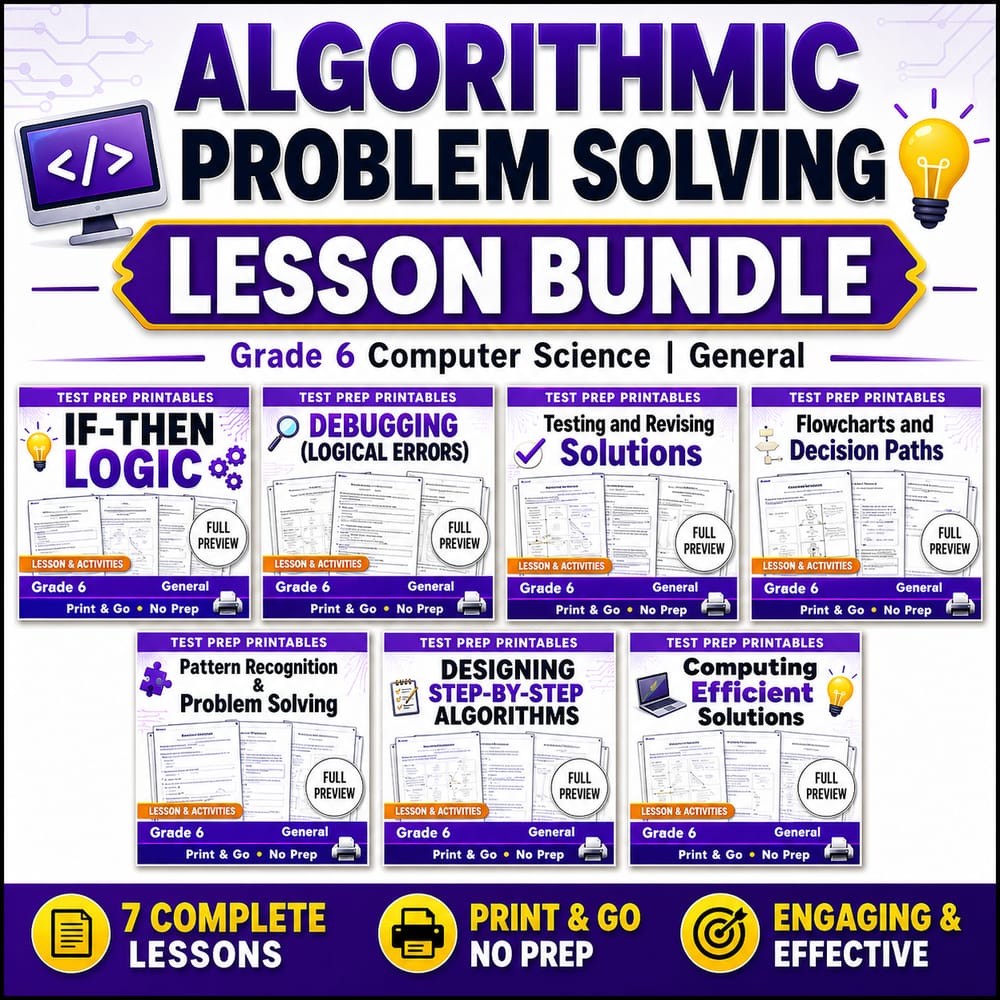
Algorithmic Problem Solving Lesson Bundle | Grade 6 Computer Science | General
$32.00$40.00Save $8.00
Prism Point Learning
·2 followers·13 sales
SubjectComputer ScienceGradeGrade 6Pages240 Pages
What’s included
8 worksheets · 240 pages · Save $8.00 (20%) · prices shown inside the bundle
 If-Then Logic Conditional Decisions Worksheet Grade 6 Computer Science
- Explain conditional logic using if-then statements to predict outcomes.
- Identify conditions, branches, and outcomes in simple rule-based algorithms.
- Use yes-or-no thinking to follow different paths in branching algorithms.
$4.00$5.00 Debugging Logical Errors Worksheet Grade 6 Computer Science Activity
- Explain what a logical error is and how it differs from a syntax error
- Use a trace to follow each step of an algorithm and find where reasoning goes wrong
- Check inputs, assumptions, and decision paths to debug and correct solutions
$4.00$5.00 Testing and Revising Solutions Worksheet Grade 6 Computer Science Activity
- Explain how testing an algorithm helps find errors under different conditions.
- Use test results to revise and improve a solution’s accuracy and clarity.
- Identify common weaknesses in a procedure and evaluate whether changes fix them.
$4.00$5.00 Flowcharts and Decision Paths Worksheet Grade 6 Computer Science
- Explain how flowcharts show step-by-step processes using symbols and arrows.
- Use decision paths to describe how choices affect outcomes in an algorithm.
- Identify and interpret common flowchart vocabulary: flowchart, decision, branch, and symbol.
$4.00$5.00 Pattern Recognition in Problem Solving Worksheet Grade 6 Computer Science
- Identify patterns in routines, data, and step-by-step solutions.
- Use patterns to predict what comes next in an algorithm or sequence.
- Explain how repeatable structure helps solve new problems using familiar ideas.
$4.00$5.00 Designing Step-by-Step Algorithms Worksheet Grade 6 Computer Science
- Define algorithm, sequence, instruction, and process and use the terms correctly.
- Create an algorithm by ordering steps logically and with enough detail to follow.
- Evaluate statements about algorithms for correctness and clarity.
$4.00$5.00 Decomposing Complex Problems Worksheet Grade 6 Computer Science
- Explain how decomposition breaks a large problem into smaller subproblems.
- Use a simple strategy to plan steps before coding.
- Identify whether a statement correctly describes decomposition and solutions.
$4.00$5.00 Comparing Efficient Solutions Worksheet Grade 6 Computer Science Activity
- Compare different algorithms to choose the more efficient strategy for a given task.
- Explain how efficiency can mean fewer steps, less time, or less repetition.
- Use computer science vocabulary accurately: efficient, compare, optimize, and strategy.
$4.00$5.00
Reviews & Feedback
Loading reviews...
Questions & Answers
Loading questions…
About this bundle
Related categories
Frequently asked questions
Who is Algorithmic Problem Solving Lesson Bundle | Grade 6 Computer Science | General designed for?
Algorithmic Problem Solving Lesson Bundle | Grade 6 Computer Science | General is designed for Grade 6 students and Computer Science learners and can be used in classrooms, homeschool, or independent practice.
How do I download Algorithmic Problem Solving Lesson Bundle | Grade 6 Computer Science | General?
Add it to your cart and complete checkout. After payment, you can download immediately from your account, and you'll also receive a download link by email.
Similar Products

Algorithms & Problem Solving Worksheets Bundle | Grade 3 Computer Science
$19.20$24.00

Algorithms & Problem Solving Worksheets Bundle | Grade 3 Computer Science
$24.00$30.00

Data Structures & Algorithms Lesson Bundle | Grade 12 Computer Science | General
$24.00$30.00

Data Structures & Algorithms Lesson Bundle | Grade 11 CS | General
$24.00$30.00

Grade 10 Computer Science Algorithms Lesson Bundle – Recursion & Big-O General
$20.00$25.00