
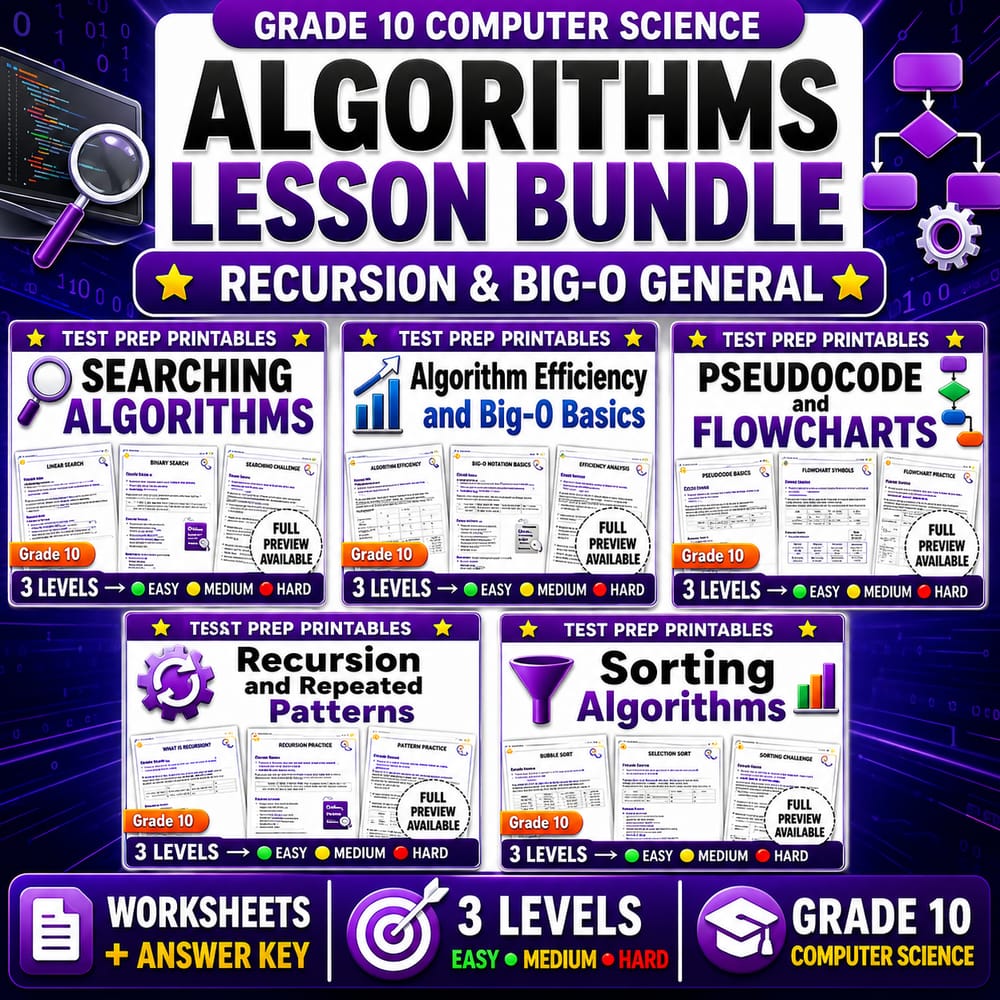
Grade 10 Computer Science Algorithms Lesson Bundle – Recursion & Big-O General
$20.00$25.00Save $5.00
Prism Point Learning
·2 followers·13 sales
SubjectComputer ScienceGradeGrade 10Pages155 Pages
What’s included
5 worksheets · 155 pages · Save $5.00 (20%) · prices shown inside the bundle
 Grade 10 Searching Algorithms Worksheet | Linear vs Binary Search Activity
- Explain how linear search works and when it is efficient.
- Describe how binary search works and why it requires a sorted list.
- Compare searching algorithms by time efficiency and suitability for different data sets.
$4.00$5.00 Algorithm Efficiency and Big-O Basics Worksheet | Grade 10 Computer Science
- Explain what algorithm efficiency means as input size grows
- Use Big-O notation to compare growth rates of common time complexities
- Identify which algorithm is more efficient for large data sets and justify the choice
$4.00$5.00 Grade 10 Pseudocode and Flowcharts Worksheet | Computer Science Test Prep
- Translate an everyday process into structured pseudocode using sequence, selection, and iteration.
- Use flowchart symbols and arrows to represent the same logic as pseudocode.
- Compare statements and logic to decide whether a pseudocode or flowchart step is correct.
$4.00$5.00 Grade 10 Computer Science Recursion and Repeated Patterns Worksheet
- Identify the base case and the recursive step in a recursive algorithm
- Trace repeated steps in recursion to predict outputs and termination
- Recognize patterns where recursion is appropriate compared to iteration
$4.00$5.00 Sorting Algorithms Worksheet | Grade 10 Computer Science Test Prep
- Explain how bubble sort, selection sort, and insertion sort work at the level of passes and swaps
- Trace sorting steps to predict the final ordered list
- Compare algorithm behavior by describing how many times elements may move or swap
$4.00$5.00
Reviews & Feedback
Loading reviews...
Questions & Answers
Loading questions…
About this bundle
Related categories
Frequently asked questions
Who is Grade 10 Computer Science Algorithms Lesson Bundle – Recursion & Big-O General designed for?
Grade 10 Computer Science Algorithms Lesson Bundle – Recursion & Big-O General is designed for Grade 10 students and Computer Science learners and can be used in classrooms, homeschool, or independent practice.
How do I download Grade 10 Computer Science Algorithms Lesson Bundle – Recursion & Big-O General?
Add it to your cart and complete checkout. After payment, you can download immediately from your account, and you'll also receive a download link by email.
Similar Products

Data Structures & Algorithms Lesson Bundle | Grade 12 Computer Science | General
$24.00$30.00

Data Structures & Algorithms Lesson Bundle | Grade 11 CS | General
$24.00$30.00

Artificial Intelligence Ethics & AI Algorithms Lesson Bundle | Grade 7 CS | General
$24.00$30.00

Grade 11 Computer Science Lesson Bundle: AI & Algorithm Design Patterns
$24.00$30.00

Grade 8 Algorithms Design & Testing Lesson Bundle | Computer Science General
$24.00$30.00