
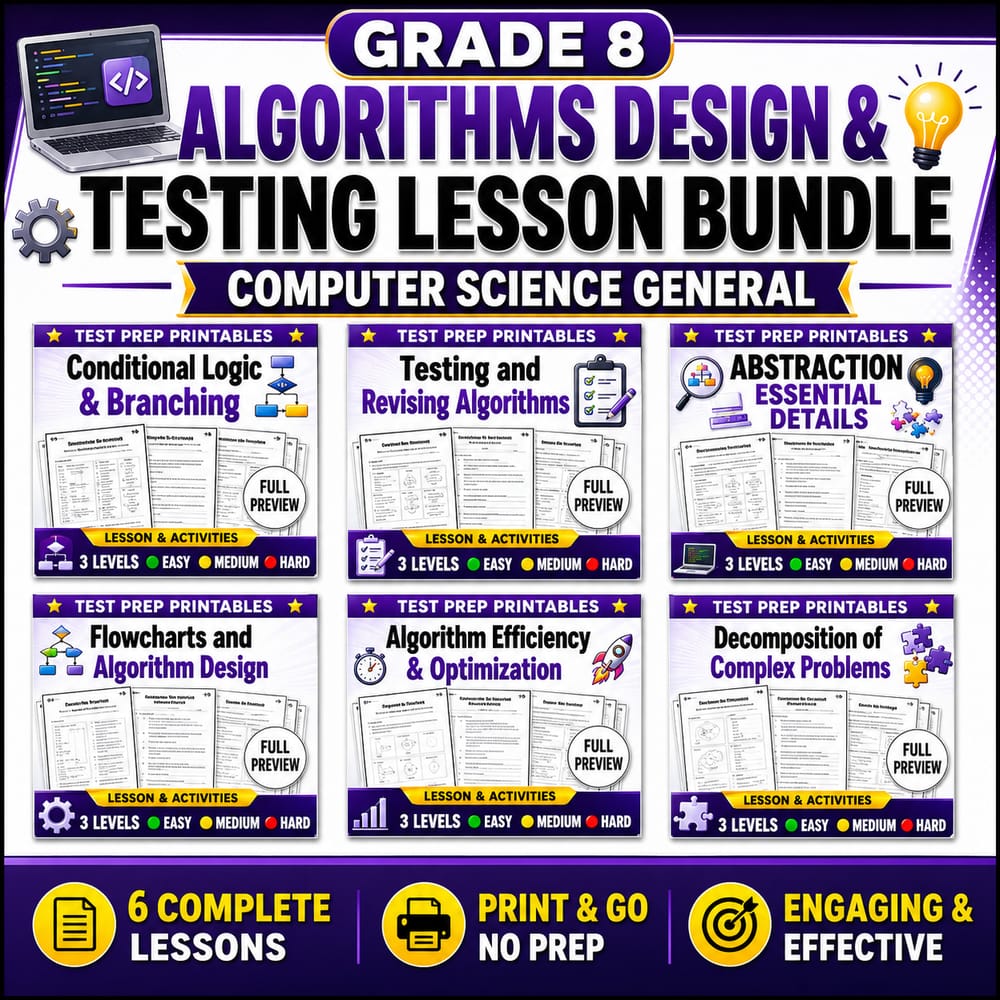
Grade 8 Algorithms Design & Testing Lesson Bundle | Computer Science General
$24.00$30.00Save $6.00
Prism Point Learning
·2 followers·13 sales
SubjectComputer ScienceGradeGrade 8Pages180 Pages
What’s included
6 worksheets · 180 pages · Save $6.00 (20%) · prices shown inside the bundle
 Grade 8 Conditional Logic and Branching Worksheet | Computer Science
- Explain how conditional logic uses an if-then condition to choose between branches in an algorithm.
- Identify how inputs and data lead to different outcomes in branching systems.
- Use conditional vocabulary (condition, branch, outcome) correctly when describing decision paths.
$4.00$5.00 Grade 8 Testing and Revising Algorithms Worksheet | Computer Science Activity
- Explain why testing an algorithm is important for correctness under different inputs, including edge cases.
- Revise an algorithm to fix errors and improve clarity after receiving feedback.
- Use vocabulary such as test, revise, validate, and correct when describing debugging steps.
$4.00$5.00 Abstraction and Essential Details Worksheet Grade 8 Computer Science
- Explain how abstraction removes unnecessary details to focus on essential information in a system.
- Identify how models simplify complex situations and help communicate ideas in computer science.
- Use lesson vocabulary (abstraction, model, simplify, essential) accurately in explanations.
$4.00$5.00 Grade 8 Flowcharts and Algorithm Design Worksheet | Computer Science
- Explain how flowcharts use standard symbols to show the steps of a process.
- Design and revise an algorithm using clear step-by-step instructions and decision points.
- Identify correct uses of branches and decisions in flowcharts.
$4.00$5.00 Algorithm Efficiency and Optimization Worksheet Grade 8 Computer Science
- Explain how algorithm efficiency measures time, steps, and resources.
- Use optimization to improve an algorithm while keeping the same goal and final result.
- Compare two methods for the same task and justify which is more efficient.
$4.00$5.00 Grade 8 Decomposition of Complex Problems Worksheet | CS Skills
- Explain how decomposition breaks a complex problem into smaller subproblems with clear goals.
- Apply a decomposition strategy to plan steps for a solution.
- Evaluate whether proposed steps match the subproblems needed for a solution.
$4.00$5.00
Reviews & Feedback
Loading reviews...
Questions & Answers
Loading questions…
About this bundle
Related categories
Frequently asked questions
Who is Grade 8 Algorithms Design & Testing Lesson Bundle | Computer Science General designed for?
Grade 8 Algorithms Design & Testing Lesson Bundle | Computer Science General is designed for Grade 8 students and Computer Science learners and can be used in classrooms, homeschool, or independent practice.
How do I download Grade 8 Algorithms Design & Testing Lesson Bundle | Computer Science General?
Add it to your cart and complete checkout. After payment, you can download immediately from your account, and you'll also receive a download link by email.
Similar Products

Grade 11 Computer Science Lesson Bundle: AI & Algorithm Design Patterns
$24.00$30.00

Grade 7 Algorithm Design & Optimization Lesson Bundle | Computer Science | General
$32.00$40.00

Data Structures & Algorithms Lesson Bundle | Grade 12 Computer Science | General
$24.00$30.00

Data Structures & Algorithms Lesson Bundle | Grade 11 CS | General
$24.00$30.00

Grade 10 Computer Science Algorithms Lesson Bundle – Recursion & Big-O General
$20.00$25.00