
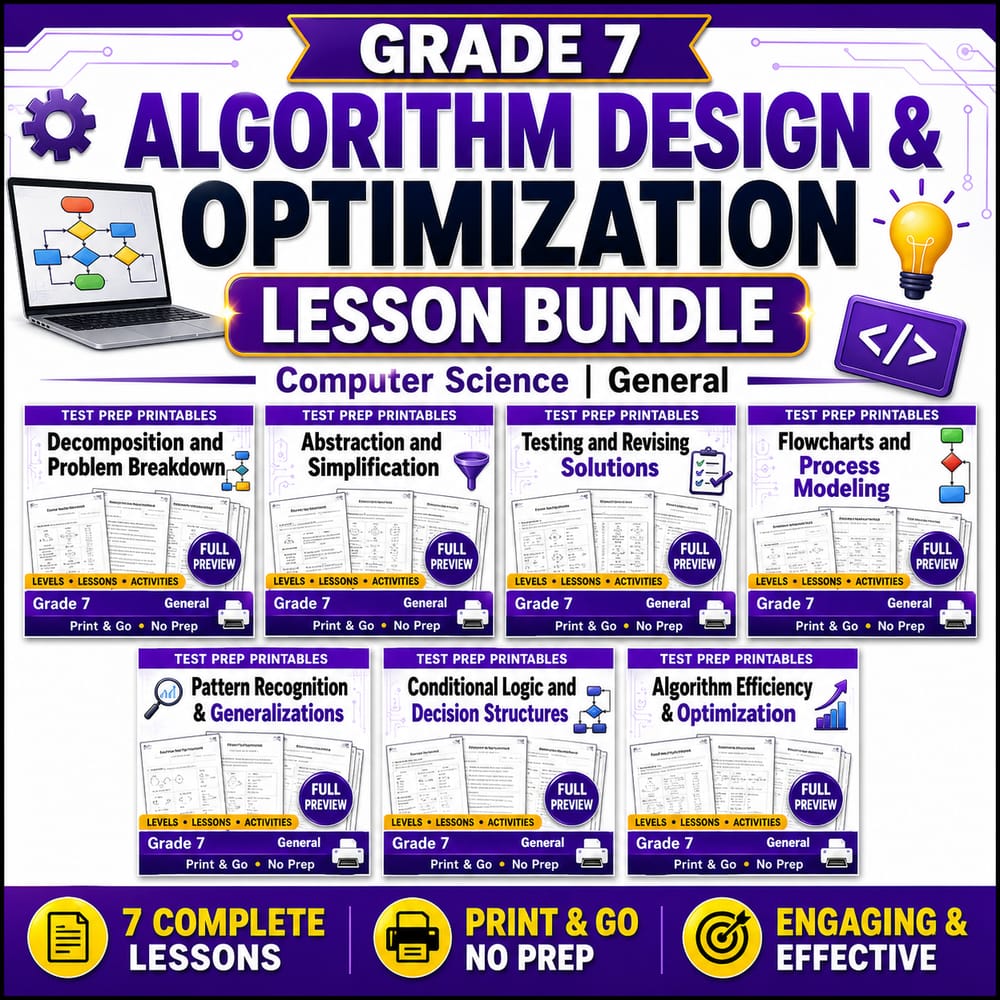
Grade 7 Algorithm Design & Optimization Lesson Bundle | Computer Science | General
$32.00$40.00Save $8.00
Prism Point Learning
·2 followers·13 sales
SubjectComputer ScienceGradeGrade 7Pages240 Pages
What’s included
8 worksheets · 240 pages · Save $8.00 (20%) · prices shown inside the bundle
 Decomposition and Problem Breakdown Worksheet Grade 7 Computer Science
- Explain how decomposition helps break a complex problem into smaller parts.
- Identify subproblems and choose a strategy for solving each part.
- Describe how solutions from subproblems combine into one final solution.
$4.00$5.00 Abstraction and Simplification Worksheet Grade 7 Computer Science
- Explain how abstraction helps focus on important information while ignoring unnecessary details.
- Identify and describe a model or representation of a system using simplified features.
- Use abstraction to simplify a problem and support an algorithm design.
$4.00$5.00 Testing and Refining Solutions Worksheet Grade 7 Computer Science
- Explain how testing helps validate an algorithm under different conditions.
- Identify ways to revise an algorithm based on observed test results.
- Use vocabulary such as testing, validation, refinement, and revision to describe improvement steps.
$4.00$5.00 Flowcharts and Process Modeling Worksheet Grade 7 Computer Science
- Interpret flowcharts by following arrows and decisions to predict an outcome.
- Use correct flowchart vocabulary to describe a process and its branches.
- Create a simple process model using decision points and branches.
$4.00$5.00 Pattern Recognition and Generalization Worksheet Grade 7 Computer Science
- Identify patterns and relationships in examples to predict outcomes
- Use generalization to reuse a solution strategy for new problems
- Explain why a rule or prediction works using evidence from patterns
$4.00$5.00 Conditional Logic and Decision Structures Worksheet Grade 7 Coding
- Explain how conditional logic lets an algorithm choose different paths based on a condition.
- Identify outcomes of decision structures using if/else reasoning.
- Use key vocabulary (condition, branch, logic, outcome) to describe rule-based decisions.
$4.00$5.00 Algorithm Design Fundamentals Worksheet Grade 7 Computer Science Activities
- Define key algorithm vocabulary and explain how an algorithm is a sequence of instructions.
- Identify whether a set of steps forms a clear, logical algorithm.
- Use precision and logical reasoning to choose, write, and evaluate algorithm steps.
$4.00$5.00 Algorithm Efficiency and Optimization Worksheet Grade 7 Computer Science
- Explain how algorithm efficiency affects performance and resource use
- Use optimization strategies to improve an algorithm without changing its correct outcome
- Compare multiple algorithms for the same task and justify which is more efficient
$4.00$5.00
Reviews & Feedback
Loading reviews...
Questions & Answers
Loading questions…
About this bundle
Related categories
Frequently asked questions
Who is Grade 7 Algorithm Design & Optimization Lesson Bundle | Computer Science | General designed for?
Grade 7 Algorithm Design & Optimization Lesson Bundle | Computer Science | General is designed for Grade 7 students and Computer Science learners and can be used in classrooms, homeschool, or independent practice.
How do I download Grade 7 Algorithm Design & Optimization Lesson Bundle | Computer Science | General?
Add it to your cart and complete checkout. After payment, you can download immediately from your account, and you'll also receive a download link by email.
Similar Products

Grade 11 Computer Science Lesson Bundle: AI & Algorithm Design Patterns
$24.00$30.00

Grade 8 Algorithms Design & Testing Lesson Bundle | Computer Science General
$24.00$30.00

Data Structures & Algorithms Lesson Bundle | Grade 12 Computer Science | General
$24.00$30.00

Data Structures & Algorithms Lesson Bundle | Grade 11 CS | General
$24.00$30.00

Grade 10 Computer Science Algorithms Lesson Bundle – Recursion & Big-O General
$20.00$25.00