
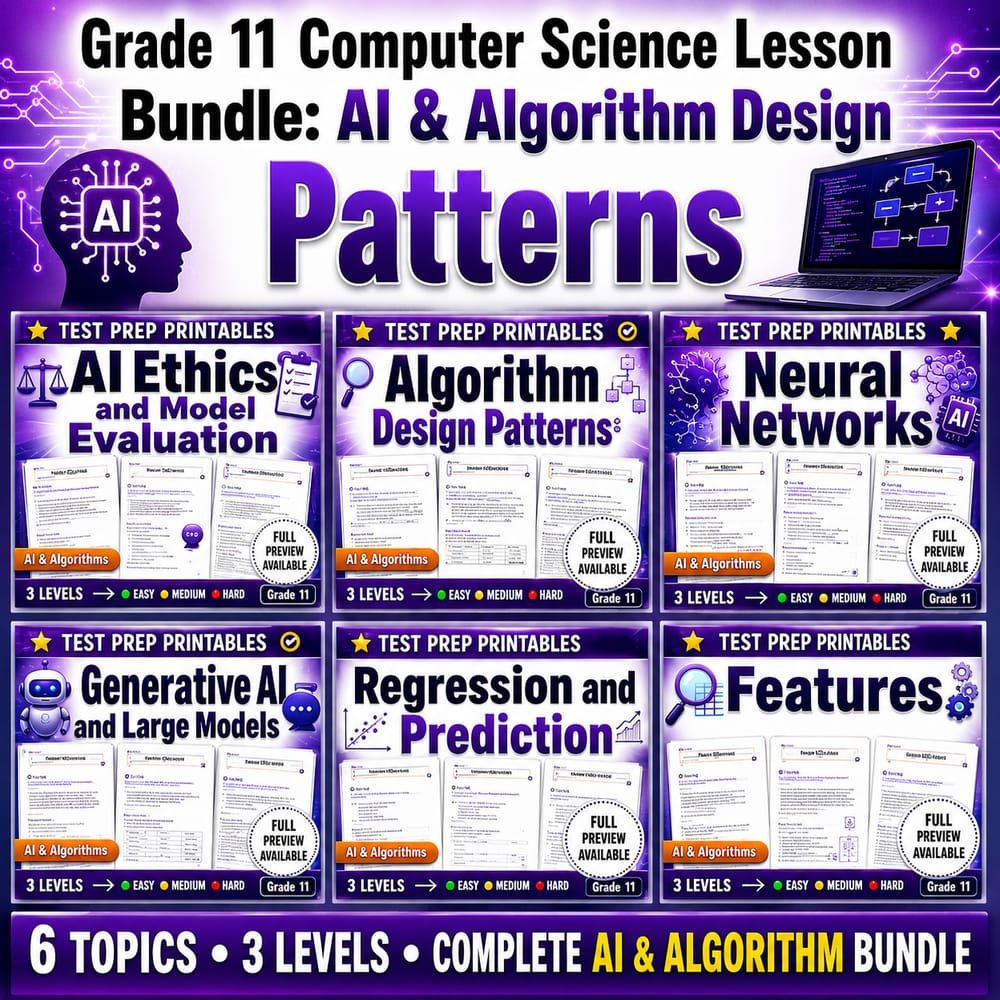
Grade 11 Computer Science Lesson Bundle: AI & Algorithm Design Patterns
$24.00$30.00Save $6.00
Prism Point Learning
·2 followers·13 sales
SubjectComputer ScienceGradeGrade 11Pages185 Pages
What’s included
6 worksheets · 185 pages · Save $6.00 (20%) · prices shown inside the bundle
 Generative AI and Large Models Worksheet Grade 11 Computer Science
- Explain how AI ethics principles like fairness, transparency, privacy, and accountability connect to real-world impact.
- Identify common sources of bias and evaluate harmful or unreliable outputs.
- Use model evaluation ideas to judge whether an AI system can be trusted across different users and situations.
$4.00$5.00 Algorithm Design Patterns Worksheet for Grade 11 Computer Science
- Explain how training data, features, and labels affect a machine learning model’s predictions.
- Identify common data-quality problems and how they can reduce model performance.
- Compare supervised learning concepts using correct vocabulary such as feature, label, and prediction.
$4.00$5.00 Neural Networks Worksheet Grade 11 Computer Science AI Learning
- Explain how inputs, hidden layers, and outputs work in a neural network.
- Describe what weights do and how learning changes them.
- Identify common neural network terms and evaluate statements about neural networks.
$4.00$5.00 Trees and Graphs Traversal Worksheet Grade 11 Computer Science
- Explain how generative AI and large language models learn patterns from data to produce new content
- Identify common limitations of generative AI, including errors, bias, and unclear reliability
- Apply strategies for deciding when to use generative tools and when to require human review
$4.00$5.00 Regression and Prediction Worksheet | Grade 11 Computer Science Data
- Distinguish regression models from classification models based on the type of prediction target.
- Identify factors that affect prediction accuracy, including model fit and variable relationships.
- Use basic reasoning to select appropriate modeling choices for numerical prediction problems.
$4.00$5.00 Computer Science Features Labels Worksheet Grade 11 Programming Review
- Explain how labels are used in diagrams and documentation to identify parts of a system or model
- Distinguish between labels and other features such as captions, annotations, and component names
- Apply correct terminology when describing features of labeled representations
$4.00$5.00
Reviews & Feedback
Loading reviews...
Questions & Answers
Loading questions…
About this bundle
Related categories
Frequently asked questions
Who is Grade 11 Computer Science Lesson Bundle: AI & Algorithm Design Patterns designed for?
Grade 11 Computer Science Lesson Bundle: AI & Algorithm Design Patterns is designed for Grade 11 students and Computer Science learners and can be used in classrooms, homeschool, or independent practice.
How do I download Grade 11 Computer Science Lesson Bundle: AI & Algorithm Design Patterns?
Add it to your cart and complete checkout. After payment, you can download immediately from your account, and you'll also receive a download link by email.
Similar Products

Grade 8 Algorithms Design & Testing Lesson Bundle | Computer Science General
$24.00$30.00

Grade 7 Algorithm Design & Optimization Lesson Bundle | Computer Science | General
$32.00$40.00

Data Structures & Algorithms Lesson Bundle | Grade 12 Computer Science | General
$24.00$30.00

Data Structures & Algorithms Lesson Bundle | Grade 11 CS | General
$24.00$30.00

Grade 10 Web Design & Publishing Lesson Bundle | Computer Science | General
$24.00$30.00