
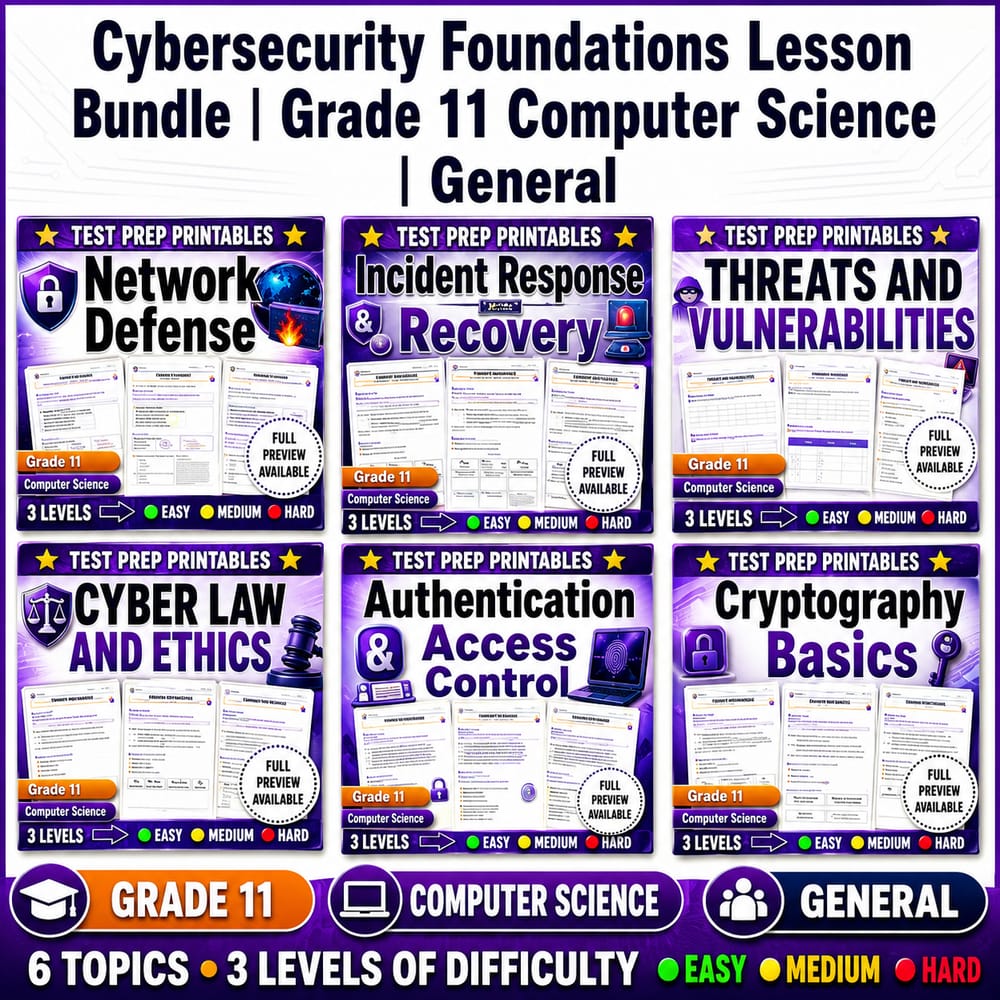
Cybersecurity Foundations Lesson Bundle | Grade 11 Computer Science | General
$24.00$30.00Save $6.00
Prism Point Learning
·2 followers·13 sales
SubjectComputer ScienceGradeGrade 11Pages183 Pages
What’s included
6 worksheets · 183 pages · Save $6.00 (20%) · prices shown inside the bundle
 Network Defense Worksheet Grade 11 Computer Science Cybersecurity
- Explain how network defense tools help detect and block threats.
- Describe how secure configurations and safe habits reduce unauthorized access.
- Match common threats to the most appropriate defensive controls.
$4.00$5.00 Incident Response and Recovery Worksheet | Grade 11 Computer Science
- Order key incident response steps from detection to recovery while explaining why each step matters.
- Describe how documentation supports evidence handling, communication, and post-incident improvement.
- Select the best action during incident recovery to restore normal operations safely.
$4.00$5.00 Threats and Vulnerabilities Worksheet Grade 11 Computer Science
- Identify common cybersecurity threats and explain how specific vulnerabilities enable them.
- Classify risks by matching real-world examples to categories such as password weaknesses, outdated software, and unsafe downloads.
- Evaluate statements about cybersecurity and justify short answers using accurate security terminology.
$4.00$5.00 Cyber Law and Ethics Worksheet Grade 11 Computer Science Privacy IP
- Explain key cyber law and ethical responsibilities related to privacy and data handling.
- Identify appropriate and responsible actions when facing unauthorized access or misuse.
- Describe how intellectual property rules apply to copying and sharing digital content.
$4.00$5.00 Authentication and Access Control Worksheet Grade 11 Computer Science
- Explain how authentication verifies identity before granting access to systems or data.
- Describe how access control limits what users can view or do after logging in.
- Compare passwords, multi-factor authentication, and permission models using real security scenarios.
$4.00$5.00 Cryptography Basics Worksheet Grade 11 Computer Science Security
- Explain encryption, decryption, and the role of cryptographic keys in protecting data.
- Identify how cryptography helps secure communication and data online.
- Evaluate statements about ciphertext, plaintext, and security properties.
$4.00$5.00
Reviews & Feedback
Loading reviews...
Questions & Answers
Loading questions…
About this bundle
Related categories
Frequently asked questions
Who is Cybersecurity Foundations Lesson Bundle | Grade 11 Computer Science | General designed for?
Cybersecurity Foundations Lesson Bundle | Grade 11 Computer Science | General is designed for Grade 11 students and Computer Science learners and can be used in classrooms, homeschool, or independent practice.
How do I download Cybersecurity Foundations Lesson Bundle | Grade 11 Computer Science | General?
Add it to your cart and complete checkout. After payment, you can download immediately from your account, and you'll also receive a download link by email.
Similar Products

Grade 9 Cyber Safety & Cybersecurity Lesson Bundle — Computer Science General
$24.00$30.00

Grade 7 AI & Cybersecurity Computer Science Lesson Bundle | General
$24.00$30.00

Grade 8 Cybersecurity & Safe Device Protection Lesson Bundle | Computer Science (General)
$24.00$30.00

Cybersecurity & Secure UI/UX Lesson Bundle | Grade 12 Computer Science | General
$24.00$30.00

Cybersecurity & Internet Lesson Bundle – Grade 10 Computer Science General
$24.00$30.00