
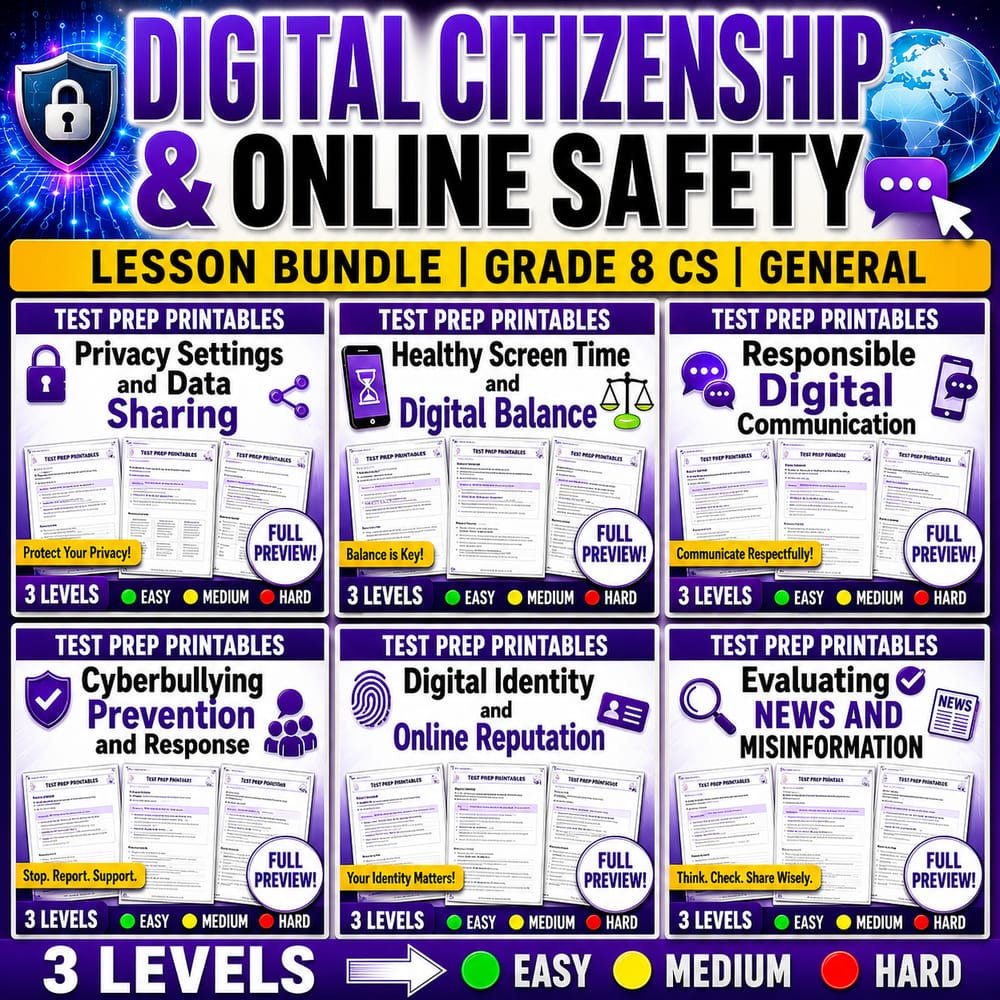
Digital Citizenship & Online Safety Lesson Bundle | Grade 8 CS | General
$24.00$30.00Save $6.00
Prism Point Learning
·2 followers·13 sales
SubjectComputer ScienceGradeGrade 8Pages180 Pages
What’s included
6 worksheets · 180 pages · Save $6.00 (20%) · prices shown inside the bundle
 Privacy Settings and Data Sharing Worksheet Grade 8 Computer Science
- Explain how privacy settings affect who can view content, contact accounts, and access personal information.
- Identify common app/website permissions and decide when they are appropriate.
- Describe how consent relates to data sharing and user control.
$4.00$5.00 Grade 8 Healthy Screen Time and Digital Balance Worksheet | Computer Science
- Explain how digital balance supports learning, social connection, and wellness.
- Describe how screen time habits can affect sleep, concentration, mood, and physical activity.
- Use lesson vocabulary (balance, wellness, habit, screen time) in accurate statements.
$4.00$5.00 Grade 8 Respectful Digital Communication Worksheet | Computer Science
- Use appropriate tone and respectful word choices in digital communication
- Explain how context and timing affect clarity and relationships in online messages
- Identify helpful versus harmful communication practices and choose better responses
$4.00$5.00 Cyberbullying Prevention and Response Worksheet for Grade 8 Computer Science
- Identify harmful online behaviors that qualify as cyberbullying or harassment.
- Choose safe, responsible responses as a bystander or target.
- Use key vocabulary (cyberbullying, harassment, report, bystander) to explain next steps.
$4.00$5.00 Grade 8 Digital Identity and Online Reputation Worksheet | CS
- Explain how digital identity forms from usernames, profiles, posts, comments, and shared content.
- Describe how online reputation is influenced by tone, audience, and sharing choices.
- Apply vocabulary such as digital identity, reputation, audience, and presence to real-life online scenarios.
$4.00$5.00 Grade 8 Evaluating News and Misinformation Worksheet | Computer Science
- Identify misinformation, credibility, bias, and evidence in online posts.
- Use source credibility and evidence to judge whether a claim is likely true.
- Explain how bias and missing evidence can mislead readers.
$4.00$5.00
Reviews & Feedback
Loading reviews...
Questions & Answers
Loading questions…
About this bundle
Related categories
Frequently asked questions
Who is Digital Citizenship & Online Safety Lesson Bundle | Grade 8 CS | General designed for?
Digital Citizenship & Online Safety Lesson Bundle | Grade 8 CS | General is designed for Grade 8 students and Computer Science learners and can be used in classrooms, homeschool, or independent practice.
How do I download Digital Citizenship & Online Safety Lesson Bundle | Grade 8 CS | General?
Add it to your cart and complete checkout. After payment, you can download immediately from your account, and you'll also receive a download link by email.


