
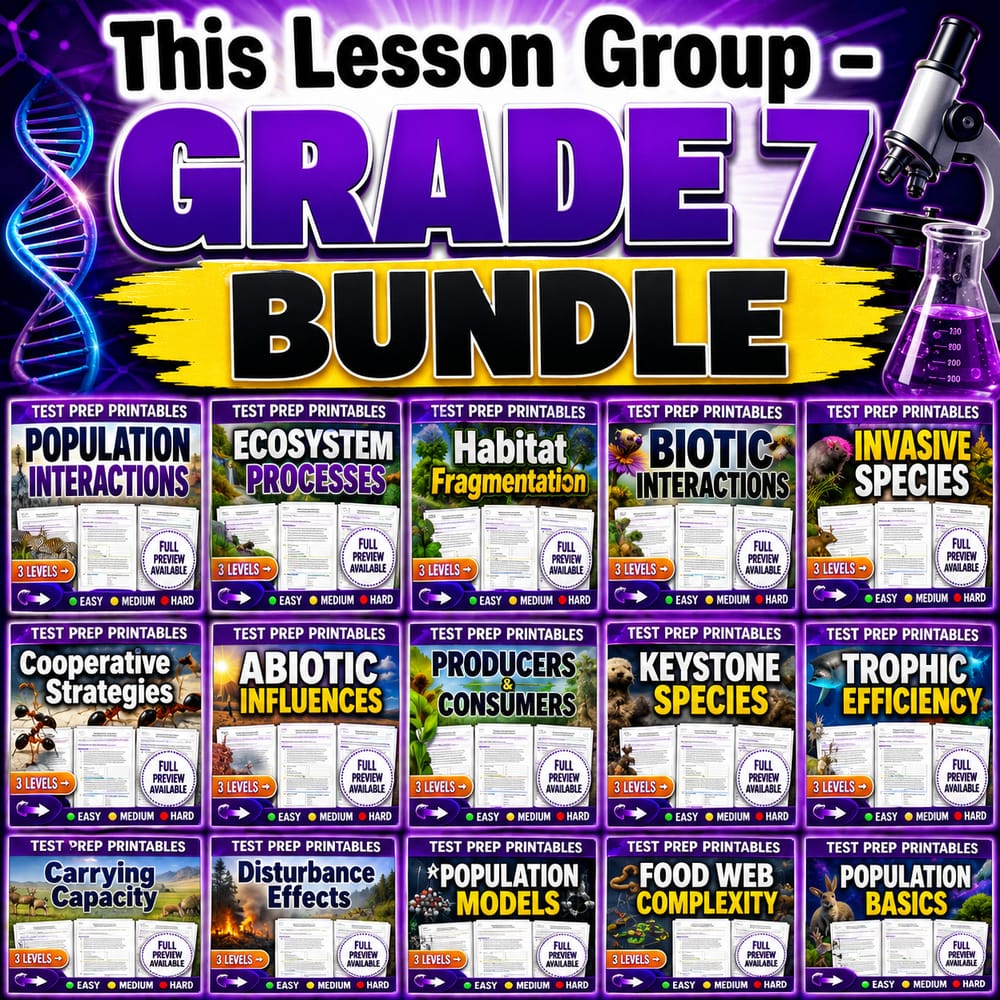


Ecosystems & Interactions Lesson Bundle – Grade 7 Science BC Framework
$60.00$75.00Save $15.00
Prism Point Learning
·2 followers·13 sales
SubjectScienceGradeGrade 7
What’s included
15 worksheets · Save $15.00 (20%) · prices shown inside the bundle
 Population Interactions Test Prep Worksheet | Grade 7 Science BC Standards
- Explain how competition, predation, and mutualism affect population sizes and community composition.
- Describe how niche differences and habitat or timing changes can reduce competition and allow species to coexist.
- Use evidence-based reasoning to predict population outcomes from different interaction types.
$4.00$5.00 Ecosystem Components Practice Worksheet | Grade 7 Science Review
- Identify biotic and abiotic components of ecosystems and explain how they interact.
- Describe how energy enters an ecosystem through primary producers and moves through feeding relationships.
- Explain why both living organisms and nonliving factors are needed for ecosystem structure and function.
$4.00$5.00 Habitat Fragmentation Test Prep Printable | Grade 7 Science
- Explain how habitat fragmentation creates isolated habitat patches and increases edge effects
- Describe how fragmentation affects species interactions, dispersal, gene flow, and population sizes
- Evaluate how habitat connectivity (like corridors) can reduce extinction risk and support ecosystem processes
$4.00$5.00 Biotic Interactions Practice Worksheet | Grade 7 Science Review Assessment
- Explain how different biotic interactions (predation, competition, mutualism, commensalism, and parasitism) affect survival and reproduction.
- Describe how changes to one species can spread through a community and alter biodiversity.
- Predict how human actions (habitat alteration, overharvesting, and species introductions) may disrupt ecological relationships.
$4.00$5.00 Invasive Species Review & Practice Worksheets | Grade 7 Science
- Explain how invasive species spread beyond their native range and why they can grow quickly
- Describe ecological effects of invasive species on food webs, energy flow, and nutrient cycling
- Evaluate how invasive species can reduce biodiversity and change habitats
$4.00$5.00 Conservation Strategies Worksheet | Grade 7 Science Review & Practice
- Explain how conservation strategies reduce human impacts on ecosystems and biodiversity.
- Describe how habitat protection and restoration support food webs and species survival.
- Evaluate species management and policy actions using ideas about population dynamics and adaptive monitoring.
$4.00$5.00 Abiotic Influences Practice Worksheet | Grade 7 Science Assessment
- Explain how abiotic factors (temperature, moisture, light, nutrients, and pH) affect where organisms live and how well they survive.
- Describe how daily and seasonal changes in abiotic conditions can create stress or opportunities for populations.
- Use cause-and-effect reasoning to predict how extreme abiotic events can change population size and carrying capacity.
$4.00$5.00 Producers and Consumers Test Prep Worksheet | Grade 7 Science BC
- Explain how producers capture energy through photosynthesis and why they form the base of energy pyramids.
- Differentiate between primary, secondary, and tertiary consumers based on what they eat.
- Describe why energy transfer between trophic levels is inefficient and how that affects population sizes.
$4.00$5.00 Keystone Species Practice Worksheet | Grade 7 Science Review & Assessment
- Explain how a keystone species can strongly affect ecosystem structure and biodiversity even when it is not the most abundant organism.
- Describe how removing a keystone species can cause trophic cascades and change energy flow through a food web.
- Use evidence from food webs to identify why keystone species are important for conservation planning.
$4.00$5.00 Trophic Efficiency Practice Worksheet | Grade 7 Science Review
- Explain what trophic efficiency means and how energy changes between trophic levels
- Describe why energy pyramids shrink toward higher trophic levels
- Use the ideas of losses (heat, respiration, waste) to predict how many consumer levels can exist
$4.00$5.00
Reviews & Feedback
Loading reviews...
Questions & Answers
Loading questions…
About this bundle
Related categories
Frequently asked questions
Who is Ecosystems & Interactions Lesson Bundle – Grade 7 Science BC Framework designed for?
Ecosystems & Interactions Lesson Bundle – Grade 7 Science BC Framework is designed for Grade 7 students and Science learners and can be used in classrooms, homeschool, or independent practice.
How do I download Ecosystems & Interactions Lesson Bundle – Grade 7 Science BC Framework?
Add it to your cart and complete checkout. After payment, you can download immediately from your account, and you'll also receive a download link by email.
Similar Products

Grade 6 Life Processes & Ecosystem Interactions Science Lesson Bundle: General
$28.80$36.00

Grade 7 Science Ecosystems Lesson Bundle | NGSS Interactions & Energy
$20.00$25.00

Grade 12 Science Biology and Ecosystems Lesson Bundle | AP Framework
$33.60$42.00

Grade 9 Science Ecosystems Lesson Bundle | NGSS Interactions & Energy
$12.00$15.00

Species Interactions & Ecosystems Grade 8 Reading Lesson Bundle | General
$25.60$32.00