
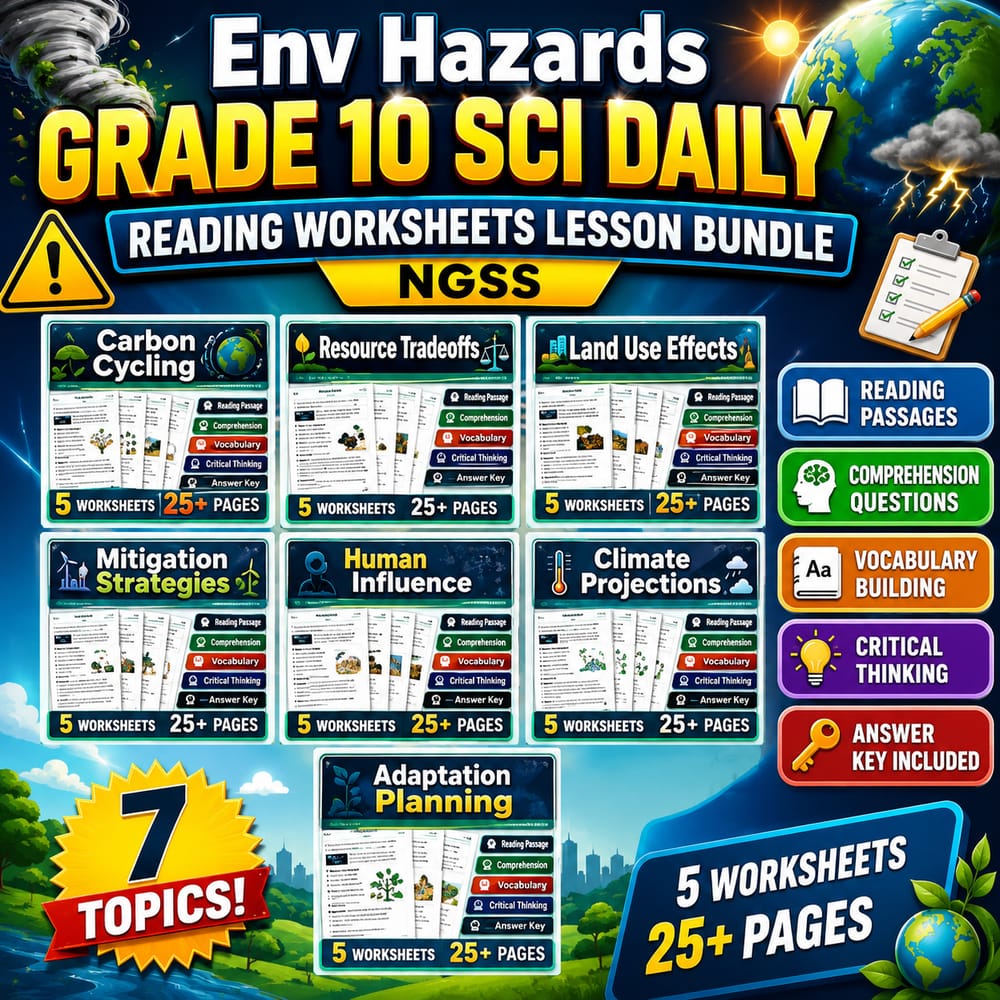
Env Hazards Grade 10 Sci Daily Reading Worksheets Lesson Bundle | NGSS
$28.00$35.00Save $7.00
BRIGHT PATH RESOURCES
·3 followers·23 sales
SubjectScienceGradeGrade 10Pages393 Pages
What’s included
7 worksheets · 393 pages · Save $7.00 (20%) · prices shown inside the bundle
 Grade 10 Introduction to Carbon and Its Cycle Worksheet | NGSS Science Activity
- Identify the main components of the carbon cycle
- Understand how carbon moves among different Earth systems
- Recognize human impacts on the natural carbon cycle
$4.00$5.00 Grade 10 Resource Tradeoffs in Energy & Mineral Management | NGSS Worksheet
- Understand the environmental impacts of fossil fuels
- Analyze economic versus ecological trade-offs of resource development
- Evaluate sustainability and long-term resource management strategies
$4.00$5.00 Grade 10 Land Use Effects Worksheet | NGSS Environmental Science Activity
- Understand key concepts related to Science
- Apply knowledge through practice questions
- Demonstrate comprehension of the material
$4.00$5.00 Grade 10 Mitigation Strategies in Environmental Science | NGSS Worksheet
- Understand the concept of renewable energy sources and their environmental benefits
- Identify different types of renewable energy and their advantages
- Analyze how renewable energy contributes to reducing pollution and greenhouse gases
$4.00$5.00 Grade 10 Hazard Influence: Water Scarcity & Human Settlement | NGSS Worksheet
- Understand how water availability impacts human settlement patterns.
- Analyze the relationship between natural hazards and land use changes.
- Evaluate historical and scientific evidence on resource distribution and societal responses.
$4.00$5.00 Grade 10 Climate Projections: Analyzing Temperature Trends | NGSS Worksheet
- Understand different sources of temperature data and their significance
- Analyze historical temperature trends using instrumental and proxy records
- Interpret model scenario outputs and assess future temperature changes
$4.00$5.00 Grade 10 Adaptation Planning in Environmental Hazards | NGSS Science Worksheet
- Understand different types of environmental hazards and their characteristics.
- Learn how hazard risk assessments inform adaptation strategies.
- Analyze various infrastructural and policy responses to environmental challenges.
$4.00$5.00
Reviews & Feedback
Loading reviews...
Questions & Answers
Loading questions…
About this bundle
Related categories
Frequently asked questions
Who is Env Hazards Grade 10 Sci Daily Reading Worksheets Lesson Bundle | NGSS designed for?
Env Hazards Grade 10 Sci Daily Reading Worksheets Lesson Bundle | NGSS is designed for Grade 10 students and Science learners and can be used in classrooms, homeschool, or independent practice.
How do I download Env Hazards Grade 10 Sci Daily Reading Worksheets Lesson Bundle | NGSS?
Add it to your cart and complete checkout. After payment, you can download immediately from your account, and you'll also receive a download link by email.
Similar Products

Human Physiology Grade 10 Science Daily Reading Worksheets Lesson Bundle | Ngss
$28.00$35.00

Energy & Env Grade 9 Science Daily Reading Worksheets Lesson Bundle | NGSS
$24.00$30.00

Grade 12 Environmental & STSE Science Daily Reading Lesson Bundle | Alberta
$51.20$64.00

Ecosystems Grade 9 Science Daily Reading Worksheets Lesson Bundle | NGSS
$20.00$25.00

Geoscience Grade 8 Science Daily Reading Worksheets Lesson Bundle | NGSS
$16.00$20.00